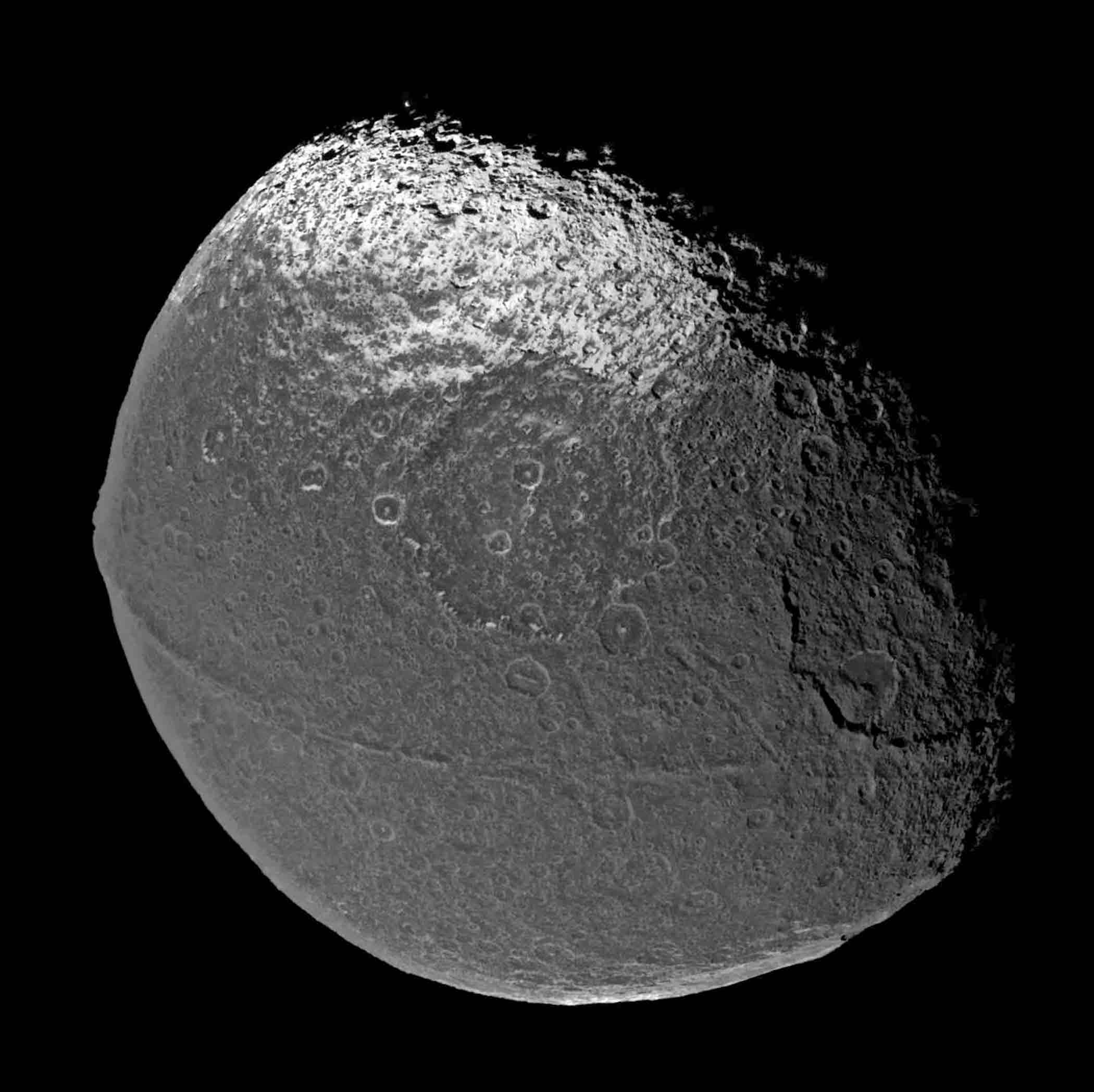
Iapetus, the third largest of Saturn’s moons, is the site of the “Star Gate” in the novel 2001: A Space Odyssey. Arthur C Clarke selected Iapetus because, mysteriously, it has one face ten times brighter than the other. What better place to locate an artificial alien artefact than on a moon which appears to be artificial?
Actually, the key to Iapetus’s Janus faces may be an ancient encounter with Saturn’s rings. Stretching almost a third of the way around Iapetus’s equator is an extraordinary ridge, in places more than twice the height of Everest. The ridge bisects the dark region, hinting at a connection.
According to Paulo Freire of Arecibo Observatory in Puerto Rico, in the past Iapetus grazed Saturn’s rings, pretty much like a rock encountering a strimmer. Whereas Everest took millions of years to rear up, the Iapetus Ridge may have been built in a matter of hours.Freire says the rings contain tiny dust grains – a perfect source of blackening material.
They also contain ice – such as carbon dioxide, or “dry”, ice – which in the collision would instantly have turned into vapour. Super-fast winds would have blown out from the ridge, depositing dust over a large area, blackening the face centred on the ridge.
If Iapetus did hit Saturn’s rings, it must have orbited in the same plane as the rings, creating the ridge along its equator. Since Iapetus no longer orbits in this plane, Freire speculates that it must have been ejected into its present orbit, perhaps when it was hit by another moon.