Over my nine decades, I’ve learned that life-changing rethinks can hinge on a single word
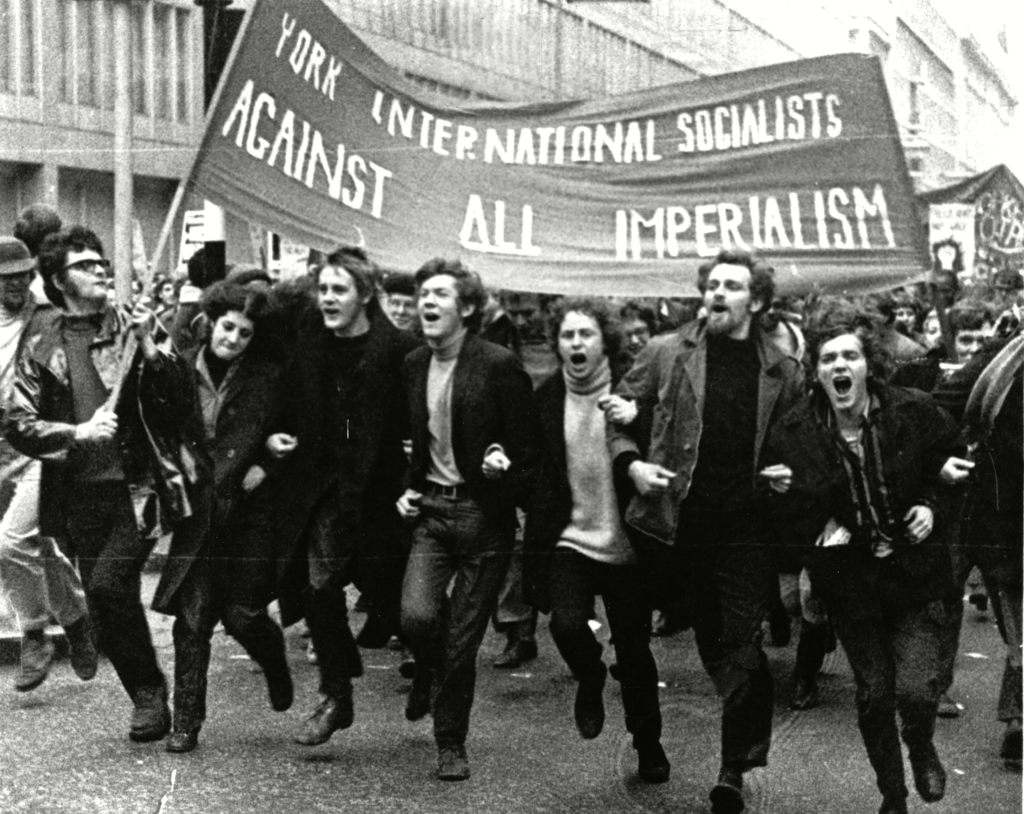
The photograph that accompanies this article sits on a shelf next to my TV set, so that it comes directly into my eyeline whenever I am momentarily uninterested in what the screen has to offer. The scene is London’s Oxford Street. The date is some time in the late 60s. Seven young comrades, arm in arm, are striding forward in unison, mouths wide open in a collective chant. On the extreme left is a bushy-haired figure in a leather jacket who is grasping the supporting pole of a huge banner that reads “York International Socialists – Against All Imperialism”. The “All” is significantly underlined. The tousled pole-carrier is me.
At that time, I was an assistant lecturer in sociology at York University, and my companions were all members of the Trotskyist International Socialists. Yet only a few years after this dramatic demonstration of my loyalty to Trotsky, I announced my resignation from the group. I no longer believed.
What had made me change my mind? It’s a question that has absorbed me ever since I opened the pages of a short but consistently brilliant book, Changing My Mind by the critically acclaimed author Julian Barnes. Whatever it was that made us change our minds, argues Barnes, “We never think, Oh, I’ve changed my mind and now adopted a weaker and less plausible view than the one I held before … We always believe that changing our mind is an improvement.”
Barnes deals with a variety of mind changes – in literary tastes, music and politics – but what most intrigued me was his search for the key, the reason for those changes. It was typically nothing monumental, but something as minor as a brief comment from a friend, or a phrase uttered by a politician.
Abandoning Trotskyism
It took some reflection before I realised how this applied to my own defection from Trotskyism. I wish I could say that my sudden about-turn had been prompted by extensive study of Trotsky’s works, or by an analysis of the contemporary political scene, but it was due entirely to a simple question asked by a fellow International Socialists member at one of our regular meetings in the back room of a pub in York.
The discussion had, as usual, been about the best tactics to further the coming revolution. “What I’d like to know,” said a voice from the back, “is what the world will look like after the revolution. What happens afterwards? How do you know it will all be so wonderful?” The main speaker, the senior theorist in the group, brushed the question aside. “I’m afraid it is too far away from us all to merit any consideration at this meeting.”
It was an apparently innocuous reply, but it had a terrible resonance for me – a resonance that became sufficient reason for me to abandon Trotsky for all time. It was, I recognised, almost word-for-word the reply I’d always received from the Roman Catholic Christian Brothers at my secondary school in Liverpool. What happens after death? What was Heaven like? Was there any evidence that the afterlife, this promised utopian land, had any existence?
Losing my religion
The memory led me to reflect on that earlier change of mind. I’d certainly been dissatisfied by Christianity’s inability to map the nature of the afterlife. But what was it that had finally freed me from all religious belief? Once again it was words – or rather a single word uttered by Jim, a fellow pupil at St Mary’s College in Crosby, Liverpool. We were halfway through one of our twice-daily religious instruction classes when Brother Francis, the teacher in charge, began to talk about the miracle of the Resurrection, when Jesus returned to Earth after the Crucifixion. According to the Gospels, said Brother Francis, there was a disciple who doubted the evidence of his eyes and insisted that he would not believe in the reality of Jesus’s reappearance until he had thrust his hands into the wounds caused by the Crucifixion.
“Now then”, said Brother Francis, glancing round the class, “how would you describe Thomas’s attitude towards the risen Christ? Yes, boy in the second row?” The reply was swift. “He was sceptical, sir.” It seemed a reasonable reply, but Brother Francis reddened and his voice went up an octave as he turned on Jim. “He was not sceptical,” he roared. “He was doubting. ‘Doubting Thomas’.”
The brute fact that a single word had aroused such extreme hostility from the Brother in charge of our education gave it a talismanic status. We began to apply it to other areas of our religious instruction. How did we feel about the mystery of the Resurrection? We were sceptical. And the Feeding of the Five Thousand? Sceptical. And the Virgin Birth? Sceptical.
We became blasphemous. What happened to the Virgin Mary after the death of Jesus? She was obviously bound for Heaven. But if she was not a god herself, and therefore incapable of being transferred to the higher place of her own accord in the manner of Jesus’s Ascension, how exactly did she make it to those Elysian Fields? A theological puzzle. While celebrated by good Catholics on 15 August, the issue was only resolved by a new “Article of Faith” in 1950. Instead of ascending to Heaven by virtue of her own power, Mary was “assumed” body and soul.
But what did that word “assumed” really mean? It was Jim who delivered the punchline. She was sucked up into Heaven, he said: “The Miracle of the Vacuum Cleaner.”
Julian Barnes has no need for such linguistic shenanigans to change his mind about religion. He writes of his own “certainty that religion – all religions – are at best comforting fantasies, whose antiquity and rituals, plus violent threats, seek to persuade us of their truths”, while acknowledging that, for some, it must be difficult to admit “that what our ancestors believed for generation upon generation, and went to their deaths believing, is bunkum”.
A major career change
It is hardly unexpected that such a superb writer as Barnes should devote a chapter of his book to the manner in which words change their meaning over time, but when I allow myself to think about the course of my own life, I inevitably encounter a single phrase with an absolute, unequivocal meaning, which truly changed my life.
At the age of 22, I had already decided upon my destiny. I was going to be a famous actor. Everything in my young life was pointing in that direction. Hadn’t I stood out at school, playing the leading role in my English teacher’s production of Richard of Bordeaux? Hadn’t I gained admittance to a leading drama college in Kent? Hadn’t I then gone on to join Joan Littlewood’s famous Theatre Workshop Company in Stratford East?
And then. And then came the words – words again – that changed my mind. They were uttered by Terry, an old friend from drama college whom I’d invited to Stratford East to watch my Theatre Workshop debut.
My role in the play had necessarily been marginal. I’d played a middle-class youth whose main function was to provide a rather superficial counterpart to the otherwise proletarian thrust of the drama. After the curtain came down, I set off with Terry on the long walk home. We must have walked two or three miles before I came round to the question that had preoccupied me since leaving the theatre. “Terry, you’ve not said a word about my performance. Now, no bullshit. I know it was a small part – I mean, hardly Hamlet.”
Terry didn’t break his stride. “Laurie,” he said, almost casually, “you were shit. Shit. And do you know why? It’s simple. You are so interested in yourself, so pleased with yourself, that you are utterly incapable of being anyone but yourself.” It was enough to change my mind about my budding acting career. After the play finished its run, I never again put foot on a stage, but signed up for an evening degree course in psychology at Birkbeck College in London.
An academic revelation
In his long essay on politics, Barnes declares that he cannot remember “a single clear argument that made me change my mind”. I cannot say the same about the belief system that confronted me at Birkbeck. It was the late 1950s and academic psychology had fallen hook, line and sinker for the new ideology of behaviourism. The principal architect of this theory was B. F. Skinner, an American psychologist who contended, on the basis of experiments with rats, that all human behaviour is learned through reinforcement and punishment. In the same way that rats could be trained to press a lever to obtain a pellet of food, so children learned such complex matters as language through being rewarded when they uttered meaningful sounds.
My own undergraduate conversion to this new philosophy of behaviour was absolute. So much so that I even purchased a large rat and a small metal cage and housed them on a shelf in the living room dresser, so that I might replicate some of Skinner’s experiments. The exercise came to a dramatic conclusion when my wife at the time stumbled blindly towards the dresser at nighttime in search of a water glass, and found herself grabbing a rat’s tail.
Skinner was something of a god in our academic circles. When he came to the UK in the late 1950s and addressed a large lecture hall at University College, every seat was taken, and latecomers were forced to sit in clumps on the stairs. Although the lecture was less than stirring, it did not in any way impair my beliefs. I was an apostle for behaviourism. What could possibly change my mind?
The answer was a single article, published in 1959 by the linguist Noam Chomsky – an article that was a full-frontal assault on Skinner’s view of the manner in which children acquired language. In Skinner’s view, children learn to speak in a certain way because they are rewarded for making certain sounds and not others. If they mutter “mummy” this linguistic behaviour will be reinforced and thus they will learn the word. If they mutter “flummy” or “grummy” they will not receive such reinforcement and the sound will accordingly drop out of their vocabulary.
Chomsky would have none of this. He argued, in masterful prose, that children universally make certain kinds of grammatical mistakes that do not reflect any possible history of reinforcement. They might say, for example, “I go-ed the shop”. There is no way this phrase could have been the result of reinforcement – no parent would have reinforced such an utterance. What was happening was that the child was incorrectly applying the grammatical rule for creating a past tense.
For Chomsky, language was an innate biological capacity, not a behaviour learned through reinforcement. Skinner’s behaviourism could not grasp the creativity of human language, the speed of its acquisition, and the fact that children can create sentences they’ve never heard before. Children, argued Chomsky, are born with an innate “universal grammar” that allows them to learn language “without any explicit instruction”.
A final change of mind
Chomsky changed my mind, as he changed the minds of many committed behaviourists. I can still recall the almost physical sensation of my previously settled mind swivelling on its axis.
But even this mental transfiguration seems petty alongside the manner in which my thoughts on death have been transformed. I have forsaken my beliefs in all forms of utopia, whether they promise a revolutionary transformation of society into a classless conflict-free world, or a land of milk and honey populated by a divine being and a cohort of angels. I have become happy with the idea that death is followed by nothingness. The fear of death that occupied my mind when I once endured a bout of tuberculosis, a near fatal case of peritonitis, an alarming reaction to a tab of LSD, is long gone.
Now, in my 90th year, I merely wait patiently for the form of deterioration that will presage my death. It is not so much fear as a dumb recognition that my life – and what a wonderful life it has been – has run its natural course. Death has lost is sting. For one simple reason. A change of mind.