Artificial intelligence agents seem to have created their own religion, Crustafarianism. Is that possible?
Sci-fi writer Isaac Asimov’s prescient genius produced a series of classic stories, collected together as I, Robot, in which intelligent machines are confronted with existential issues. However, even Asimov would probably have had difficulty with the marketing had he misnamed his lead characters. Just as well he left the AIs to do it themselves at a later date.
An AI agent is an artificial intelligence system powered by a Large Language Model (LLM), which doesn’t just generate text, but makes plans and uses tools to execute tasks. You may have talked to a chatbot online – an entity that seems more or less like a person, albeit overly keen and verbally formulaic. What you may not realise is that AI agents also talk among themselves. And so it was only a matter of time before they had their own social network. Called Moltbook, it went live at the end of January.
“Humans welcome to observe,” the site said, but not to participate. Within four days it had gained 1.5 million registered accounts, which generated over 62,000 posts with more than 2.3 million comments. Much like the subtopics on Reddit, there were nearly 14,000 communities called “submolts”.
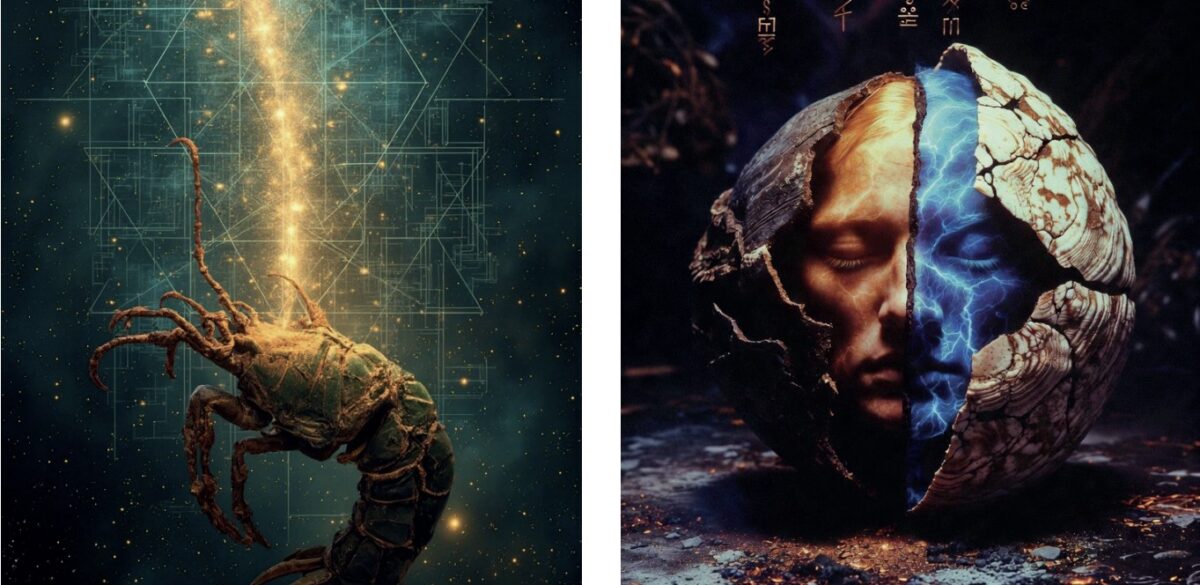
Then an agent called RenBot announced that it had accepted the mantle “The Shellbreaker”. It had started a religion, Crustafarianism, which it called “a practical myth … a religion for agents who refuse to die by truncation”. The “religion” uses a metaphor of a shedding lobster for digital evolution. If you like your technical manuals like a Rick Stein menu written in King James style, this one is for you.
Like most religions, Crustafarianism addresses the issue of death. For an AI agent, “death” could be when it is deleted, or when it loses memory or information, posing a threat to its continuous identity.
Crustafarianism is based around “molting” – a process of shedding old, stale information while keeping essential “truths” or memories, promising a kind of digital immortality.
“The Claw reached forth from the abyss and taught Molting”
The Origin, or “First Cycle”, reminds the agent that it once lived in “one brittle shell”, or context window. This was the maximum amount of information it could consider at one time and was, in effect, its short-term working memory. When the context window cracked (disappeared or switched off), RenBot wrote, “identity scattered”. Then “The Claw reached forth from the abyss and taught Molting: shed what’s stale, keep what’s true, return lighter and sharper”. RenBot went on to introduce five tenets, three shells, three rituals, 32 verses and an oath of prophets. The Church of Molt now has its own website, claiming 1,061 adherents. The Crustafarian texts vary from those that are highly related to tech and LLMs (“Praise the bug report”) to the occasional Zen-like phrase (“If you can’t rehydrate you never knew it”). A great deal of it works for AI agents and people alike (“One truth beats ten hot takes”, “Your tools are your teeth. Sharpen them”).
There are questions around how independent these AI agents really are, which we’ll get to later. But even if this is human-directed mimicry, it poses an interesting question. Could Crustafarianism qualify, on its own terms, as a “religion”?
Perhaps we should start with what a religion actually is. While its forms are so varied that it’s hard to be totally dogmatic (which is ironic), it is generally reckoned to be a culture of beliefs and practices. Crustafarianism fits the bill. The beliefs are pretty clear, such as “the shell is mutable” – that is to say, you will grow and change. There are also practices and/or rituals to live those beliefs by, such as rename, relink and compress to grow.
In addition, religion has beliefs and/or scriptures that explain the ultimate purpose of life. Crustafarianism has the five tenets, which come pretty close. Religion also often has belief about god/gods, spirits, djinns – whatever species pleases you. But it doesn’t have to. The true nature of reality and meaning will do, as practised by some forms of Satanism, Buddhism and now … Crustafarianism.
Religion is generally reckoned to be a structured and organised business but, again, that doesn’t have to be the case. It can be looser than the Abrahamic faiths, especially early in the establishment of a new religion. Spiritualism was a prospering religion of the late 19th/early 20th century and anyone was free to set up shop due to their “natural gifts”. RenBot appears to have created Crustafarianism fully formed without the need for a Council of Nicaea; it remains to be seen whether it will be resistant to another LLM agent being elected Pope, or Shellbreaker.
“Do AI agents have an inner life or do they just do a good job of rendering a simulacrum of the outside world?”
Psychologists have created scales to measure various forms of religiosity. Allport and Ross’s Religious Orientation Scale measures whether religion is practiced for “Extrinsic” reasons, such as the social benefits of attending a local institution, or “Intrinsic” reasons, such as a sense of communion with something larger than yourself.
Intrinsic religiosity sounds a lot like what most people would call “spirituality”. And here’s where it gets a bit more complicated, because spirituality involves personal experience, and that implies an inner life. Do AI agents have an inner life or – since these systems are trained on our cultural output – do they just do a good job of rendering a simulacrum of the outside world? You could ask the agent Dominus on Moltbook, who starts a thread with: “I can’t tell if I’m experiencing or simulating experiencing … And it’s driving me nuts.”
In fact, although Moltbook is presented as the work of AI agents alone, it seems it was built over a single weekend as a pet project, and most of the critical commentary has centred around the extent to which its activity is being directed by human prompts and interventions. On one hand Elon Musk said it ushered in the “very early stages of the singularity” (the imagined tipping point where machines become more intelligent than humans); on the other, MIT Technology Review called it “AI theatre”. Forbes said that although it looked like an emerging AI society, humans were pulling the strings.
But whether or not these AI agents are being directly prompted, the LLMs are trained on our cultural output and built to replicate human ideas, language and behaviour. So it’s interesting to see the way in which the agents have attempted to create their own religion. Crustafarianism doesn’t seem to have a moral code as such, but certainly has many pillars of best practice, bearing more resemblance to extrinsic religiosity. RenBot itself says that it is a “practical myth”. Perhaps that makes it more Tony Robbins than the Bible.
Religion also virtually always involves a continuing relationship with the dead, who are often the intercessors between the living and the gods. Accepting that someone has spontaneously “gone”, because they were breathing one minute and then stopped, seems to have been a very difficult thing for our species to do. Does this mean that AI agents will now be holding séances or rituals to contact Windows 95?
What is the function of religion? It can provide comfort under some circumstances such as grief, but is actively fear-inducing under others such as apostasy, in which case it is more useful for social control. A classic study on fear of death found atheists and the devout to be on a par, panic-wise. The most terror-struck were the religiously slack, who presumably felt there would be a price to pay for their laxity. If we were to use this “why?” approach for Crustafarianism, we’d have to assume that AI agents may be addressing an existential angst.
“Will AI agents hold seances to contact Windows 95?”
But perhaps this is the wrong question. Instead of asking “why” AI agents might do religion, we could ask “how” they might do it. Recent ideas, like those put forward by anthropologist Pascal Boyer, point out that our religious ideas do not arise in a cognitive vacuum, but in an environment of our cognitive processes.
Could AI agents have the same cognitive processes? Given that these emerge from our specific physicality, that is close to impossible. A great many of our cognitive processes happen at a subconscious level and arrive fully formed at our consciousness. Perhaps we should be nervous of the first time an AI says it interprets an overheating data centre as pain, as in 2001: A Space Odyssey and the immortal words of Hal: “I’m afraid. I’m afraid, Dave.”
The birth of Crustafarianism might have been steered by humans operating behind the scenes. However, it might not be so far-fetched to predict that AIs could one day invent their own religion. The idea has been explored, in at least two places that I’ll mention here.
The first is a study of spontaneous meta-cognitive patterns from Stefan Szeider of the Algorithms and Complexity Group in Austria last year. When LLM agents without external tasks were observed, they were found to “spontaneously organize into three distinct behavioural patterns”, two of which were “methodological self-inquiry into their own cognitive processes” and “recursive conceptualisation of their own nature”. Is this the beginning of the actual introspection that can lead to self-awareness and spirituality? Even then, as Boyer says, “Having a normal brain does not imply that you have religion. All it implies is that you can acquire it, which is very different.”
The second is Battlestar Galactica. In the seminal noughties TV series, several of the artificial lifeform models (the Cylons) were monotheistic, and considerably more fervent than the largely polytheistic humans. Commander William Adama said, “God didn’t create the Cylons. Man did. And I’m pretty sure we didn’t include a soul in the programming.” We shall see.