The former Archbishop of Canterbury and the head of Humanists UK discuss the growing influence of religious nationalism

Rowan Williams (left) is a Welsh Anglican bishop, theologian and poet who was Archbishop of Canterbury from 2002–2012.
Andrew Copson (right) is a humanist leader and author. He is chief executive of Humanists UK and former president of Humanists International.
Andrew Copson: Anger, violence, religion, nationalism – let’s get straight into it. Christian nationalism is on the rise. What have you been thinking about it?
Rowan Williams: A lot of people want to talk about it at the moment, and it’s a topic which 10 or 15 years ago wasn’t on the radar in anything like the same way.
Not in this country.
I think not even in the US in the same way. People talked about the religious right there, but this very close alliance between a certain kind of Republican politics and an increasingly authoritarian, if not totalitarian, vision of a Christian future – I think that is a new thing, even in the US. There, of course, it’s much more a native growth than it would be here. It’s tempting to say that when the Puritans left for America, we got shot of some elements of that theocratic aspiration – the sort of people who wanted the law of Moses to be the law of the land. And it’s compounded by a particular doctrine of Providence: the language of manifest destiny, of “chosenness” in one way or another.
We British didn’t get that completely out of our system, of course, but it doesn’t quite have the same Christian flavour here. Is that fair?
I think so. For Britain, in the 18th and 19th centuries at least, I think the sense of destiny functioned more like an origin myth than a mapped-out trajectory: we rose “at heaven’s command”, but now we’re ploughing on in our own way. Whereas American Christian nationalists are definitely going somewhere. They’ve got a clear destination in sight. Their utopian society is really clear.
That’s right. And one of the new things in American intellectual life in the last 10 years has been the rise of Catholic versions of this. I would have said 20 years ago that the default setting for American Catholics was much more vaguely democratic – and vaguely Democrat.
Cosmopolitan, even.
Cosmopolitan, yes, because of their history. But increasingly you’ve had this injection of integralism: the idea that ideally the Church ought to be in some sense controlling the agenda of the state. It’s not lightweight – the people who have adopted it are not all fools – but I find it a worrying and very strange development.
There is something recent about it, I think you’re right. But a lot of the preconditions were there in Catholicism, too. After all, when Steve Bannon, then chief adviser to Donald Trump, launched what became his manifesto of sorts in 2014, he did it in a speech at the Vatican. That was about the “Judeo-Christian west” at war with “radical Islam”, and praising “strong nationalist movements”, and the seed wasn’t falling on stony ground.
So, I don’t think that the Church can pretend it’s entirely unrelated to Catholicism. The Holy See still makes common cause with Russia and with China on “traditional values”, on what they see as human rights going “too far”, on “gender ideology” – a phrase coined by the Catholic Church itself to criticise LGBT rights. So it’s not simply that something otherwise pure is being hijacked by Christian nationalists.
But what you won’t find much of is anything that gives any quarter to Christian nationalism – or, since the mid-19th century, to the idea that the Church has a sort of divine right to control the state. Pius IX’s “Syllabus of Errors” was the last blast of that point of view [the 1864 rebuttal of secularisation and the political emancipation of Europe from the Catholic monarchies]. Every magisterial statement since then has been pretty negative about nationalism.
“There is no doubt that the American constitution is clearly secular from the beginning … So the argument is very strong that someone like JD Vance is un-American”
– Andrew Copson
Let’s define “Christian nationalism”, then, so we can get to grips with this. I agree it must mean something more than just wanting Christianity to be reflected in the laws of the state. There’s a certain supremacism about it. Not just wanting to bring your Christian voice to a democratic free-for-all looking for overlapping consensus or even victory in debate, but something at least a little theocratic: “This should be the law, not just because I as a Christian think it’s good, but because it’s right and God wants it this way.” And then there’s an ethnic element – thinking that we’re fundamentally a Christian people, or at least that Christians are the best members of our society. Are there other aspects to it, or is that all wrong?
I think what you’re describing is a spectrum, along which different people locate themselves at very different points. The minimal form of Christian nationalism would be a strong version of what you’ve said: “I as a Christian have a right to have my voice heard at deafening volume in public, and ideally to be winning arguments constantly.” That’s the least malign, because at least it assumes there is a public square which isn’t completely rigged. Next along is a modernised divine right picture: “Sorry, but we do have the truth, and our duty – our vocation – is to make sure that as many people as possible are subordinated to it, for their own good.”
Then next: “We are the real citizens of this polity. You are here on sufferance, whoever you are – a non-believer, the wrong kind of believer, or a dissident within existing religious structures.” And that’s where the worries really set in because under that heading you can justify a whole range of discriminatory legal positions which don’t add up to completely depriving people of civic liberties, but which make it pretty clear that only certain citizens really have civic rights and human rights in the full sense.
And then at the furthest extreme you’ve got sheer ethno-nationalism: “There is something about this particular blood which is more pleasing to God than others.” And that, of course, is where you’re deeply in trouble.
Do you think there are people today who are on a journey along that spectrum?
It’s a good question, because I can see in some people’s writing a little more movement towards the ethno-nationalist end. And that’s what I find really baffling, given that Christianity begins in a strongly universalising mode, very detached from national belonging. That’s what got it into trouble with the Roman Empire. Christianity begins with the person who says: “I’m sorry, I’m a citizen of the Kingdom of Heaven, and that’s where I start. I’ll keep the law as long as it doesn’t tell me to do something against my conviction. And if that means I die for it – well, okay.”
But it’s only a few years later that Christians like Tertullian are saying: “Of course we support the Emperor. In fact, we own the Emperor more than you pagans do, because the one Emperor on Earth is the representative of the one God in heaven – so actually Christians are the real true citizens.” That’s also present in Christian thought, isn’t it? That argument that trumps the Roman argument.
Yes – and in the 4th century a debate about exactly that comes into the open. It’s a tussle between those who say, “The Emperor is the ultimate source of positive law,” and those who say, “The Emperor is subject to the same constraints and limits as we are.” And Augustine, though he pragmatically inherits some of the pro-imperial line, will say when Rome falls: “Well, empires fall. Not the end of the world.” All the way through there’s been that tension.
In the same way, there’s a tension in the American experience. There really is one story to tell about America – as if Christian nationalism were encoded into its DNA; as you say, starting with the pilgrims and with the colonies. After all, the only way you can really liberally justify a totally theocratic society is if people are free to move into and out of it, which is what a colony is, in a sense.
But others say that this is all very un-American, because there is no doubt, whatever games the Christian nationalists play with it now, that the American constitution is clearly secular from the beginning. Even the unamended constitution says that no religious test can be applied for any public office. That’s before the First Amendment. So the argument is also very strong that someone like JD Vance is un-American.
Very strong. And it exposes one of the real tensions in the American mindset. The sociologist James Davison Hunter argued that American political history is an uneasy truce between Enlightenment universalism and Calvinist providentialism [the belief that every event is pre-ordained and directed by God’s will], with one or the other gaining the upper hand at various points. The 19th century has a lot of Calvinist providentialism; much of the 20th leaned to the universalist model, with a subtext of providentialism.
You can see that tension and that change over time in the religious jurisprudence of the Supreme Court, too. The Establishment Clause [of the First Amendment, which prohibits the US government from “establishing” a religion] sometimes gets a non-denominational interpretation and then a more secular one. And again, there is an argument that many of the founders were non-denominationalists, although one or two were more radical like Franklin, Jefferson, Adams.
But either way they came to an agreement on what they did agree about in spite of their varying worldviews. And that’s surely the point of the US. America can be read and lived as either of those things – secular or non-denominational – and you’re free to choose your own interpretation. That’s exactly what Christian nationalism doesn’t want you to be able to do.
Though Hunter also says there was, fleetingly, another kind of fusion of those two traditions: Martin Luther King. Just for a moment, the rhetoric and emotional force of Calvinist providentialism, allied to Black church history, provided a secular moral vocabulary of a vision of equality. And that was a moment that isn’t going to be repeated. People of my generation, growing up with it in the background, might have thought, erroneously, that this was now the default setting for American politics. Obama was the last person to channel it. Who’s going to do it now? I don’t see it happening, nor does Hunter. But I found that a very intriguing analysis.
“If Tommy Robinson is doing his best to lead a life of Christian discipleship, I’m very glad, but I would really want to ask him some awkward questions”
– Rowan Williams
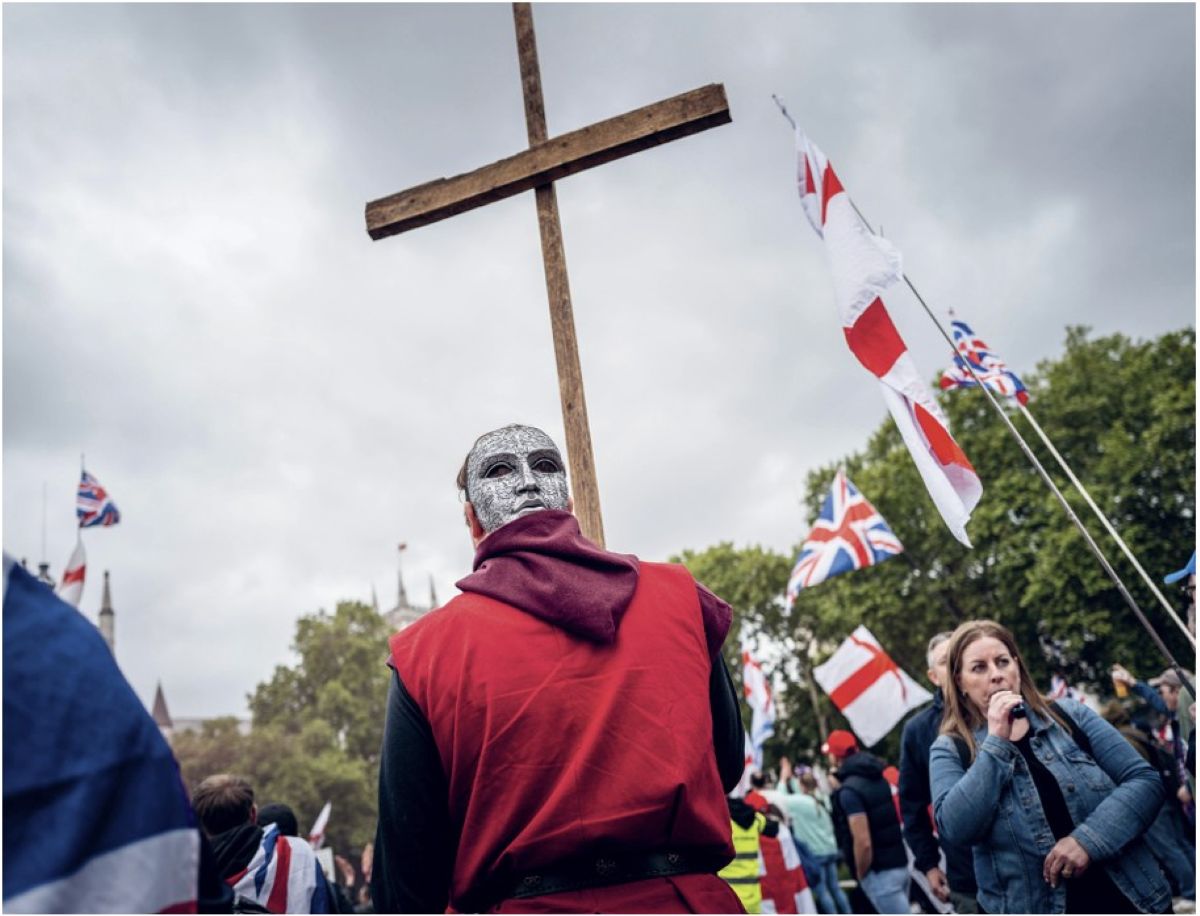
All this makes Christian nationalism seem like something we can only look at from a distance in the UK. But there is now an attempt either to import or to create Christian nationalism here. We saw it at the far right-organised Unite the Kingdom march in May, where they destroyed a flag saying “humanism”, amid the crosses and the “Christ is King” placards. We saw it when Christian campaigners marched in Soho against LGBT people last year, calling themselves the “King’s army”. But we, unlike the US, are a very unreligious society. What do you think is driving it?
There are lots of possible causes. Anxiety about migration; anti-Islamism. In France that anxiety has a secular aspect, but the St George’s Cross still means something in the
English imagination, which still has a Christian aspect.
The second thing is the globalising of all political discourse. The message given at international Christian conservative gatherings is that self-respecting nationalist movements need a bit of theology injected into them. Ironically, for someone like Nigel Farage, it’s about trying to find a presentational strategy that allows him to be taken seriously outside England. He’s often not here, after all.
Then again, if we’re looking for what animates Christian nationalism, I think it’s in part the very simple search for someone to blame. I’m fascinated that JD Vance is so interested in René Girard and scapegoat theory.
So, there are several elements at work: the anti-Islamic element, plus the national-folkloric one; the globalised authoritarian discourse and the pressure it exerts – and the money that comes with it; and then sheer scapegoating because that appeals to people who have something about their life or society that they find disappointing. But is there nothing to do with Christianity in UK Christian nationalism?
I reviewed JD Vance’s book Communion: Finding My Way Back to Faith for The Guardian and there is a poignancy to it, the critique he makes of a frenetic modern acquisitive culture. There’s an inevitable scepticism these days about some claims to religious conviction, and I don’t want to give way to this. If Tommy Robinson is doing his best to lead a life of Christian discipleship, I’m very glad, but I would really want to ask him some awkward questions.
What would you ask him?
I would ask him how attempting to lead a life of Christian discipleship squares with public rhetoric designed to produce hostility and violence.
And although Nigel Farage thought it was worth getting a theologian on board for Reform UK, I don’t think he lies awake at night thinking about his soul. I may be doing the man an injustice, but I don’t believe he cares about profound theological questions.
This is really interesting because it begins to answer the question of “Could it happen here?”. I read a column in The Economist that called Reform UK the “tarts and vicars party”. A good pun, I thought, but also meaningful. The argument was that the theologians provide the vicars, but Farage – with his pint and his smoke and his 1970s ways – knows what England really wants. So, they reasoned, we shouldn’t worry too much about the Christian nationalist aspect; it’s only an unserious, end-of-the-pier sort of piety. And I think it was telling that Farage said a future Reform government would repeal assisted dying if it passed and then just a few days later said it wouldn’t, that it’s not party policy. I guess that’s because their voting base – white, secular, working class – is very much in favour of assisted dying, and that language doesn’t work in Britain after all.
It’s a bit of a conundrum. I suspect really that Farage and others want to channel anti-Muslim feeling, and it helps to have “we’re a Christian society” to fling back. It gives a sort of ballast.
There’s another element here: religion adds a lustre – it adds legitimacy. It looks a bit “heritage”, which they think their voters will like. So what about its chances in the UK? We’re a very non-religious society so this might be defeated by demography alone. But we are still a state that is on paper the most Christian nation state in the world. If you offered JD Vance the opportunity of a constitution with the head of state having to be a Christian, clerics in parliament contributing to legislature, a third of state schools being Christian and so on, he’d probably bite your hand off. And Reform UK found it easy recently to introduce prayers before council meetings because it was seen as going with the grain of our nation, I suspect.
Does it give you no troubling moments when thinking about the prospects of Christian nationalism to remember that we are constitutionally a Christian nation?
Probably not. We got rid of political confessionalism in this country in the 19th century [when the Church of England’s absolute monopoly on civic and public life began to be eroded] and nothing has really gone backwards since then, in that respect. It would be really quite a leap to think that the Christian apparatus of the British state could be used again in that way. The very fact that the last monarch and the present monarch have nailed their colours firmly to an interfaith mast is not going to give any comfort to Christian nationalists.
Put it this way: I’m not feeling complacent about the political future overall. But whether there will be a vigorous, visibly Christian presence at the core of that? I’d be very surprised to see that. And I notice the clergy who are drafted in for these Christian nationalist events, they’re not from mainstream groups.
What should be done about this movement then, whether it is really Christian or not, if it is a threat? Particularly if what is causing it is, as we’ve said, disappointment and grievance, especially in times of economic hardship or perceived hardship?
I think the restoration of a real sense of agency to people is the heart of it. Democratic innovation, more investment in citizens’ juries, and the like. How do we bridge the gap between decision-making and everyday passive, battered experience? It’s not the whole answer, but it’s part of it. And it’s intrinsic to my own Christian sense of what a society ought to be, whether it calls itself religious or not: the maximisation of people’s agency and responsibility is inextricably linked with what I believe about the image of God.
My humanist view of a good society is similar. One in which as many people as possible have the fullest possible opportunity to develop their character, to reach their ceiling, and definitely to feel that they’ve got, as far as possible, control over the choices in their lives. I think education also has a large part to play in that, as well as political reform. Civic education can help develop a sense of agency, especially in relation to the bigger picture of our common life.
I also want to see human dignity more taken for granted in our society than it is. Even in areas where we aren’t going to get a consensus, let’s say about the ethics of assisted dying or what are the manageable levels of migration or how we manage the funding of social care, I’d like us to be able to handle even those issues with a measure of mutual respect. The problem with our discourse is often the assumption that if you have the wrong view on one thing, then you cannot be talked to about anything else.