A Richard Dadd retrospective reveals the artist's prolific work inside the walls of Bedlam and Broadmoor
Review: Richard Dadd: Beyond Bedlam
At the Royal Academy of Arts, London, until 25th October
Can an artist’s work be separated from their mental health? If not, can mental illness aid creativity? Or is it creativity that ultimately supports mental wellbeing? These questions came to mind during a visit to the Royal Academy of Arts in London, which is hosting a major retrospective dedicated to British artist Richard Dadd (1817-86).
Dadd emerged onto London’s art scene in the early 1840s with his paintings of fairies, inspired by Shakespeare’s A Midsummer Night’s Dream. The most famous of these, “Titania Sleeping” (1841), is a feverish composition featuring naked fairies and pipe-playing goblins. Nearby hangs “Puck” (1841), in which the sprite from Shakespeare’s play sits on a toadstool while a troop of fairies dance around him.
Dadd’s ability to render supernatural scenes in extraordinary detail brought early acclaim and led him to join a trip to the Middle East as part of the first wave of British Orientalist artists.
But this is where Dadd’s story takes a dark turn. While abroad he started experiencing psychotic episodes, now thought to be symptoms of paranoid schizophrenia. A few months after his return to England in 1843 he stabbed his father to death, believing him to be the devil. He fled to France, where he was caught, and spent the rest of his life in psychiatric facilities – including 20 years at Bethlem Hospital in south London (‘Bedlam’), followed by 22 years at Broadmoor.
During his long incarceration, Dadd continued to paint prolifically, drawing on legends, literature, memories of his travels and his roving imagination. Although mental illness was highly stigmatised at the time, Dadd benefited from (relatively) enlightened carers who encouraged his work, believing it would support his wellbeing.
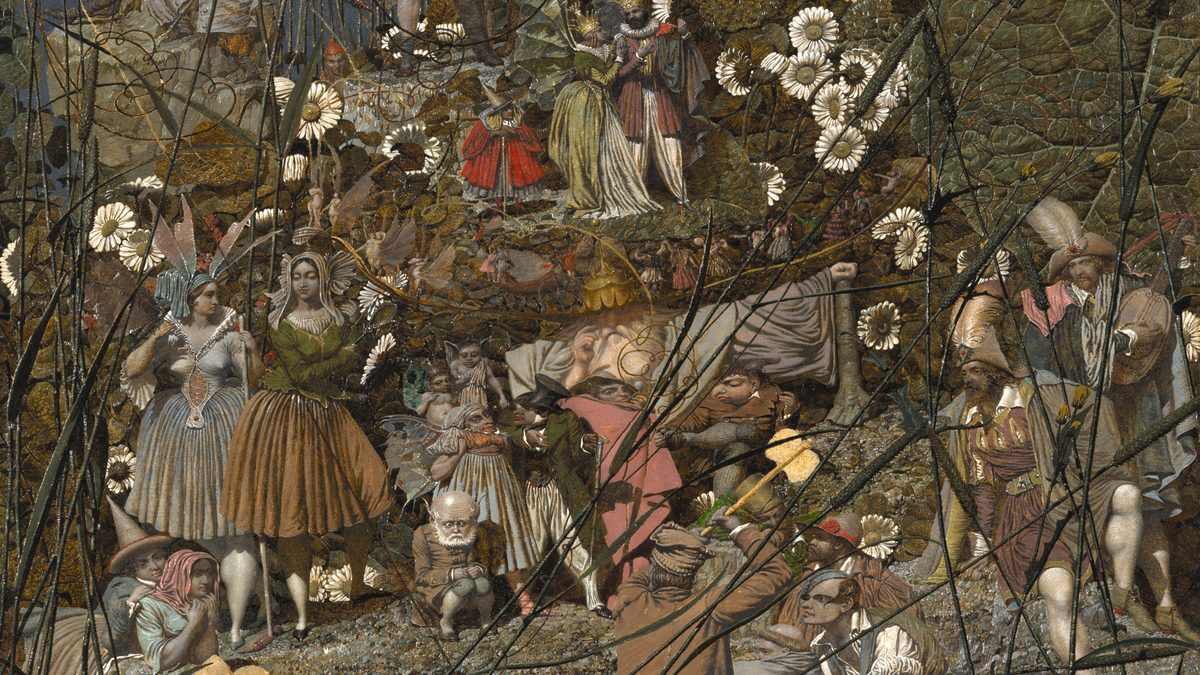
At Bethlem, he produced Orientalist scenes, portraits and light-hearted watercolours. But the supernatural still held its allure, and he spent almost a decade on his standout work, “The Fairy Feller’s Master-Stroke” (1855-64). The level of detail in this painting is overwhelming, as the eye is drawn to each grouping of fairies in the composition, as well as his intricate rendering of flowers and foliage.
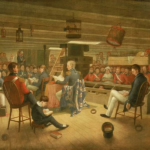
Upon moving to Broadmoor in 1864, Dadd continued to work, supported by hospital staff who sat for portraits and allowed him to beautify the facility with decorative panels.
This exhibition is a wonderful introduction to Dadd, featuring nearly 100 of his works. The curators rightly wanted to foreground Dadd’s art rather than the sensationalist details of his illness. However, the chronological ordering and the separation of his work at Bethlem and Broadmoor can’t help but foster a “before and after” perspective, with the violent murder of his father serving as the pivotal point.
Could there be truth in this? His early paintings are traditionally ordered compositions, whereas later works such as “The Fairy Feller’s Master-Stroke” teem with endless details and unclear focal points. Are these disorienting paintings the result of a mind in disarray? Or does the continuity of themes from his early career imply a natural evolution to his artistic journey?
People often romanticise mental illness, and the trope of the suffering artist is deeply engrained. But attributing Dadd’s unique vision to his ill health does him a disservice as a talented painter. What does come across is how support from hospital staff helped Dadd to thrive as an artist, even as he remained incarcerated for most of his life.