
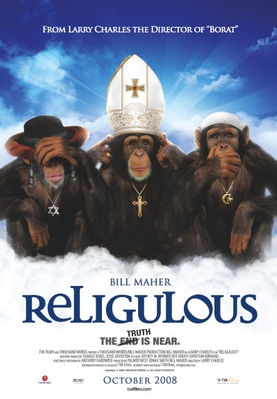
 Religulous is a curious little documentary. It’s not quite clear who is in charge, to begin with. In front of the camera is comedian Bill Maher, on his vaguely defined quest to discover the point of religion (or something similar; it’s never made entirely clear) and behind it is Larry Charles, he of Seinfeld and, as the poster so proudly proclaims, Borat fame. So, at once, Maher’s claims of his being a personal quest are called into question. Why couldn’t he direct it? Charles isn’t that great a director: many, many shots of Maher talking are taken with the fascinating background of the interior of their car, en route to the next location (we assume). He also intersperses normal interviews and scenarios with wide shots showing the first camera and various crew members. Perhaps this is done in order to give the sense of their ragtag band, constantly harassed by the authorities. Or to spice up some rather dull footage of Maher talking in front of a building. Either way, it doesn’t work.
Neither does the structure. The film begins with Maher interviewing various Christians, with whom he disputes some of the most outlandish aspects of the Gospel (talking snakes, Jonah in the whale, and so forth) to hilarious effect. Do not misunderstand – Maher is very, very funny and for the better part of two hours it is a joy to see him gleefully challenging as many religious spokespeople as he can get his hands on. The problem is, this flippancy goes on for the better part of two hours. Just before the film’s climax, Maher makes his most interesting and valid point – that religion is an extension of a human desire for self-destruction, and by institutionalizing it and mass marketing it, we are essentially preparing to fulfil our own prophecies of Armageddon, biblical, nuclear or otherwise. However, by the time that he has made this point, the film is almost over and this, his most compelling argument, is never put forth to any of his interviewees. The time with them is spent enjoyably but glibly poking holes in their already outrageously fallacious viewpoints. Even when they reveal some kind of self-damning contradiction, Maher undermines them with comedy cutaways to other films, or contradictory subtitles. Some despicable people (including Geert Wilders, who is on screen for all of 20 seconds and to whom Maher politely listens while some of his more benign contacts get a much harder time) get away far too easily.
Regardless of his politics, Michael Moore is a filmmaker from whom Charles and Maher could learn a lot. Bowling for Columbine, a film from which Religulous takes more than a few cues is far more logically structured, selects fewer interviewees and allows them (comparatively) to get their viewpoints across before it trashes them. Maher has also misunderstood Moore’s bumbling nice-guy act. Behind the baseball cap and glasses lies a ruthless individual who will stop at nothing to get his subject to shoot themselves in the foot before, innocently, jumping on their mistake and tearing their argument wide open. Maher, on the other hand, veers unpredictably between confrontational and “oh, only joking, let’s be friends again”.
One of the film’s key arguments is that many religious leaders don’t fully comprehend the power that they wield over people, and have become deeply self-indulgent. Having watched Religulous, it seems clear that Maher and Charles share a few of the same problems. They don’t seem to fully understand the potency of the moving image, and the result is a documentary that is, while often hilarious, too confused to be the incendiary treatise that it aspires to.