We have recently witnessed a spectacular cosmological event. Two black holes – both more massive than the Sun – have collided to make an even larger massive black hole, in a merger so big that it was, by our current models, theoretically impossible. The event has been observed by an array of gravitational wave detectors in the US, Europe and Japan. It is a perfect example of why we do science: in the hope that nature will surprise us. Donald Trump, however, is threatening to cut the funding of one of the two US detectors that contributed to the discovery, putting further breakthroughs at risk.
Gravitational waves are “ripples” in the fabric of space-time, caused by such violent and energetic events as two black holes spiralling together. They were predicted by Einstein in 1916, but were first directly observed from Earth on 14 September 2015. Think of them as cosmic sound waves. For all of history we have been able to see the Universe, with our eyes and latterly with our telescopes. Now we can hear it. Gravitational waves are the voice of space, and the loudest voices come from the mergers of black holes.
A black hole is a region of space where gravity is so strong that nothing, not even light, can escape. They form when a massive star explodes as a supernova. Paradoxically, it is the catastrophic implosion of the star’s core that drives the explosion. And it is in the super-dense conditions of that implosion that a black hole is born.
The gravitational waves picked up on 14 September 2015 were from two monster black holes that whirled around each other one last time, kissed, then coalesced – creating a tsunami of tortured space-time that spread outwards at the speed of light. Briefly the power in the waves was 50 times greater than the power emitted by all the stars in the Universe combined.
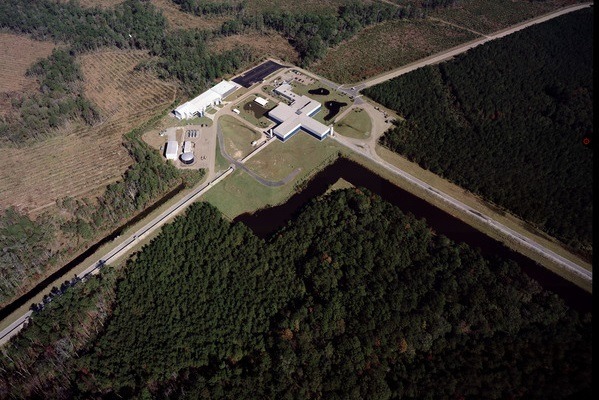
The gravitational waves from this event became ever more diluted as they spread through an ever-greater volume of space, until, after a 1.3-billion-year journey, they arrived on Earth. There they encountered gravitational wave detectors in Washington State and Louisiana. At each site, the passage of the wave caused a four-kilometre “ruler” made of laser light to periodically stretch and squeeze by one-billionth the diameter of an atom. No wonder the detection earned three Nobel prizes.
Now two more detectors have been added: in Italy and Japan. And it is this enhanced array that has detected the “impossibly” big black holes.
So why do – or did – we think that such black holes were impossible? If a star is too massive and goes supernova, the imploding core becomes so hot that it triggers a “pair-instability catastrophe”. Don’t worry about the details – the key thing is that the core blows itself to smithereens without leaving a black hole relic. According to theorists, there should be no black holes with masses from 60 to 130 times the mass of the Sun. However, the black holes in the recently witnessed merger are estimated to weigh in at 100 and 140 solar masses, challenging our understanding of black hole formation.
There’s a possibility that each of the black holes was formed by an earlier merger. But that would mean these mergers are more common than anyone thought. A more remote possibility is that the two black holes were spawned by some unknown “exotic” process in the inferno of the Big Bang fireball and therefore had survived from the first split-second of the Universe’s existence.
One thing is for sure: with gravitational waves now detected from about 300 black hole mergers, a new window has been opened up on the Universe. But this crucial source of astronomical knowledge is now under threat from the US administration’s mania for cuts.
Trump’s decision to slash the federal science budget is hitting hard in the US. There are worries that the cuts to LIGO – the Laser Interferometric Gravitational Wave Observatory – will result in the loss of the expertise of hundreds of researchers, built up over decades.
The weird thing is that someone in Trump’s government seems to realise that LIGO is important and should not be shut down entirely. They apparently think that shutting down one of the two detectors is making an efficiency. Perhaps they think it’s simply replicating work. But this makes little sense. The gravitational waves picked up by the detectors are so impossibly weak that someone riding past one of the sites on a bicycle would jiggle the giant laser rulers more than any cosmic event. With two identical detectors in the US, we can rule out such false alarms: If they both see the same signal, it is considered real. With only one detector, the results will be in doubt.
Elsewhere in the world of black holes, astronomers are answering fundamental questions about them. The black holes in question are not stellar-mass ones but “supermassive” ones. These weigh in at millions to tens of billions of times the mass of the Sun. There is one in the heart of essentially every galaxy, including the Milky Way.
Supermassive black holes are one of the outstanding mysteries of our Universe. We do not know how they form. We do not even know the answer to the chicken-and-egg question: “Which came first: supermassive black holes or galaxies?” In other words, were supermassive black holes the “seeds” about which galaxies of stars later gathered? Or did galaxies come first and supermassive black holes form later, perhaps from the catastrophic shrinkage of a dense star cluster?
Enter Nasa’s James Webb Space Telescope. Launched on Christmas Day 2021, this 6.5-metre telescope with a mirror made out of 18 hexagonal gold segments, is hanging in space 1.5 million kilometres beyond the Earth on the extension of the line from our planet to the Sun. The JWST peers back to the dawn of time when the Universe was only about 5 per cent its current age of 13.82 billion years. It can do this because it “sees” infrared, which has a longer wavelength than visible light. The enormous expansion of the Universe since its earliest moments has stretched the visible light of its galaxies and stars, so it arrives at the JWST as infrared light.
This newborn universe is filled with so many baffling objects – underlining yet again why we do science – that the excellent Quanta Magazine last year described it poetically as “the beautiful confusion of the first billion years”. Among the objects are ultra-compact galaxies, dubbed Little Red Dots because of their distinctive colour.
The light from these – hundreds or thousands of times smaller than our Milky Way – reveals the existence of both stars and supermassive black holes. Usually, matter swirls down onto a supermassive black hole like water down a plug hole and friction in the gas heats it to millions of degrees. It is the prodigious light from such “accretion” disks that powers the most violent galaxies such as quasars. However, in the case of Little Red Dots, dense dust is cloaking the supermassive black hole, and the light from the accretion disk is being absorbed by the dust and re-radiated as red light, just as dust over a polluted city turns the Sun red.
Here is the point. In today’s Universe, supermassive black holes are 0.1 per cent of the mass of their parent galaxy’s stars. But the JWST finds that in the Little Red Dots the supermassive black holes are 1 per cent or even 10 per cent of the total mass. This is strong evidence that supermassive black holes came first. Then, as time went by and galaxies spawned ever more stars, the fraction of total mass they made up dwindled.
We still do not know the origin of the Universe’s supermassive black holes. But we now know it is probable that they seeded galaxies. In other words, you would not be reading these words were it not for a black hole.
This article is a preview from New Humanist’s Winter 2025 issue. Subscribe now.