Amazon's Hedda courts controversy with a bold adaptation of Ibsen's classic
Henrik Ibsen’s Hedda Gabler was first performed at the Residenztheater, Munich, in 1891. Despite its success, with productions soon running internationally and the published text becoming a major bestseller, not everyone was impressed with the four-act play. “[A] hideous nightmare of pessimism”, wrote the London weekly Pictorial World. “The play is simply a bad escape of moral sewage-gas.” While the Lord Chamberlain’s Office had declined to grant a licence for the public performance in Britain of Ibsen’s previous play, Ghosts (1881), they allowed Hedda Gabler to escape censorship on the grounds that it was “too absurd altogether to be injurious to public morals”.
What, then, was so absurd, so noxious to the authorities, and yet so popular with audiences? Well, the play features drunkenness, debauchery, death and destruction, but that was nothing new. What was new was the character of Hedda herself – a strong, morally ambiguous woman who contrives to be the master of her own fate.
Ibsen, aged 62 at the time of Hedda Gabler’s première, had already established himself as a pioneer of naturalism (a very deliberate, socially conscious kind of realism), and was well known for his concern with issues of social justice, and in particular for his strong female protagonists. At a time when the Women’s Movement was ascendant, and the old social order seemed to be giving way, the play struck a nerve, and has continued to do so ever since.
The story covers one day in the life of 29-year-old Hedda Tesman (née Gabler), a famously untameable beauty who has recently returned home after an extended honeymoon with her dull academic husband, George Tesman.
George, who is hoping to secure a professorship, has overextended himself in acquiring and furnishing their lavish home, in the hopes of pleasing the more sociable, and easily bored, Hedda. In doing so he has placed himself in the debt of family friend Judge Brack, who comes and goes as he pleases, usually through the back door, and who hopes for a closer relationship with Hedda.
The reappearance in the small town of Eilert Lövborg, Hedda’s former lover and a friend and professional rival to George, and the presence of a very Chekhovian pair of pistols, threatens to shatter the uneasy peace of the newlyweds’ new life.
Hedda’s complex psychology – she is both charming and spiteful, romantic and cold-hearted, totally in control and entirely unpredictable – has made her one of the archetypal hero-villains in world theatre, and a figure of women’s liberation. The image of Hedda with her pistols is almost as iconic as that of Hamlet with his skull. For this reason the play has long proved a fruitful vehicle for female leads and ripe for reimagining in new contexts.
It was the first of Ibsen’s plays to be filmed (by Nance O’Neil in 1917) and the title role has been played by such stars as Joan Greenwood, Glenda Jackson and Susannah York, with Ingrid Bergman giving a nicely icy performance in a very fine 1963 BBC television adaptation.
Now, Nia DaCosta, who is best-known for directing Candyman (2021) and The Marvels (2023), has made an adaptation very much geared towards modern sensibilities. The setting has been updated to an English country house in the early 1950s, and Hedda (played by Tessa Thompson) is now black (the “bastard child” of the formidable General Gabler, whose prized pistols are all that was left to his daughter). More daringly, the character of Eilert Lövborg (played superbly by Nina Voss) is now a woman named Eileen. Thus, race and sexuality are thrown into the mix, along with the pre-existing themes of freedom, confinement and the possibility or impossibility of personal fulfilment in a patriarchal society.
The film, unlike the original play, begins in aftermath. Hedda, looking a little the worse for wear, is questioned by two policemen as to the events of the night before – and, more pressingly, on the location of one of the pistols, which is apparently missing. So back we go, 24 hours, to find our heroine sashaying through her enormous house in a sumptuous dress, as staff prepare for an extravagant party to be thrown in honour of Hedda and her new husband, George (Tom Batemen).
As the guests arrive, we learn that both husband and wife are on tenterhooks: he because of the arrival of Professor Greenwood, who will ultimately decide on the matter of his own professorship, and she because of the possible arrival of her old flame Eileen, who has renounced her hard-drinking and self-destructive ways and written a much-praised book. She might even be a competitor for increasingly nervous George’s professorship. The unexpected arrival of Thea (Imogen Poots), Eileen’s lover and amanuensis, and a band of Hedda’s bohemian chums, complicates things further.
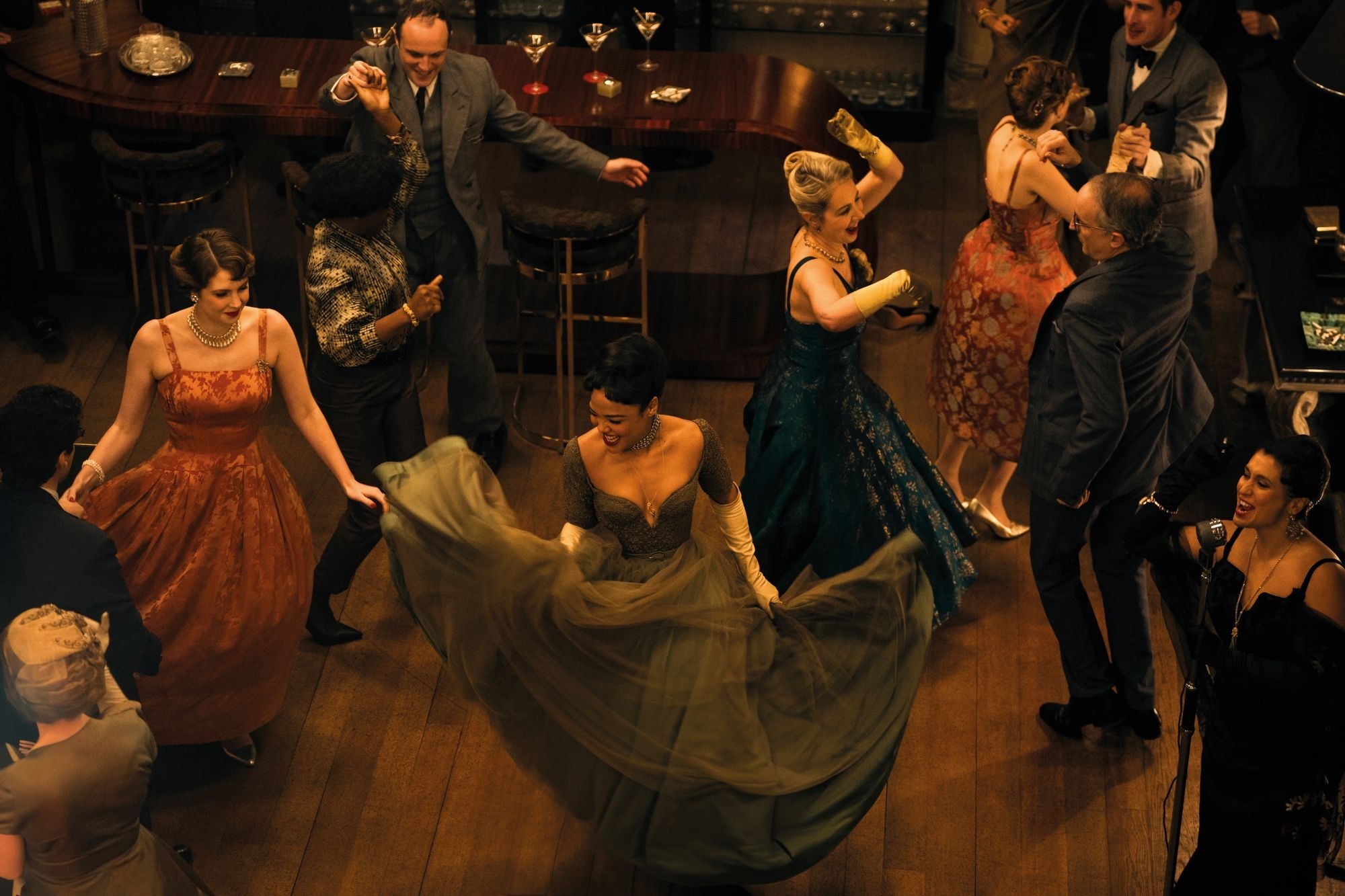
At first, the evening is a roaring success. Hedda is the life and soul of the party and manages even to get George’s buttoned-up colleagues onto the dance floor. Professor Greenwood is successfully charmed, and plied with many a cocktail. Altogether, DaCosta has introduced far more fun and games to the proceedings. Gone is the traditionally stifling atmosphere and dour confines of the bourgeois small-town living room (the play’s action ordinarily takes place largely in this one room). Here, everything is turned up to 11. There are cocktails galore, lines of cocaine, a swinging band, fireworks, a huge bonfire, skinny dipping in the lake, a maze to get lost in. Every darkened corner seems to be pulsating with couples in flagrante. The action races from room to beautiful room as the party gets more and more out of control. Guns are fired; punches thrown. Overall, the glitzy and hectic style seems to owe more to the 1920s Jazz Age (by way of Baz Luhrmann’s The Great Gatsby) than to straitened post-war Britain.
In an interview with Vanity Fair, DaCosta explained her approach thus: “Wouldn’t it be cool to do a movie where I make all the subtext text?” In a play famed for its icy surface and unfathomable depths, this is quite the reversal. And it largely pays off. DaCosta tackles head on that era’s sexual politics: Hedda is the too intelligent housewife, of whom nothing but her beauty and her body are expected; Eileen is the patronised career woman, leered at or passed over at every turn.
In fact, Nina Voss’s brilliant but doomed Eileen is the real star of the show, with a number of showstopping scenes, next to which Tessa Thompson’s Hedda somewhat wilts. Chief among them is one in which Eileen, coerced into drinking by the spiteful and scheming Hedda, outlines the theme of her new book – the future of sex – to a room full of George’s male colleagues. At first titillated, then threatened, the men soon turn on her. It is wrenchingly toxic and tragic.
Overall, it’s a brash and ballsy adaptation, structured more like a whodunnit than a chamber piece. DaCosta has cited Robert Altman’s country-house murder mystery Gosford Park as inspiration. Stylistically, though, it has more in common with Bridgerton. This Hedda is not too concerned with historical or societal accuracy; it is certainly not naturalistic. There is nothing necessarily wrong with that, but at times it can feel stylised and celebratory to the point of vacuity. More damagingly, amidst all the noise, Hedda rather loses her potency and becomes a more straightforward victim, one whom (as the altered ending makes clear) we are meant to unequivocally root for.
Ibsen might have been proud of DaCosta’s determination to so plainly subvert the dominant narrative by re-centring the play around a black, queer, female protagonist. However, to echo those long-ago critics, this adaptation is also, in the end, somewhat absurd in its excitability and superficiality. And in its more obviously feel-good depiction of Hedda, the ambiguity central to her character is lost. DaCosta might have felt she was striking a blow for progress; but viewed from another angle, she is playing it pretty safe.
This article is from New Humanist’s Winter 2025 edition. Subscribe now.