Without female doctors, women in Afghanistan are being denied medical care – as the recent earthquake made painfully clear
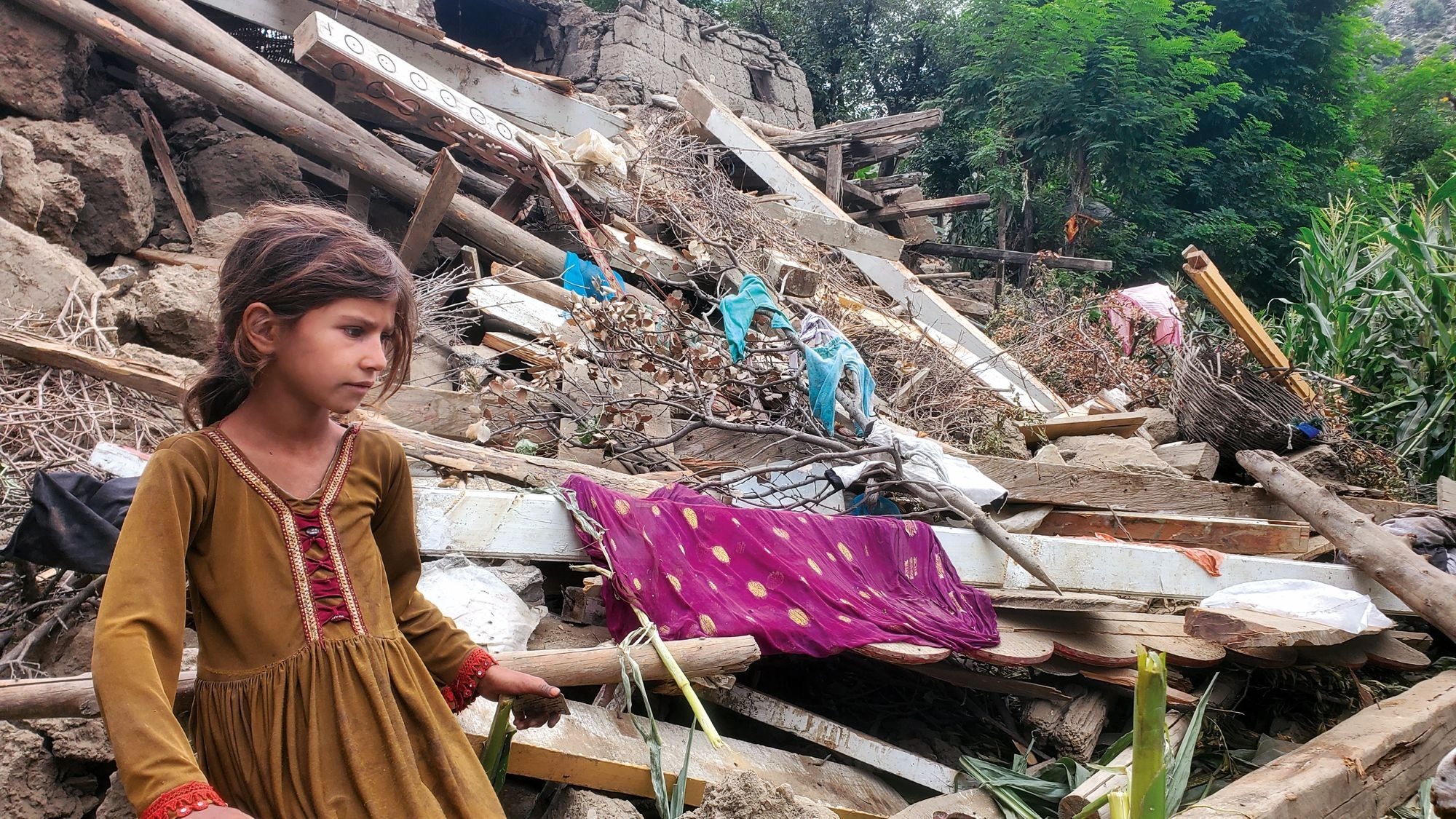
When a powerful earthquake hit eastern Afghanistan in August, 30-year-old Shakeeba survived – but most of her family did not. In the remote, mountainous Nurgal district of Kunar province, she described how the terrifying quake killed 13 of her family members, including her three children. Her husband is still missing; she doesn’t know whether he is dead or alive.
Shakeeba was rescued the next morning, after spending the night trapped beneath the debris of her house. The danger she faced was compounded by the fact that she was pregnant and suffering from severe bleeding. “Under the debris, I could hear my kids screaming till the morning,” she said, her voice trembling. “When their cries stopped, I realised that they had passed away. Now I can’t sleep at night because the sounds of my children are still in my mind.”
Several provinces in eastern Afghanistan were affected by the magnitude 6.0 earthquake that left more than 2,200 people dead and thousands more injured. Among those who survived, many of their homes were destroyed or seriously damaged, leaving them with nowhere to live. The United Nations says half a million people were affected. Hilly and remote areas were hit particularly hard, as landslides and damaged roads left some villages unreachable. This significantly hindered rescue and relief efforts and made it extremely difficult for emergency responders to reach those in need with supplies.
The earthquake received news coverage around the world. But the particularly devastating impact on women received less attention. The Taliban governs Afghanistan, having returned to power when US-led forces withdrew in 2021 after two decades of military presence. When the earthquake hit, the Taliban government was overwhelmed by the scale of the disaster. But their policies, based on their interpretation of religious law, also meant that women caught up in the humanitarian disaster were in many cases abandoned – left without support or medical care to a disproportionate degree.
That’s because severe restrictions on women’s education have led to a shortage of female medics, as well as female rescuers and aid workers – particularly in the remote areas that were worst affected by the earthquake. Women who were already qualified as medics before the Taliban’s return to power are also subject to restrictions on their work. On top of that, the Taliban’s “no-touch” rule prohibits women from having skin contact with unrelated males. In many cases, this prevented male rescuers, doctors and health workers from physically assisting women – even in order to save their lives or the lives of their babies.
When Shakeeba was found underneath the rubble, there were no female doctors to help her. As soon as the male rescuers saw that she was pregnant, and badly injured, they hurried her to a nearby helicopter and took her to the Nangrahar regional hospital. There, she was treated by female doctors who gave her a blood transfusion. But she has been told that because of the complications from her injuries, the chance of her baby surviving the pregnancy is lower.
Shakeeba survived. Other pregnant women did not. When the earthquake hit, she was entertaining three guests at her home. They were all also pregnant, and she says that they died because of the lack of healthcare. “I believe that many women would have been saved if there had been female doctors and [proper healthcare] accessible on time,” she told me. Shakeeba herself is experiencing severe emotional stress, according to the medical staff looking after her, and she frequently breaks down in tears. She remains in hospital.
Dwindling numbers of female medics
The earthquake has drawn attention to the massive challenges that female doctors confront when attempting to treat women in traditional and rural areas in Afghanistan. “The biggest challenge is that the number of patients is quite large, but female healthcare professionals, [as well as] medical supplies, medicines, and equipment are very limited,” says Dr Nadia Ghazal, a female doctor working as part of the rescue effort in Dewagal and the remote Mazar Valley of Kunar. She says there are about 20 female health workers operating in these two areas, but only half of them are qualified medical professionals – in most cases, either nurses or partially qualified doctors who have only been able to complete part of their studies. Across the earthquake-affected area of Afghanistan, roughly 90 per cent of medical staff are male, according to an estimate from Dr Mukta Sharma, deputy representative of the World Health Organization’s country office.
The burden on the small number of female doctors in these areas is resulting in physical and mental burnout, said Ghazal. “Sometimes there are so many patients that I am unable to see them all at once. For women with internal bleeding, complex fractures or pregnancy-related crises, this wait may be deadly.”
The most urgent needs for women following the earthquake involve the treatment of injuries, including fractures and internal bleeding. But another significant issue is maternal and child health, since expectant mothers need postnatal care, safe delivery facilities and timely examinations. A UN report published in September found that 11,600 pregnant women required immediate assistance in the wake of the earthquake. And many women, like Shakeeba, are now experiencing psychological issues as a result of having lost loved ones, and having undergone severe trauma.
Even without the Taliban’s discriminatory approach, treating these women would have been a challenge. The earthquake devastated a large number of healthcare facilities and roadways. But the government’s policies are worsening the catastrophe. After the earthquake hit, the World Health Organization urged the Taliban to remove restrictions on female aid workers, so they could travel without male guardians and assist women who are having difficulty accessing care. Aid from outside Afghanistan was also hampered, as there are also restrictions on women working with the UN. But the restrictions weren’t lifted, nor was the “no touch” rule. The rule is deeply embedded in the Taliban’s policies because it is based on an interpretation of sharia law, where men are forbidden from touching women who aren’t part of their family, even in life-and-death situations.
“This restriction, combined with the Taliban’s strict ban on gender mixing, has directly resulted in the unnecessary deaths of many women who could have been saved,” said Habib Khan Totakhil, a journalist and researcher formerly based in Kabul. “According to people interviewed in affected areas, some women had very basic [or easy to treat] medical needs, but because of the lack of female medical workers, they lost their lives.”
Silencing criticism
The earthquake shone a light on the extent of preventable suffering under the Taliban’s gender restrictions. The scale of the problem was confirmed by former Afghan parliamentarian Mariam Solaimankhil. She left Afghanistan in 2021 after the Taliban takeover but is in touch with women in need of support through activist networks. “A woman in Zabul had a miscarriage recently,” in the aftermath of the earthquake, she told me. “She has nowhere to go and is in pain. Terrified to even share her story at home, she shared it with me in terror. We are currently working to bring her to India for treatment after I got in touch with her family.” India is one of the few nearby countries that is still offering medical and humanitarian visas for Afghans.
This is just one case of neglect among countless others, said Solaimankhil, including survivors of sexual assault who have been left without care, women dealing with heart issues and pregnancy concerns, and thousands of women dealing with psychological trauma, all of whom are silenced by the Taliban. Women who speak out risk beatings, imprisonment, public flogging or forced disappearance. In some provinces, women have been dragged from their homes for posting on social media or for participating in peaceful protests. Families are pressured to silence women out of fear of collective punishment.
But the earthquake has shown that the Taliban can no longer avoid addressing the issue of women’s healthcare, said Ghazal. Untreated illness may end up as chronic syndromes, and neglected injuries may cause lasting disability. “Investing immediately in the education and training of female physicians and healthcare professionals is the only way to solve the problem. To encourage girls to serve in remote and disaster-affected areas, safe working conditions and opportunities for medical studies must be established,” she said.
But for the shortage of female medical professionals to be addressed, the Taliban would have to change its gender exclusion policies. Since they returned to power in August 2021, women’s rights have been drastically restricted, and they have been largely shut out from public life. Their freedom of movement and employment has also been severely limited.
The ban on women’s education was supposed to be temporary. When the Taliban returned to power, they assured the world that they would be setting up a gender-segregated system, where women would receive their own specialised education, taught exclusively by women. The approach was justified on the grounds of a rigid interpretation of Islamic law requiring “suitable environments” for women’s education.
But no deadline was set for when this women’s education system would begin operating. A women’s rights activist who asked not to be named said: “The Taliban claim that, as a Muslim country, they will create Islamic-based systems and educate women. But they don’t intend to do so. They have no policies to back up their claim, and it’s been almost five years; if they were sincere, they would have done it by now.”
No access to education
According to data shared by former Ministry of Education spokeswoman Najeeba Arian, there were 3.7 million girls enrolled in schools prior to the Taliban’s return, making up 40 per cent of pupils. There were also 36,500 female students at public universities, accounting for 21 per cent. But all of these women and girls have had to drop out of education – and every year, thousands more girls are denied a chance to even begin to receive schooling.
As a result of the limitations, no women have graduated from medical school since the Taliban returned to power. The pipeline of new professionals has been destroyed. And many of the female doctors and nurses who had already qualified left the country when the Taliban returned, since they were unable or unwilling to work under the restrictions. Those who stayed, like Ghazal, will not be practising for ever, and no one will take the place of today’s exhausted professionals when they retire. “Most of the women doctors who were already practising have left Afghanistan, because it is nearly impossible to work under Taliban rule,” said Totakhil. “With no new female graduates, this is creating a healthcare disaster for Afghan women that will only worsen as the population grows.”
If the education ban had not been in place, women who were already at university when the Taliban returned – including some who had nearly reached graduation – would have been working in essential sectors by now, giving their communities much-needed support. “In the next five to 10 years, there will be no women in any profession if the Taliban sticks to the same policies,” Arian told me. “The humanitarian crisis will likely worsen further, forcing people to look for assistance from neighbouring countries even for their most basic requirements”.
Afghan women and activists continue their efforts to educate girls online or in secret classes, but it is difficult and dangerous. In September, a female teacher was detained in Herat by agents from the Ministry for the Propagation of Virtue and Prevention of Vice for secretly teaching scientific subjects to girls. In January 2025, the Taliban sentenced six teachers in Daikundi for teaching computer skills and English to women. There have been countless other cases where activists who were working covertly to educate women have been arrested by the Taliban. Meanwhile, women who had been pursuing their own education online were hampered by an internet shutdown in September, which the Taliban said was necessary to prevent “immorality”, and there are concerns that internet connectivity could be lost again.
Arian draws attention to the government’s double standards, pointing out that women are permitted to attend madrasas for religious education. “Why can’t women attend schools with the same rules and attire as madrasas?” she asked, suggesting this raises questions about the true motivations behind the ban on women’s education.
Disaster looms
But if women cannot work in or access healthcare, Solaimankhil pointed out, it will affect the nation as a whole. “This is more than just a women’s issue; it will collapse Afghan society. Without female healthcare professionals, maternal and infant mortality rates, already among the highest globally, will increase even further.” Education, she added, helps mothers raise children who are healthier and more literate, while keeping women out of the workforce will adversely impact Afghanistan’s economy. “When half the population is illiterate, poverty grows, child marriages increase and preventable deaths become common.”
Numerous activists and politicians have voiced their disappointment with the international community for the lack of tangible action. They are calling for the Taliban to be held responsible for crimes against humanity, and for their systematic effort to exclude Afghan women from public life. Some activists are calling on global funders to find ways to get around Taliban systems and permissions and instead ensure that funding is provided directly to Afghan women, doctors and educators. “This is gender apartheid,” Solaimankhil said. “It is a systematic campaign to remove Afghan women from education, healthcare and society at large.”
Meanwhile, for those still in Afghanistan, the devastating impact of the earthquake has intensified feelings of anger and defiance that have been boiling under the surface for nearly five years. “We need to come together,” said the women’s rights activist. “We shouldn’t permit the Taliban to use religion to deny us our fundamental rights.”
Research for this article was supported by a reporter within Afghanistan who has chosen to remain anonymous for security reasons.
This article is from New Humanist’s Winter 2025 edition. Subscribe now.