Proto-Indo-European gave birth to a plethora of modern languages, but there remains a question mark over its origins
Proto: How One Ancient Language Went Global (William Collins) by Laura Spinney
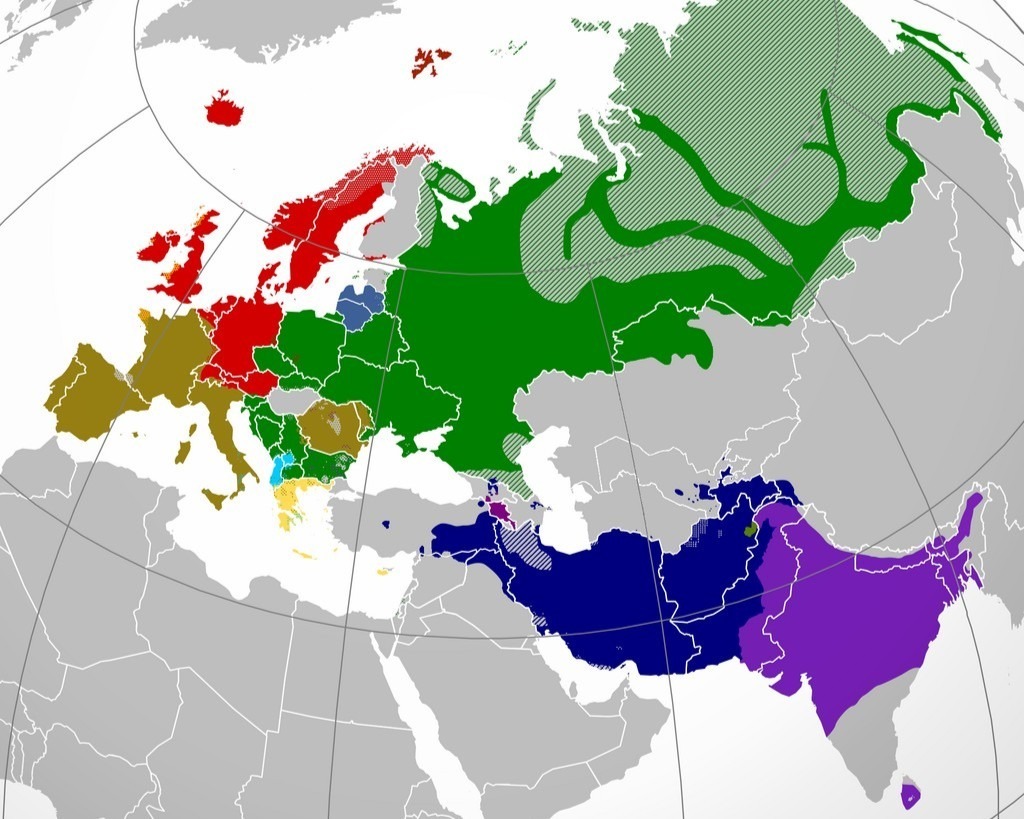
In 1786, Sir William Jones, a British philologist and judge, made the remarkable discovery that the ancient Indian language Sanskrit resembled Latin and Greek, “bearing to both of them a stronger affinity, both in the roots of verbs and the forms of grammar, than could possibly have been produced by accident”. So was born the knowledge that has now expanded to recognise almost all of the modern European languages as Indo-European – alongside the main northern Indian languages, and some western Asian ones, such as Farsi.
A book by science journalist Laura Spinney now gives us the background on how the Proto-Indo-European (PIE) language was discovered, with linguists ingeniously managing to trace dozens of languages back to construct a hypothetical source language, estimated to have been spoken from 4,500 to 2,500 years ago. Most of the book is taken up with the question of where the language originated, and how it managed to spread so successfully across the globe.
The search for the region that birthed the language had proved elusive, until Svante Pääbo, in 2010, developed the technique of ancient DNA sequencing, for which he won the Nobel Prize in 2022. Originally used to sequence the Neanderthal genome, the work expanded so rapidly, especially in David Reich’s laboratory at Harvard, that in 2015 the renowned British archaeologist Colin Renfrew wrote that “In just five years the study of ancient DNA has transformed our understanding of world prehistory.”
That same year, a paper was published by Reich’s group, imperiously titled “Massive migration from the steppe was a source for Indo-European languages in Europe”. This, along with another, similar paper, proclaimed the end of the PIE mystery. The steppe is the vast region of grassland that runs for 5,000 miles from central Europe to Manchuria. The origin of PIE (and hence the languages now spoken by almost half the world’s people) was judged to be the Pontic-Caspian steppe, north of the Black Sea – land that is now part of southern Russia and Ukraine. The population of the steppe, the Yamnaya, were animal-herding, horse-riding and chariot-driving nomads.
However, as Spinney explores, the mystery hasn’t been quite resolved. An earlier theory had proposed that PIE originated in Anatolia, land that now makes up the majority of Turkey – and it turns out that both might be correct. In 2022, Reich and his group showed that there had been an earlier migration from the mountains of Armenia, around 5000 BC, to both the Black Sea and Anatolia. In this theory, one branch of an archaic root language became the Anatolian languages, and another – via the Yamnaya culture – went on to produce the plethora of Indo-European languages.
Spinney shows us why this debate matters to us today. One pressing reason relates to false ideas around racial superiority. Yamnaya is the greatest part of the genetic heritage of most white Europeans (including in North America); English is the world lingua franca today; and from 1492 Europeans colonised a large part of the rest of the world. For some people, the belief that so many of our languages were birthed from the Yamnaya lent spurious credence to the notion that it was natural for white Europeans to conquer other peoples. The Nazis were invested in this idea, falsely locating the Indo-European source in Germany.
But how did the Yamnaya manage to dominate other cultures and impose their language? They were highly mobile nomads, and may have been physically stronger. Spinney writes, they are thought to have been “10 centimetres taller than the male farmers they encountered”. But were they violent conquerors? In Britain around 4,000 years ago the population was 90 per cent replaced by people with Yamnaya genes. But Spinney reports that, as with the British colonists in North America, who carried lethal smallpox (to which they were immune), the cause of the population change might have been infectious disease.
As a story emerges, what are we going to make of our exceedingly murky heritage? These issues are only hinted at in Proto but it is the best source – as up to date as possible – on the fantastic odyssey of our languages and the migrating peoples that carried them.
This article is from New Humanist’s Winter 2025 edition. Subscribe now.