Could lab-grown luminescent plants help us fight drought and disease?
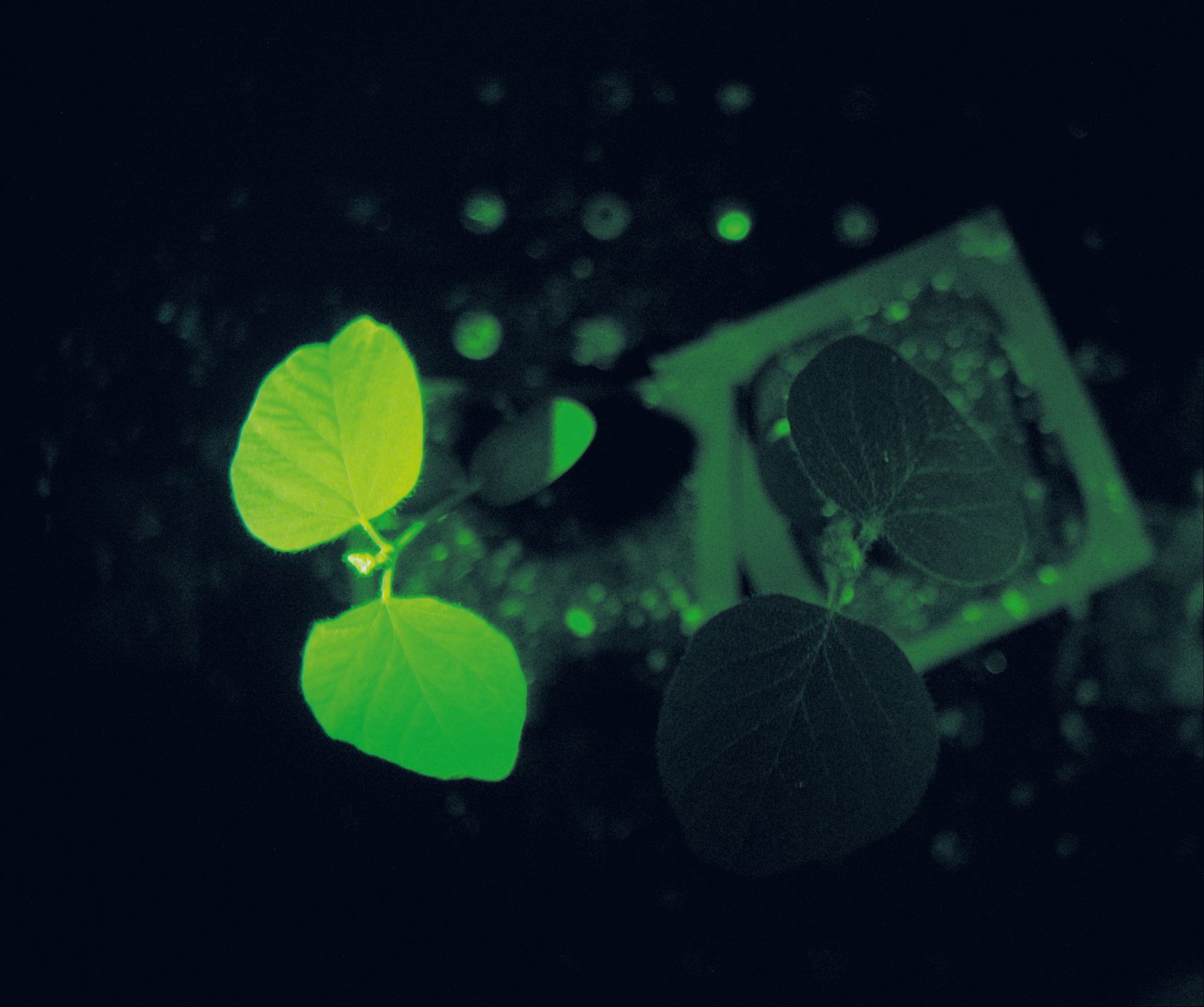
In February 2024, people across the US began placing orders for a plant that glows at night. The Firefly Petunia, sold by the synthetic biology startup Light Bio, looks like a regular white petunia by day – but in darkness it transforms, emitting a soft light, most visible in its flower buds. The first glowing plant was created in 1986, but it has taken 38 years for the technology to be enjoyed in people’s homes and offices.
Most people are interested in the beauty and novelty of the flower. But while the glowing petunias are aesthetically remarkable, they also demonstrate that “living light”, as it’s often called, can move beyond the lab into everyday environments. Most promisingly, bioluminescent and fluorescent plants have practical uses in agriculture. The light the plants emit can help us understand and combat complex threats to crops – including rot, pests and fungal disease – which are likely to deepen with the ongoing climate crisis.
Most of us have seen some instance of bioluminescence, which is defined as light made by living things, and occurs naturally in fungi and animals. Fireflies are the most obvious example, as well as deep-sea creatures and a handful of glowing fungi. The chemistry is straightforward enough: enzymes called luciferases act on small molecules called luciferins (sometimes with cofactors like ATP, an energy-carrying molecule), in the presence of oxygen. The reaction then releases energy as photons.
Fungi and animals have evolved to glow naturally for a variety of reasons. Fireflies emit light to attract mates and warn predators that they’re an unpleasant meal. It’s thought that the deep-sea lanternfish glows in order to blend in with the blue of the sea and avoid predators. In the case of fungi, however, scientists are still speculating. The leading theory is that the glow attracts insects, aiding reproduction and dispersal, which might be especially helpful in dark forest environments.
But plants don’t glow naturally; they never had to evolve that way. We humans have intervened. So how did we engineer these plants, and why?
The science of bioluminescence
The first glowing plants in the 1980s were only suitable for lab environments, and were mostly designed to study genetic processes. Bioluminescence can be used to provide a real-time indicator of plant development and stress response – all without harming the organism. Keith Wood, now chief executive of Light Bio, worked with the team that created the first glowing plant, by inserting a firefly bioluminescent system into a tobacco plant.
Bioluminescent systems from various insects, marine life and fungi can be inserted into plants, but there are important differences in how this is done and how it affects the glow. In some cases, scientists insert just the genes for luciferase, the enzyme that produces light when it reacts with luciferin, or introduce the luciferin chemically along with luciferase. This approach can make the plants glow, but the light usually lasts for a limited time, since luciferin is not produced inside the plant and must be replenished externally.
The next step, then, was to engineer plants to glow throughout their life. This involved designing plants to produce both luciferase and luciferin themselves by inserting the full set of fungal bioluminescent genes. Because these fungal systems use caffeic acid, which plants naturally produce, the engineered plants can run this light-producing reaction autonomously without needing outside chemicals, creating a sustainable, self-sufficient bioluminescent system. But the light emitted was still too weak and unstable for conditions outside the lab.
More recent work has adapted the mushroom genes so that they function better in plant cells and tissues, boosting brightness by up to a hundredfold.
Today, Light Bio focuses primarily on producing ornamental plants. “People are not only excited and surprised when they see a living plant glow in the dark, they’re often deeply moved,” Wood tells me. But the same technology has practical applications outside the lab.
It is being used, for example, in food safety contexts. Quality-control tests use enzymes and chemicals to help detect contamination in milk and meat. These tests measure the presence of ATP, which reacts with the luciferase added to the food products, triggering the chemical reaction that produces light. The amount of light generated is proportional to the level of ATP, which then shows the extent of contamination.
What about using glowing plants in agriculture? One avenue of exploration relates to pollination. Some researchers speculate that glowing cues might affect insect behaviour. For example, a faint bioluminescent cue at dusk might help nocturnal insects such as moths, which rely on colour and shape, to find flowers. Even adult fireflies, themselves pollinators, could be drawn to these flowers at night. If pollination can be encouraged, then this benefits farmers because it can lead to better fruit and seed development, resulting in improved crop yields. But this idea needs more testing outside the labs, with real crops and in real weather, with attention to the ecological side-effects.
The power of fluorescent plants
For now, another kind of light-emission is yielding more concrete benefits for farmers: fluorescent plants. Like bioluminescence, fluorescence also makes living things emit light, but it can’t operate in the dark. A molecule absorbs incoming light and then re‑emits it at a specific wavelength. With the right illumination and filters, the signal answers back. In practice, this usually means using artificial light sources and optical sensors, since ambient sunlight alone is rarely enough to give a clear reading. In short, bioluminescence shines by itself, while fluorescence shines when asked.
The Californian biotechnology company InnerPlant engineers crops to fluoresce in patterns designed to be read with specialised optics, from the ground and from aircraft. Their commercial product is focused on fungal infections in soybeans. Sensors are planted in plots across a region, acting somewhat like towers in a mobile network. Farmers do not host or manage the hardware, rather they subscribe to the network. InnerPlant’s agronomists send weekly scouting reports during high-risk periods and send alerts by text and email when sensors confirm infection.
“It helps take the guesswork out of fungicide decisions,” said Sean Yokomizo of InnerPlant. “[Farmers] only have to take action when and where it’s needed, rather than spraying entire fields.” Farmers are pragmatic and want clear benefits, he said. Technology has to be low-risk and consistent to win trust.
As of 2025, InnerPlant’s network covers 50,000 acres across the Midwest US, including in Illinois, Iowa, Nebraska and South Dakota. They plan to increase the network to cover more than half a million acres in 2026, and to add insect detection in soybeans in 2027, followed by a corn fungal sensor. The company is also looking into satellite use, with the aim of improving their large‑scale visibility.
Whether or not InnerPlant succeed in their plans, other companies are likely to take advantage of these new technologies. Fluorescent technologies may be particularly helpful in coping with climate change, which is already leading to unpredictable weather patterns. These include raised temperatures and humidity – conditions in which fungal disease can escalate rapidly. An early fluorescent signal lets a grower treat the right block before spores spread further across crops. Blanket “just in case” sprays can become the exception, targeted passes can become the norm, and costs fall – as does the chemical load that runs into streams.
Fluorescence can also help to guide watering practices – which is especially important in times of drought, or where water is expensive or scarce. Plants shift their fluorescent signatures when stressed, often before leaves wilt. If you can see that change early, irrigation moves from routine to need, which saves energy and helps prevent salt build-up in soils. It’s useful for monitoring nutrients, too. If low nitrogen shows up as a clear map rather than a hunch, variable-rate equipment can treat poor zones and skip healthy ones. Yields hold and, again, excess fertiliser stays out of rivers.
Challenges ahead
While fluorescent plants offer a powerful tool for monitoring plant health, they come with significant limitations that justify continued interest in bioluminescent systems. Fluorescence relies on external light sources to excite the fluorescent proteins, meaning it requires specific field conditions, special optics and a clear line of sight to detect the signal accurately. These requirements can make it challenging to implement widespread, real-time monitoring in open agricultural fields.
In contrast, bioluminescent plants produce their own light through biochemical reactions, offering the potential for continuous, autonomous signalling of plant health or stress without external illumination. This intrinsic glow could enable easier, more flexible monitoring in diverse environments and at night, providing a unique approach that fluorescence alone cannot currently offer.
Daniel Voytas, a professor at the University of Minnesota and a leader in plant genome editing, says we shouldn’t give up on bioluminescence as a developing field that could have future applications in agriculture.
Along with engineering plants using the fungal bioluminescent system, researchers are also making good progress with insect systems. “The use of insect luciferases as reporters has been enormously valuable for plant biotechnology research, and I expect their role will continue, if not expand,” Voytas told me. “These are primarily research tools rather than traits in themselves, so their direct impact on agriculture and food security is likely to remain limited compared to other biotechnological approaches,” he acknowledged. But while achieving consistently high levels of luminescence has proven a significant challenge, the science is advancing.
There are many hurdles to overcome, for both bioluminescent and fluorescent technologies. Farms are dirty and unpredictable places. Light signals have to be bright and specific. Models need to be able to tell the difference, for example, between light emitted due to heat stress and light that indicates infection. The challenge is producing a sufficient number of plants that are bright enough to be useful. And even if luminescence improves, the trait still has to deliver under sun and heat, and earn its keep across a season. Some farms can also be reluctant to try new technologies. Mistakes in agriculture can be costly. A false positive, for example signalling disease, could be a huge waste of time and money.
Regulators will continue to ask hard questions, too. There’s no sign yet that the trait that causes plants to glow can spread by pollen, but these questions about gene flow are sensitive, and must be carefully tested and monitored. If the ability to glow draws on more of a plant’s metabolism (in other words, the energy available to them) then it may slow their growth, or ability to produce seeds or fruit.
Public acceptance is important too, given many people have negative attitudes towards genetically engineered crops. Light Bio believes that their ornamental plants can play an important role in shifting public perception. “Crop development through genetic manipulation is vital to global food security,” Wood said. “By giving the public a tangible, positive experience with a glowing plant, we believe we can help build familiarity and trust.”
When I asked him about the future, he said he expects brighter and more varied glowing plants to be developed over the next decade. “We’re improving the genetics, and we’re improving the methods of production,” he said. “I expect we’ll get brighter plants, more robust plants.”
A farming revolution?
Meanwhile, bioluminescence and fluorescence will continue to allow scientists to study plant physiology, with discoveries feeding back into knowledge around how to develop better and stronger bioluminescent traits, creating a positive cycle of learning and development.
Yokomizo of InnerPlant believes that advances in the study of the genetic processes of plants, combined with the use of bioluminescent and fluorescent traits in crops out on the field, represents a revolutionary opportunity in farming. “Data from plants has always been the missing component all the way back to the beginning of agriculture,” he said. “Finally having that critical data will change farming practices in a very fundamental way, just as the Green Revolution did.”
He’s referring to rapid changes that took place in farming in the mid-20th century, including the development of synthetic nitrogen fertiliser. There was also progress in breeding plants in order to create hybrid seeds, known as high-yielding varieties, which are more responsive to fertilisers, and better at adapting and resisting disease. All of this triggered major economic growth in agricultural regions worldwide.
It’s a bold comparison, and it should be treated as speculative. We don’t yet know whether bioluminescence and fluorescence will have revolutionary effects on the future of agriculture. It is more cautious to say that clear, early signals can help reduce waste and protect yields.
For now, bioluminescence and fluorescence will remain a powerful research tool, and field deployment should expand as engineering advances. In the meantime, ornamental plants serve a quieter purpose. They show biotechnology as something beautiful, not only as a risk. It’s a shift in perception that can help us imagine what could come next…
In late summer, a soybean grower gets a text: four fields crossed a fungal threshold overnight. The sprayer rolls that day, but only across those blocks. Time, money and effort are saved, and environmental impacts are reduced.
At a nearby farm, nitrogen goes only where the signal shows deficiency. The field map turns patchy and precise, which is how real land behaves.
At the packhouse, a bioluminescent signal flags contamination before a pallet of bananas is loaded onto a ship. The win is invisible but crucial, as prevention usually is.
Most of the time, we won’t see the light with the naked eye. But some day in the future, it may be a common occurrence to drive past a farmer’s field at night and notice a faint but magical glow.
This article is from New Humanist’s Winter 2025 edition. Subscribe now.