We’re living in a new Glass Age, so why are artists suspicious of this elusive material?
In We, a dystopian fable written in 1921-22 and set in the 26th century, the Russian author Yevgeny Zamyatin imagined a totalitarian regime called “OneState”. The buildings in this urban civilisation are uniformly constructed out of clear glass bricks, through which the sinister “Guardians”, its law enforcers, can monitor their subjects’ every move. As the automaton-like protagonist, D-503, puts it, “We live in broad daylight inside these walls that seem to have been fashioned out of bright air, always on view.” The use of glass is thus a key component of the state’s attempt to annihilate the individual personality in the machine-like collective. Zamyatin’s vision would influence George Orwell’s 1984.
At the turn of the 20th century, the introduction of machines that could manufacture large-scale flat glass led to the increasing use of glass in architecture – for better or worse. Among the vitro-optimists was Paul Scheerbart, an eccentric German writer and critic who produced both a treatise and a novel on the potential of glass architecture. The novel, entitled The Gray Cloth and Ten Per Cent White (1914), imagined a fantastical mid-20th-century society in which superstar architects travelled around the globe in airships, admiring their colossal buildings of coloured glass.
A century after Zamyatin and Scheerbart, glass has, to an extent unprecedented in human history, become ubiquitous not only in architecture but in technology, industry and daily life. Indeed, 2022 was the United Nations International Year of Glass. The official booklet proclaimed a new Glass Age and highlighted the material’s importance in areas including communications, biomaterials, energy generation, sustainability, healthcare and aerospace.
Despite its topicality, however, there is one field in which glass remains undervalued: contemporary art. Artists who work mainly in glass, especially if they actually handle the material themselves, have trouble getting their pieces accepted by the art world. “Glass is usually perceived as a traditional material for craft rather than for fine art galleries,” says Marieta Tedenac, a Prague-based conceptual artist who works in glass and other media.
This sort of attitude perhaps says more about the art world than it does about glass. Be that as it may, in the last few decades several artists, whether working alone or collaboratively, have laboured to demonstrate the potential of glass as an artistic medium – a means of free creative expression – and one which benefits from a combination of imaginative vision and inspiration, scientific and technical knowledge, and painstaking, skilful craftsmanship. Arguably, their achievements show that art in glass has a distinctive contribution to make to our uniquely glassy age.
Glass is certainly important for the digital world and Big Tech, most visibly through its use in computer and smartphone screens. This importance is reflected in the glass-heavy architecture adopted, for instance, in Apple stores. In 2013-14, Google even tried, unsuccessfully, to trademark the word “Glass” in a particular font for its “smart glasses”. It is thus surely significant that when Apple wanted to commission a public artwork for the Apple Park outside its headquarters in Cupertino, California, the proposal it selected in 2021, submitted by the Scottish conceptual artist Katie Paterson and the architectural studio Zeller & Moye, was made of glass.
Completed in 2023, Mirage is an installation of 448 glass columns, each standing two metres tall and weighing 90kg, and varying in colour from deep green to mineral blue to near-transparent. It represents a monumental collaboration involving artist, architects, Apple staff, scientists and glassmakers, as well as sand sourced from 70 deserts around the world. The columns are arranged in a pattern of three wavy lines, which, from a drone’s-eye view, suggest “desert dunes”, according to the creators – or, on a more subversive interpretation, a pixellated corporate logo.
Mirage is full of ambivalence, ostensibly being constructed for the benefit of Cupertino’s citizens, but redolent, beneath the glittering surface, of Apple’s apparent ambitions for technological supremacy – in which glass plays an essential role.
One specific type of glass that has been used effectively in art is optical glass. Made with a range of specialised chemical compositions, it was originally developed for lenses and prisms, including in a military context, which needed to refract light precisely. In the 1960s, Václav Cigler, a leading Czech artist and founder of the Glass in Architecture department at Bratislava University, began experimenting with optical glass. He designed sculptures that were precisely cut, ground and polished to achieve brilliantly reflective surfaces. His pure, minimalist forms – an egg, a pyramid, a cone – distil the essence of shapes found in nature and architecture, functioning as almost mathematical focal points which encourage detached contemplation.
One of the reasons that the art world is suspicious of glass art may be the technical challenges involved in its creation. Some contemporary artists have an awkward relationship with the act of “fabricating” (or making) artworks, following current wisdom that what matters is choosing the material that best suits what the artist wants to say, rather than one that he or she has the most skill in manipulating. Yet this attitude may itself owe something to advances in digital technologies such as graphics, 3D printing and generative AI, compared to which, these days, a human’s ability to make things can seem less impressive. Not only are machines better at fabricating, but the virtual world has become ever more sophisticated and enticing. Why bother to make anything that will be subject to the laws of nature, when you could conjure up impossible objects on the screen?
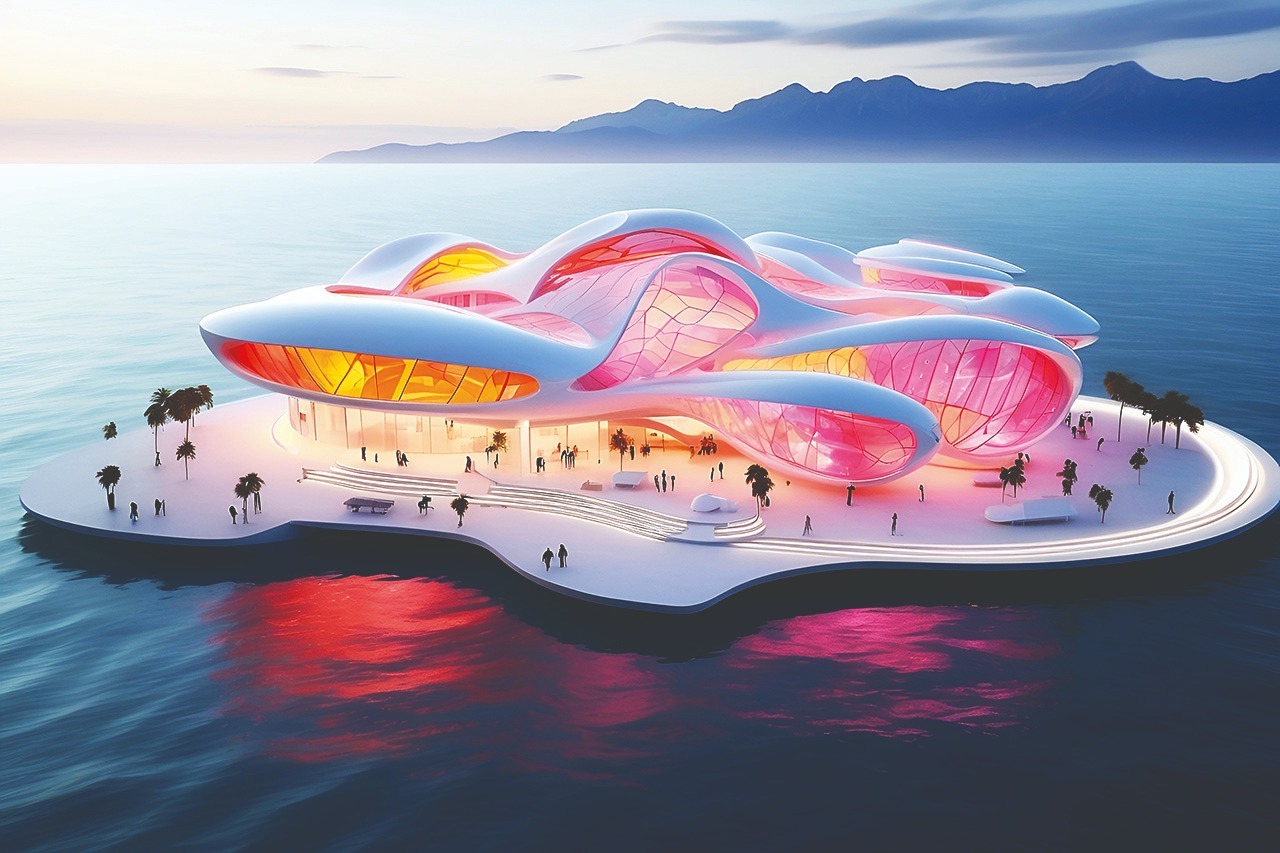
Last year, Luca Curci Architects, an Italian firm, published the “Floating Glass Museum” project on its website. This quixotic museum, designed with the aid of AI, takes the form of a curved white building with fluorescent panes of glass that floats on a swimming-pool-like sea. Inside are rooms filled with large numbers of huge glass spheres. Some of the spheres even seem to float above the ground, in defiance of gravity – which AI had apparently not quite grasped at the time. It is pretty to look at, and yet the very ease with which scenarios like this can be produced, once the limitations of the empirical world are removed, arguably makes them less interesting.
To return to “reality”, the paradox of glass is that on the one hand it is so elusive, but on the other so tactile, heavy and difficult to handle. Glass can be shattered, even on a smartphone, and be transformed instantly from something smooth and self-effacing into something sharp and destructive that also does violence to the image within it. No wonder the breaking of a mirror has traditionally been associated with bad luck.
An example of an evocative aesthetic effect derived from breaking glass occurs in the 2022 film The Glass Onion, in which, in a climactic scene, the collection of clear glass sculptures belonging to a villainous tech entrepreneur is smashed by his guests – as though the sculptures’ entire raison d’être was their destruction.
The brittleness of glass, the risk of chipping or breakage that could annihilate a work’s perfection in an instant, doubtless contributes to its perception as a challenging, even off-putting artistic medium. On the other hand, this same quality can be used as a metaphor to express contemporary concerns. One example is in Stampede, a collection of clear glass animal paws, hot-sculpted by the New York-based artist Deborah Czeresko. The sculptures are carefully modelled on real paws, both live and stuffed, and include a range of species – bat, camel, mole, ostrich, platypus, penguin. With silent eloquence, the fragility of the material, together with its phantom-like transparency, reminds us of the ease with which animal species may be destroyed. Once gone, it would be as impossible to bring them back to life as to reconstitute a shattered glass paw from its fragments – which, since glass is an amorphous solid, will always be irregular and chaotic.
The rich versatility of glass, both as material and as store of imagery, is further exemplified in the work of the American artist Jon Kuhn, who makes sculptures in the form of geometrical solids containing hundreds of facets of glass that refract the light from within like tiny prisms. He does this by a time-consuming process of cutting and polishing segments of optical glass and then laminating them together in a complex structure.
It is a piece by Kuhn, if I am not mistaken, that appears on a table just behind the eminent philosopher and public intellectual Martha Nussbaum, in a photograph taken in 2017 and published alongside an interview in the New York Review of Books in 2021. The positioning creates a connection between the jewel-like interior of the glass and the clarity and sparkle of the sitter’s mind.
As the work of artists like Cigler, Czeresko or Paterson shows, in our new Glass Age, this material can no longer be dismissed as old-fashioned or suitable merely for craft. Instead, it can be an eloquent means of imaginative creation and self-expression.
In a world where our attention is increasingly occupied by images and events behind the glass screen, the material from which that screen is made, with its combination of smoothness and sharpness, liquidity and solidity, depth and surface, can remind us of how dependent we are, despite ourselves, on physical things.
It can thus function as an empirical and metaphorical barrier – the modern equivalent of a looking-glass – between the digital realm and our own. Finally, a key function of art in our image-conscious age is as status symbol and personality extension. In this respect, while some artists may still dismiss it as a medium, glass can surely give bananas, Lego bricks or even paintings a run for their money.
This article is from New Humanist’s Winter 2025 edition. Subscribe now.