What happens when domesticated plants and animals creep back into nature?
Humans began bending wild things to their will at least 15,000 years ago (some evidence suggests these processes probably started earlier). Domestication was a turning point in human evolution. Starting with wolves, we exerted further pressure on animal and plant species honed by millions of years of natural selection – exaggerating desirable qualities and reducing undesirable ones on a much shorter timescale.
Dangerous predators became hunting partners and loyal friends. Flinty seeds and hard fruits were fattened in the forges of our appetites. And our lives became progressively easier as a result. The ability to harness evolution and turn it to our own ends was a major facilitator of civilisation and ultimately our colonisation of most of the planet.
But the organisms we now consider to be domestic were never truly our creations. We have certainly modified them beyond recognition in some cases. The obese pug waddling down the sidewalk bears little resemblance to its wolf ancestors. The plump kernels of a corn cob are nothing like the stingy, hard little knobs produced by its parent plant, teosinte. Given the chance, though, many of these organisms are more than happy to rewild themselves. They are not the static, placid entities we think they are. The genes of domesticated organisms remain compatible with those of their wild progenitors. The DNA in everything from a head of lettuce to a greyhound is primed to escape its human confines.
This rewilding process might seem benign – a return for these species to their older state, before humans started meddling. But the practical effects are more complex. When these domesticated genes make a break for it, they can have serious effects on wild populations, sometimes threatening their survival. These challenges call into question our ideas around what is “natural”, along with our assumptions about change and modification.
Interbreeding on the rise
Domestication was a messy process from the start. Ever since humans began to breed crops and domesticate wild animals, there has been some element of interchange with their ancestor species. After all, some of our domestic species were accidental in the first place, or at least partially; wolves in search of easy scraps were drawn into human encampments; wild cats attracted to rodents feeding on grain became prized as pest-killers. As they slowly integrated into human life, these early domesticates invariably returned to the wild or bred with newly acclimated wild specimens. Early dogs almost certainly bred with human-curious wolves, and freshly minted lapcats snuck off behind the grain silos for sneaky trysts with dirty-hot wild toms.
It was a similar story with plant life: crops selected for greater production (wheat and barley were two of the first) were often in proximity to their wild relatives and exchanged genes. This entry of one genetically defined population into another is called “introgression”.
However, as human civilisation has expanded, opportunities for this kind of interbreeding have increased exponentially. Large areas of the Earth are now covered by crops and livestock. Pollen is carried by wind or by insects and other creatures outside of the cultivation area, to fertilise any compatible wild plants. Of the world’s 13 most important food crops, 12 are known to hybridise with related species in the wild. Domestic animals often range freely or escape captivity entirely.
The effects of rewilding may be subtle, such as changes in size or colour or reproduction time. Or they may be massive, in some cases resulting in what is called “genetic swamping” – fundamentally altering the wild population and eliminating the genetic diversity that allows the species to adapt to changing conditions. This process is exacerbated by the fact that species are often bred by humans to be stronger and more resilient than their wild counterparts. But these advantages are general, whereas wild species may have adapted to thrive in particular environmental conditions.
Domestication can also go wrong. It can lead to the accumulation of hidden alternative forms of genes that result in problems such as greater disease susceptibility, which then enter wild populations too. In some cases, introgression can result in failed breeding events (incomplete fertilisation or the production of sterile hybrids). Think of the horse breeding with the donkey and producing the sterile mule.
Hybrid swarms of rice
It’s clear that domestic introgression affects a wide range of plants and animals. But research on the subject is patchy. In some cases, we simply do not yet know what the effects will be. “This is a somewhat avant-garde aspect of linking ecology and genetics,” says Joshua Daskin, chief scientist of biodiversity data organisation NatureServe. “There are not enough ecologists and geneticists, and there’s not enough funding to understand the depth of this threat.”
Most current research concerns the problem of hybrid plants that return to “invade” farmers’ fields, in the form of aggressive weeds. These wild-domestic hybrids can be stronger and more pesticide-resistant and can also evade detection due to their resemblance to the crop. Some of the world’s worst weeds are the result of domestic genes entering wild populations. For example, Johnson grass is a major pest of corn, soybeans and domesticated sorghum, after becoming more vigorous and resistant to herbicides as a result of breeding with its domestic relative. These supercharged weeds also produce larger, more viable seed crops. Genes originally sculpted to serve the needs of farmers have turned against them.
Another remarkable example is that of Asian wild rice. The entire global population now appears to consist of a hybrid swarm derived from domestic rice genes that made their way into the wild through wind and insect pollination. Unfortunately, domestic genes may have conferred some disadvantageous qualities, like reduced seed shattering. This is helpful for a crop meant to be consumed by humans, but wild seeds shatter as a means of resistance to insect damage.
We don’t yet know what the long-term effects of introgression may be. The picture is not clear cut, and while it should be monitored, we should also remember this process has been going on for millennia. For example, nearly all populations of wild rice have some level of domestic ancestry, to such an extent that tracing the exact origins of rice has thus far proven impossible. So clearly these mutations have not been fatal.
What we don’t know
Genetic rewilding in animals is even less well studied, with perhaps the exception of salmon. Though the domestication of species such as Atlantic salmon only began in the 1970s, alteration to their basic physiology and habits has been rapid. As with most domestic species, farmed salmon appear less attentive to predator risk, and mature at an accelerated rate. Large salmon farming operations in the Americas, Europe and other regions have led to the escape of farmed varieties from ocean pens into the wild. Their precocious maturity appears to coincide with changes in their migration patterns. Domestic salmon return to the sea at younger ages and may also return to freshwater to breed at later dates.
When salmon escapees breed with local populations, these traits become more common and alter the long-established life histories of the species. This can pose a larger ecological problem, as salmon runs are major events, upon which entire species and ecosystems are dependent (think of grizzly and black bears who rely on salmon to fatten up before their winter hibernation). Even minor alterations may result in significant consequences.
When domesticated animals re-enter the wild, it’s usually because they have escaped captivity. But in some cases, domesticated animals are freed by animal rights activists. In the last few decades, well-intended releases of domestic American mink – bred for their fur, which is highly prized for coats and other clothing – have had damaging effects on native populations of both wild American and European mink. A 2009 Canadian study found that 64 per cent of mink in Southern Ontario were either released mink or hybrids between domestic and wild mink. Because domestic mink have been selected for both exotic colouration and more moderate temperament, survival instincts may be reduced, as well as general fitness and disease resistance. If they breed with wild mink, those vulnerabilities may be passed to their offspring.
In cases where American mink have escaped in Europe, their mating with European mink has resulted in reproductive failures. While American mink are stable within their native range, European mink are critically endangered.
A 2022 study on cross-breeding in New York City also raised concern. Researchers discovered a population of coyotes in Queens that had significant levels of dog DNA – and looked more like dogs too. The researchers also detected genetic elements associated with the domesticated dog trait of hypersociality, leading to concern that they might be less avoidant of humans than pure wild coyotes. Daskin says there is evidence of more of these hybrids across the eastern US. “There’s not a lot of work yet on what that functionally means for their ability to live as wild coyotes,” he says.
This was not an anomalous event – dogs, coyotes and wolves form a genetic complex that has been subject to intensely controversial research. There is debate, for example, as to whether the black coat colour observed in some wolf populations is the result of breeding with dogs or is an ancestral genetic variation. This coat colour may be a beneficial adaptation for wolves in northern, forested environments, but also appears in other populations where it might not be effective camouflage.
One wide-ranging study from 2020 found that Eurasian wolves had nearly 3 per cent dog ancestry, whereas free-ranging dogs in the same region showed evidence of less than 1 per cent wolf ancestry. While the wolves appeared to gain little benefit from having bred with dogs, the dogs seemed to have inherited wolf genes encoding greater caution and self-sufficiency.
The case of the rare Scottish wildcat
The problem becomes more existential when the threat of extinction rears its head. Should we care if the genes of one species are altered by those of another, to the extent that the original is wiped off the map? Mike Daniels is an ecologist with the Centre for Mountain Studies at the University of the Highlands and Islands. He says that this dilemma tends to lead on to more questions. “You have a natural process: how do species form, and what is a species? Then you’ve got the even bigger question: is man part of nature?”
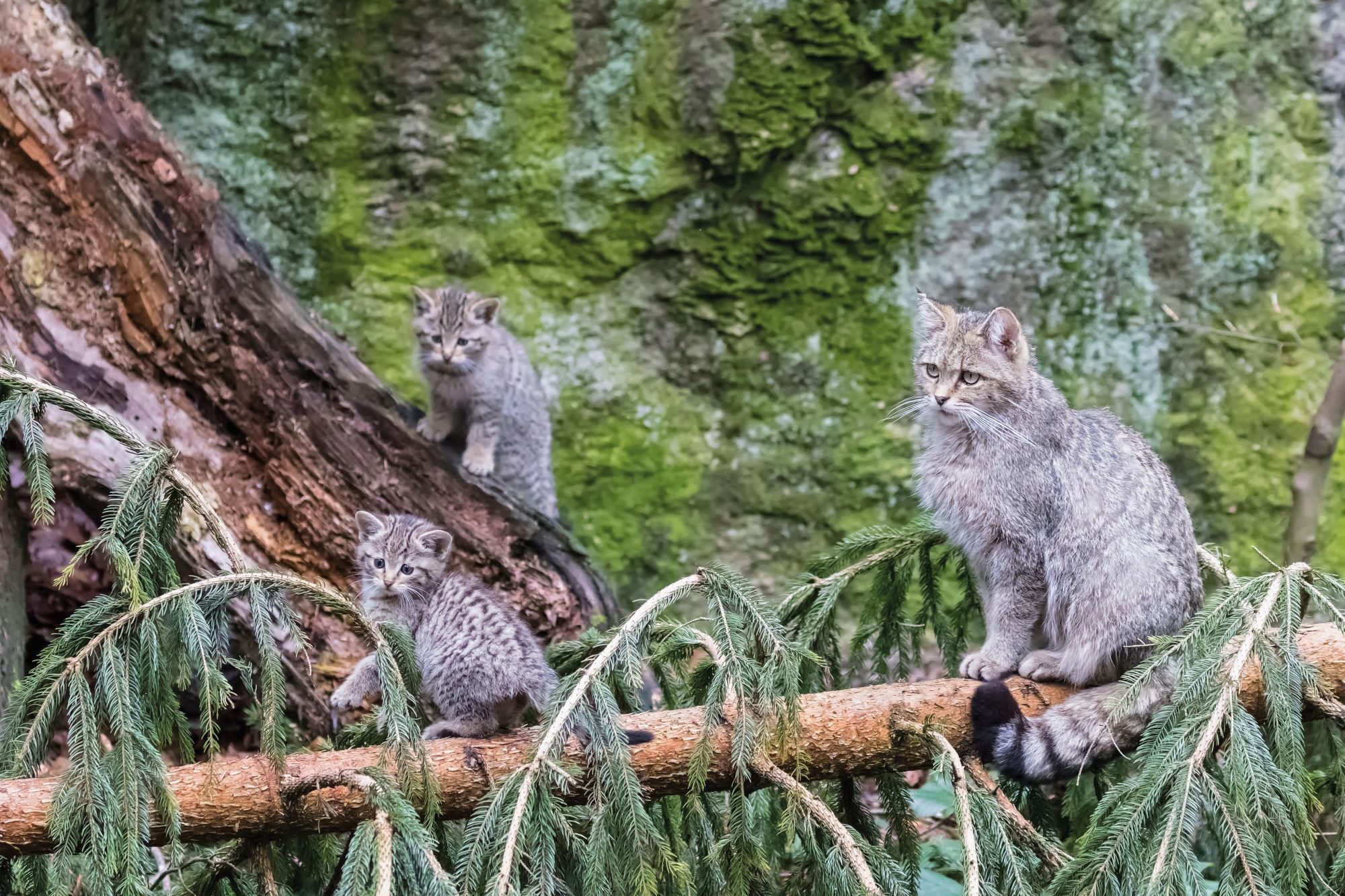
This might seem like abstract reflection, but the problem is brought into stark relief when domestic species swamp wild species. This is more likely to occur when wild populations are scant and free-ranging domestic populations are high. Such has been the case with the rare Scottish wildcat, a subpopulation of the European wildcat, now restricted to the Scottish Highlands, and thought to have been isolated from other European wildcats in Great Britain for some 9,000 years. Except now, all wild specimens are believed to carry domestic cat DNA. They are thus functionally extinct in the wild.
The Scottish wildcat is not totally extinct, however, as we humans intervened. From the mid-1950s, captive populations were established in zoos, thus protecting them from domestic cats, whose populations were spreading across the country. Modern conservationists then set up breeding programmes, pairing the purest specimens. In recent years, efforts have been made to release them back into nature, in the hope they would re-establish a true wild population. In 2023, 19 of the offspring of these wildcats were released in Cairngorms National Park in northeastern Scotland. Another nine were released the following year, which also saw the birth of the first wild litter. Further kittens were produced in 2025.
But these “pure” wildcats are constantly under threat. Daniels uses the analogy of water in a bathtub to explain. “You’ve got this bathtub full of cats,” he says. “You’ve got a cold tap and a hot tap and a [drain hole]. The hot tap is pure wild cats. The cold tap is domestic cats coming in. And then the [drain hole] is cats getting killed illegally. You put a plug [in the hole] – stop cats being killed – and you want to turn the tap off from the domestic cats.” The latter apparently has not yet happened. “They found a litter of kittens that suggests that the population they’ve reintroduced have started to introgress with domestic cats, so they’re kind of back to square one,” he says.
Abstract ideas of “purity”
Should it matter whether “pure” Scottish wildcats exist or not? These attempts at reverse engineering raise questions that have bedevilled conservation movements for generations. Are these efforts truly in the interests of a larger ecosystem? Or are they simply aesthetic or sentimental, based on a romantic notion of the superiority of the original species?
The act of reintroducing an endangered or functionally extinct species to its native environment appeals to basic human ideas around freedom and natural goodness. But does it matter if that animal can trace 5 per cent or 10 per cent or 50 per cent of its ancestry to another animal that has been touched by humanity? Outside of the scientific community, most people wouldn’t know, or care too much about that. “Normally you’re releasing Californian condors, or you’re releasing wolves. You’re not releasing something that’s a particular genetic ‘thing’,” Daniels says. The case of the Scottish wildcats is, for now, an unusual exception.
But as introgression progresses, we may want to pay more attention to genetics – and not just due to abstract ideas around “purity”. If a salmon migrates at a different time or is less resistant to predators or disease due to genes inherited from domestic escapees, that is clearly detrimental. If a crop plant is responsible for the emergence of a damaging weed because it has passed its superpowers on to wild plants, there are clear economic concerns. While the effects of interbreeding between dogs, wolves and coyotes may be less concerning, it’s still crucial that we bear witness to yet another effect of our activities on wild things.
There is a need for more research on the introgression of domestic organisms into the wild. For now, work in this area remains halting and inconsistent. Further investigation will in most cases be propelled by dramatic instances that are discovered well after they have caused damage. Occasional anomalous events will inevitably be discovered – a shockingly patterned wild animal or unusual flower betraying the adventurous sexual habits of its parents. But most of the pairings will remain beautifully obscure, taking place at the permeable boundary between wildness and domesticity, and reminding us that the line between is largely an illusion.
This article is from our Spring 2026 edition. Subscribe now.