Even in prison, Belarusian dissident women haven’t given up. The future of the country may still be in their hands
Darya Afanasyeva remembers sitting at a sewing machine, in the factory of a penal colony in south-eastern Belarus. In front of her was a round cushion, which she had studded with three pins: two white and one red. The three dots of colour were tiny, but looking at them filled her with joy. “To me, it was a form of inner protest,” she says.
During the summer of 2020, Belarus was flooded with red-and-white flags, symbolising people’s opposition to President Alexander Lukashenko. Hundreds of thousands of peaceful protestors took to the streets following a disputed election that brought the authoritarian strongman and close ally of Russia’s President Putin to office for the sixth time, making him the longest serving leader in Europe. Afanasyeva was jailed for two years for taking part.
Today, she lives in exile, and wants to tell her story, and the story of the many women imprisoned in Belarus for resisting the regime. Hundreds of dissidents were jailed after the mass protests – including politicians, journalists, activists and students. And while US-led negotiations secured the release of more than 100 political prisoners in December, people continue to be arrested for as little as liking social media posts critical of the president or supporting the opposition candidate Sviatlana Tsikhanouskaya. Of these, many are sent to penal colonies – a legacy of the Soviet-era gulags. But despite the government’s attempts to crush their spirits, the women who have emerged from these colonies tell stories of defiance and solidarity.
Afanasyeva told me about her life in the Gomel colony, one of two that hold women prisoners. She said they were put to work doing strenuous manual labour and only allowed to take a short shower once a week. One of the guards “enjoyed punishing” them by not even permitting this chance to clean themselves. “She was a young woman, about 25 years old,” Afanasyeva said. “I wanted to say to her, ‘Damn it, imagine doing this yourself: spend the whole day working at the sewing factory; then lift heavy sacks filled with metal off a truck; then sweep the [colony] streets; and then finally go to the cafeteria, where your clothes will soak up the smells – knowing you can’t change them. And after all that, you can’t take a shower!’”
But Afanasyeva also told me how she and other women were determined to resist, and to support each other wherever they could. They came up with handy inventions – for example, they would cut up a plastic bottle and use the bottom section to wash their body parts, one by one.
The women campaigning for president
Along with many of her fellow political prisoners, Afanasyeva wants Belarus to be rid of Lukashenko, so that the country can move on. He is the country’s first and only president, having held the office since 1994, following independence from the Soviet Union. In the 2020 election, he claimed to have secured over 80 per cent of the vote, but a lack of scrutiny, with no observers present, led to widespread allegations of vote-rigging.
Opposition candidate Sviatlana Tsikhanouskaya claimed that she had actually won the election. Tsikhanouskaya had launched a presidential campaign alongside two other women – Maria Kolesnikova and Veronika Tsepkalo – after their husbands and partners were imprisoned or exiled due to their own intention to run. In a country where politics has tended to be male-dominated, thousands of women came out onto the streets, calling for change and opposing the authoritarian and patriarchal culture.
When the crackdown began, Tsikhanouskaya and Tsepkalo fled the country. Kolesnikova was jailed – and only released as part of the December 2025 deal, after more than five years in prison – while Tsikhanouskaya was sentenced to 15 years in prison in absentia. Many other women who participated in the protests and women’s marches are also now in exile. Even after the December release, 175 female political prisoners remain in jail, according to the Belarus Women’s Foundation.
Journalist Ksenia Lutskina was released in 2024, after more than three and a half years of imprisonment on charges of “destabilisation of the political, social, economic and informational situation” in Belarus. When I talked to her, she also recalled how united political detainees were. “We lived as a community. The conditions were very hard, but solidarity made up for that,” she said. “If food was sent to one of us [by family and friends], we shared it. And when a new political prisoner was brought in, we knew what we needed to do, right away: give her clothes, hygiene items and food; make her tea or coffee; and if she smokes, give her cigarettes.”
Acts of solidarity
Viktoria Zhukouskaya – a Belarusian researcher with a PhD in management and sociology, who lives in exile – has interviewed many former political prisoners. She confirms the stories of solidarity. Several women have told Zhukouskaya that prison authorities would throw homeless people into the cell with them, “using the bodies of other women” to increase their discomfort. They would have to endure “the smell, the lice, and so on, in a cell designated for four people – but where eight to 12 were held.” But the political prisoners said they rejected this tactic of division. From the moment a homeless woman entered their prison cell, they would start cleaning her up: “One of them took off her clothes, another washed her, while a third extracted the lice.”
However, there was a price to pay for these acts of solidarity. In the penal colonies, they could be harshly punished.
“The [prison] system is aimed at dividing people, and not only political prisoners,” said Alana Gebremariam, who spent two years behind bars for student activism. Sharing anything – even toilet paper – could lead to punishment, such as being held in an isolation cell with no access to letters from the outside world. “You’re kept in this small, damp, dark cell, where all you can do is keep walking around to avoid freezing [to death] if it’s winter and there is no heating,” said Gebremariam.
The women were also subjected to high levels of surveillance. Gebremariam told me that, in the Gomel penal colony, authorities set up a “network of informers” among inmates. As a result, she said, people were “very suspicious of one another” and “scared of telling each other things”. Afanasyeva added that political prisoners were under particularly high levels of scrutiny, and were more likely to be labelled as “maliciously breaking the rules” – an official term that could often lead to punishment. They were made to wear yellow tags on their uniforms, which set them apart from non-political prisoners, who had white tags. Afanasyeva was once denied a visit from a loved one because she had shared “a small piece of ice cream” with another inmate.
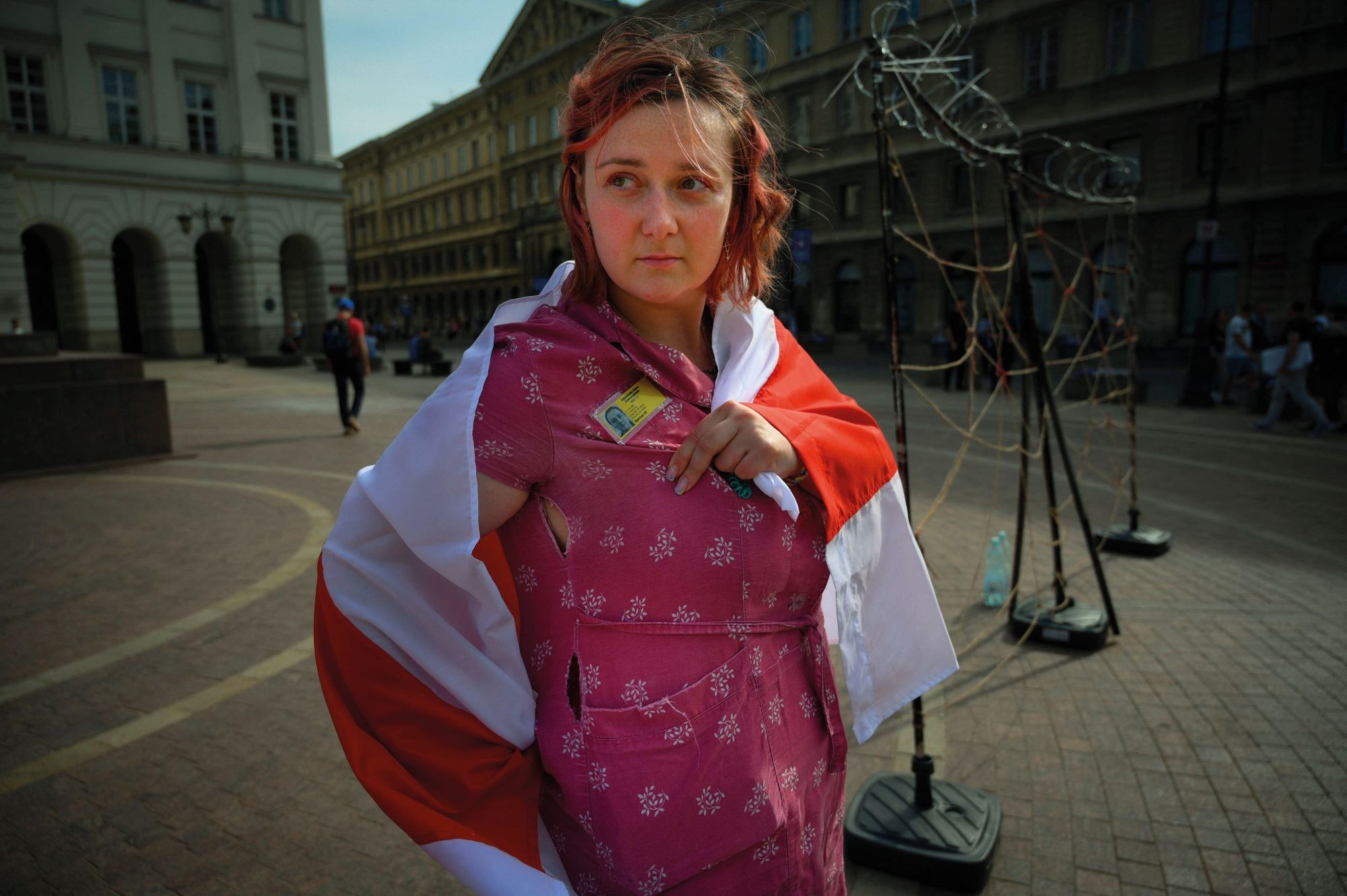
Yet these women still found ways to connect with each other. After work at the factory, many formed “interest clubs”, Afanasyeva said. “We would tell [other women inmates] about modern art, or about our hobbies, such as hiking in the mountains, and so on. As for me, I spoke about feminism and femicides.” For example, she explained to other prisoners what domestic violence is – and that being beaten by one’s husband or partner “is not the norm”. Some of the women had been jailed for murdering their husbands or partners, she pointed out, when many of them were acting in self-defence.
‘Defiance drove the authorities mad’
Gebremariam added that political prisoners tend to have a higher level of formal education and can pass on their knowledge and skills. She said that they were able to help other inmates understand the political and social situation in Belarus, as well as supporting them practically with actions such as appealing their convictions. She said it was important to educate these women about the outside world. They might have spent 10 to 20 years behind bars. For some, “the last thing they saw was a push-button phone,” so they needed to catch up with developments in Belarus and internationally, including being told about the 2020 protests and the women’s marches.
Gebremariam said you could always spot a fellow political prisoner, because they refused to be victims. “They were recognisable by their smile, their straight posture and their appearance, including hair and makeup; and by the way they carried themselves as they walked through the [colony] streets, with their heads up high,” she said. Zhukouskaya, the researcher, noted the importance of maintaining this attitude. “In a situation of absolute control, domination and violence, where people are reduced to the status of animals, the very fact of preserving one’s dignity is an act of resistance,” she said.
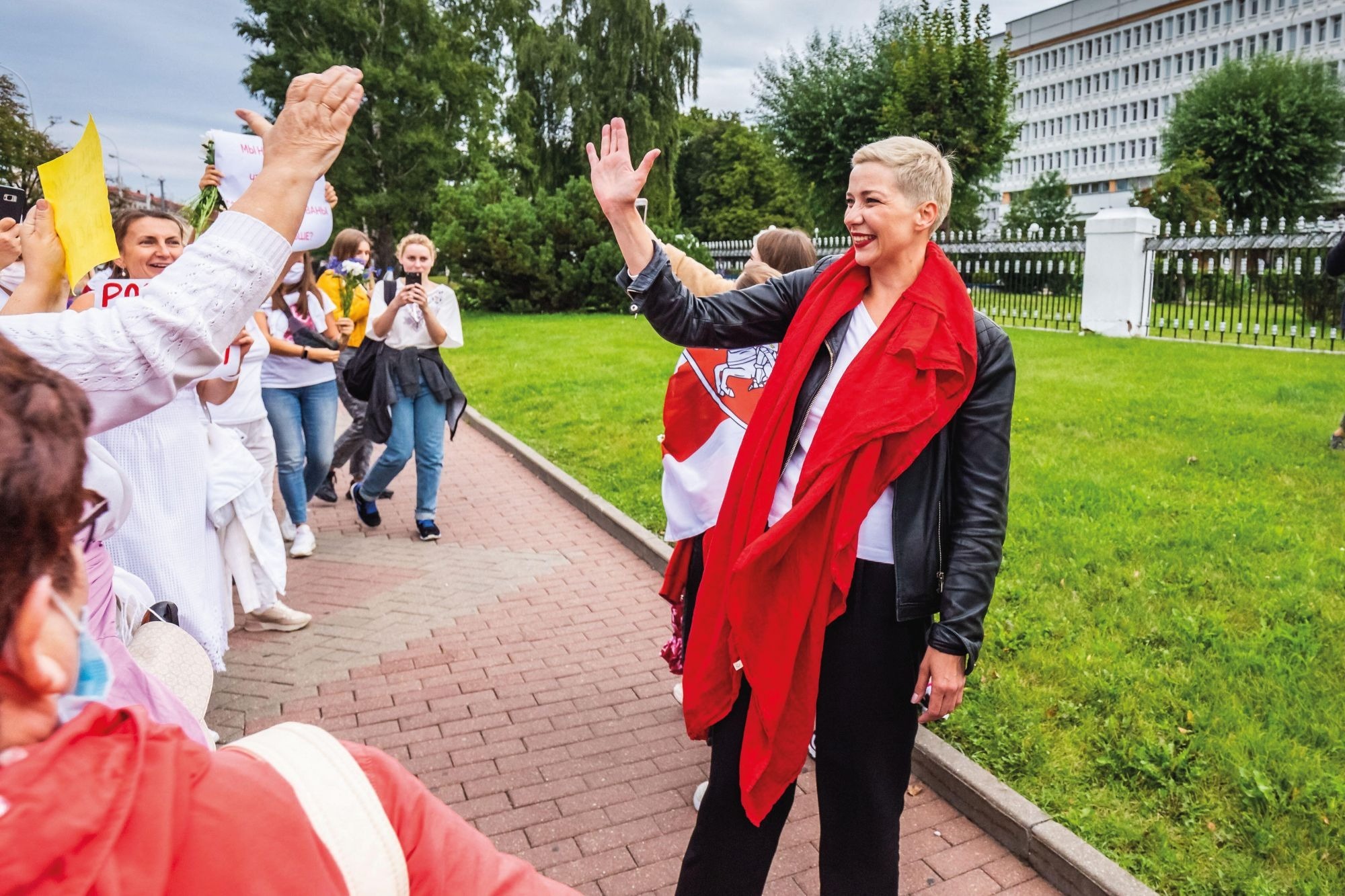
Red lipstick became a symbol for supporters of Maria Kolesnikova, mimicking the opposition figure’s signature style. “This [kind of defiance] drove the authorities mad, because they wanted to see prisoners broken and humiliated. Instead, they saw beautiful women in front of them,” said Zhukouskaya. The prisoners were later forbidden from wearing red lipstick.
The political prisoners would also try to lift the morale of their fellow inmates by organising their morning routine with an emphasis on helping each other out – such as making coffee for everyone instead of just themselves – and finding opportunities for creativity and generosity. “We drew together, we made things with our hands; we gave gifts to each other for birthdays, and New Year’s Eve,” Gebremariam said. They hand-made gifts from materials that were permitted, such as paper for origami. “We gave one of the girls a heart made from old red fabric, which we filled with feathers from a pillow.”
Secret acts of protest
There was also something else that prison guards couldn’t prevent women from sharing with one another: laughter. Ksenia Lutskina recalled how they would find humour even in the barbaric prison conditions. One of the cells was comically small – maybe nine square metres for the beds, toilet and the table where they sat to eat their food. “And so, we used to joke that while sitting on the toilet, we could put our feet on the table!”
Gebremariam told me that some of the guards couldn’t help but feel moved by the dignity and integrity of the political prisoners. She remembers one who worked in the detention centre where they were sent before trial. He was “a very simple man, who spent 15 years working in the [prison] system”. At first, he looked at political prisoners “suspiciously”, she recalls, but “little by little”, he became “intrigued” by them. “He would come near our cell and ask us what we were doing and how we were feeling.”
During their trial in court, she and other defendants had to stand next to a wall with their hands tied behind their backs “for an hour and a half, or two hours”. But the guard must have decided that this was not right, because he let them have breaks – taking them to the restroom or to have a smoke.
“When the trial was over, he said he was very tired of working in the system,” Gebremariam said. “He said its cruelty and absence of humanity was killing him, and that he wanted to live a simple life and didn’t care what became of him – whether he worked as a taxi driver, or went back home to help his father in the countryside.” I asked her what became of the man. “As far as I know, he did quit.”
But that was more of an exception, rather than the rule, she emphasised. Some guards, on the contrary, “wanted to hurt people, mentally and physically, in very perverse and sadistic ways”. Afanasyeva agreed – many of them were “overly proactive” in punishing prisoners. That’s why she often chose secret, small acts of protest, like studding the sewing cushion with red and white pins. Of the guards she said, “there is no sense in trying to prove something to them.”
The female-led government-in-exile
But with fellow prisoners it was different. She told me about making bouquets of three autumn leaves, to resemble the red-and-white opposition flag. Another form of hidden protest was doing work poorly at the sewing factory, which for her wasn’t hard to achieve. “It happened naturally because I’m not very skilled at sewing!” she laughed.
She was skilled at decorating, though. She told me how, in the colony, they only had black clothes, but they were permitted to mark these items with their names, in bleach, so that they wouldn’t get stolen. Along with some other political detainees, Afanasyeva added glittery paint to the bleach and marked one of her T-shirts with a “GRL PWR” inscription. She hid the T-shirt under other clothes, but secretly wearing it made her feel powerful.
As we talked, she lifted up the black T-shirt and showed me the words “GRL PWR” written on the back. She was able to smuggle it out of the penal colony. Now it reminds her of the years spent in imprisonment, but also of the bonds she formed with the other women, some of whom she still sees now that they’ve been released. “Many of them have become my close friends,” she tells me. “Going to the cinema, sharing a pizza, or even having a chat with someone who has been through a similar experience is easier. That’s why we stick together.”
Today, Lukashenko has regained total political control of Belarus, having dismantled the opposition and clamped down on civil society. And although he has released dozens of political prisoners under US pressure, many women dissidents remain in captivity. Inside Belarus, no one talks in public about the political prisoners. But their cause is considered a top priority by Belarusian civil society, which continues to organise abroad.
The 2020 protests showed what civil society might be able to acheive, as well as women’s ability to take the lead. Within hours of her release in December, Maria Kolesnikova was filmed wearing her signature red lipstick and calling for the release of those who remain in prison. Tsikhanouskaya has formed a government-in-exile, which is preparing democratic reforms that, according to Zhukouskaya, will be implemented as soon as “a window of opportunity” opens for political changes.
When that happens, she hopes that civil society in Belarus will come together to build a new future. Perhaps it will be led by women – once they return from exile and are released from jail. Lukashenko has put much effort into cracking down on them. But listening to the women I spoke to gave me the feeling that the state hasn’t yet managed to crush this source of resilience and opposition.
This article is from New Humanist’s Spring 2026 edition. Subscribe now.