On a heavily restricted tour, I caught glimpses of an awe-inspiring country
Last summer, I finally visited Libya. Having worked as a freelance journalist throughout African countries for half a decade, I had wanted to visit Libya for years – not for the beaches or cuisine, but because I have long been drawn to the rough intrigues of North African politics, and the stories surrounding Muammar Gaddafi and his legacy. I also wanted to see the Roman, Phoenician and Greek relics that stand along the Libyan coastline, cut off from the global tourism industry.
What I discovered was a mesmerisingly beautiful but elusive country. To some degree, I knew what I was getting myself into. You can’t just go on holiday to Libya. I had to obtain a letter of invitation, two separate visas and a pre-paid personal security attachment for each side of the country, which is split between rival factions. I also had to solemnly swear to avoid any kind of journalism at any time, or risk being deported from the country.
This produced a level of paranoia I had not felt in any of the previous 37 countries I’ve visited in my long career. I doubt the government would approve of the notes that ended up feeding this piece, but I wanted to try to understand a country that holds such a peculiar place in the western imagination.
For Europeans, Libya is the closest edge of the African continent: a borderland imagined as both exotic and dangerous, a gateway through which migrants might surge north, or oil might flow west. For Americans, it is often thought of less as a nation of people than as a geopolitical riddle – from Gaddafi’s flamboyant dictatorship and the 1986 US bombing of Tripoli to the Benghazi consulate attack by a group aligned with Al-Qaeda, on 11 September 2012. Libya is a canvas onto which western powers project their fears, ambitions and fantasies.
When I touched down in Tripoli at the apex of summer, I had only a cursory knowledge of the country. I knew that Libya today is less a unified nation than a fractured state suspended between competing factions. It sits between Tunisia and Egypt on the Mediterranean’s southern rim, where for most of the 20th century it traded oil for stability. Then came the bloody fall of Muammar Gaddafi in 2011, following the Libyan civil war and Nato’s intervention, which did not, as was piously promised by intervening leaders, deliver Libya into democracy. Libya has since splintered into rival administrations – the internationally recognised government in Tripoli to the west, and the eastern stronghold under General Khalifa Haftar – each backed by a rotating cast of foreign patrons. Hence my two security details.
I was taken to the sanitised centre of the capital, Tripoli, and then to the breathtaking Graeco-Roman ruins scattered along the coast. My tour guides and I also visited the villages of Berber tribes that existed in North Africa long before its Arab conquest. But this was Libya as stage décor: the approved exhibits of a country that seems to fear its own backstage.
In Martyr’s Square, in the centre of the capital, I was delivered to the rows of gigantic Libyan flags towering over children devouring cotton candy, and families meandering between jewelry shops and cafés. My first guide, an older man with a scholar’s passion for archaeology, became a little less stiff when I joined him in his chain-smoking habit. My police escort soon lit up, too. As we drove through Tripoli, the contrasts revealed themselves: glittering hotels, largely empty, standing beside eroded apartment blocks perforated by bullet holes. Whole districts remain scarred from the 2011 conflict, when the uprising against Gaddafi turned the city into a sniper’s playground. Fifteen years later, Tripoli has not healed. I pointed to one scarred façade. “Oh, just some fighting between the militias,” my guide muttered, eager to steer the conversation toward anything else. “You know we have a very nice fish market here!”
The escort, slouched in the backseat, alternated between his phone and sleep. But he was there at every moment. Whenever I needed a light. When I had to cross the street. He even came along on a bathroom stop on the highway. Once, I had a late-night craving for a shawarma from a small bistro no more than a block from the hotel. He came with me, and we ate our spiced meat together.
I had entertained the faint hope that after each neatly choreographed stop, the three of us might slip the leash of our schedule and wander into the neighbourhoods where people actually lived, or the outskirts of the city. My requests were met with polite but firm refusal. I soon found that every step on my itinerary had to be pre-cleared, and that I would be shadowed by my guards – equal parts friendly and suspicious – at every turn.
But I could sense another Libya, beyond the curated facades, where the country’s contradictions thrive quietly. It is a country of tension and inequality. Oil wealth, which might have been a unifying resource for all Libyans, has today become a bargaining chip between militias, bureaucrats and opportunists, feeding a political economy that thrives on corruption and opacity.
And then there is religion. Libya shares some characteristics with other strict Islamic countries: the absence of alcohol, women covering up, commerce shutting on Fridays, and the constant use of religious verbiage: Inshallah (“God willing”), Alhamdulillah (“praise be to God”) or Bismillah, which is said to announce the start of any important action. To ingratiate myself I started to say the latter before each meal, as locals did, to the apparent admiration of my guide and police escort.
But Libya has its own particular brand of Islam. It’s overwhelmingly Sunni but historically rooted in Sufi traditions, particularly the Senussi movement – a puritan yet mystical brotherhood that blended tribal unity with moral restraint. This tradition once bound Libya’s deserts and tribes under a shared faith and even produced the country’s only monarch, King Idris.
Today, though religious freedom is nominally guaranteed, straying from orthodox Sunni Islam can lead to intimidation or persecution, especially in areas controlled by conservative militias. Depending on where you are in the country, the law is uneven and often dictated by local power brokers rather than any real constitution.
I got used to hearing the call for prayer, rising from minarets five times a today and broadcast across radio stations. While I didn’t see the morality police in action, I knew that in November 2024, the Libyan Interior Minister had reinstated this force, which patrols the public and enforces rules around “modest” clothing, and the requirement for women to be accompanied by male guardians when in public.
Men moved through the streets in a disciplined palette of black, grey, brown and sand-coloured thawbs and kanduras, traditional long robes that blurred each individual into a uniform silhouette. Near the restaurants and cafés in Tripoli, I spotted young Libyans wearing western clothes, or designer shirts and jeans, but nothing loud or flashy. I didn’t see many women, except for the occasional matriarch tucked away in the back corner of a restaurant with her family, making sure the children ate.
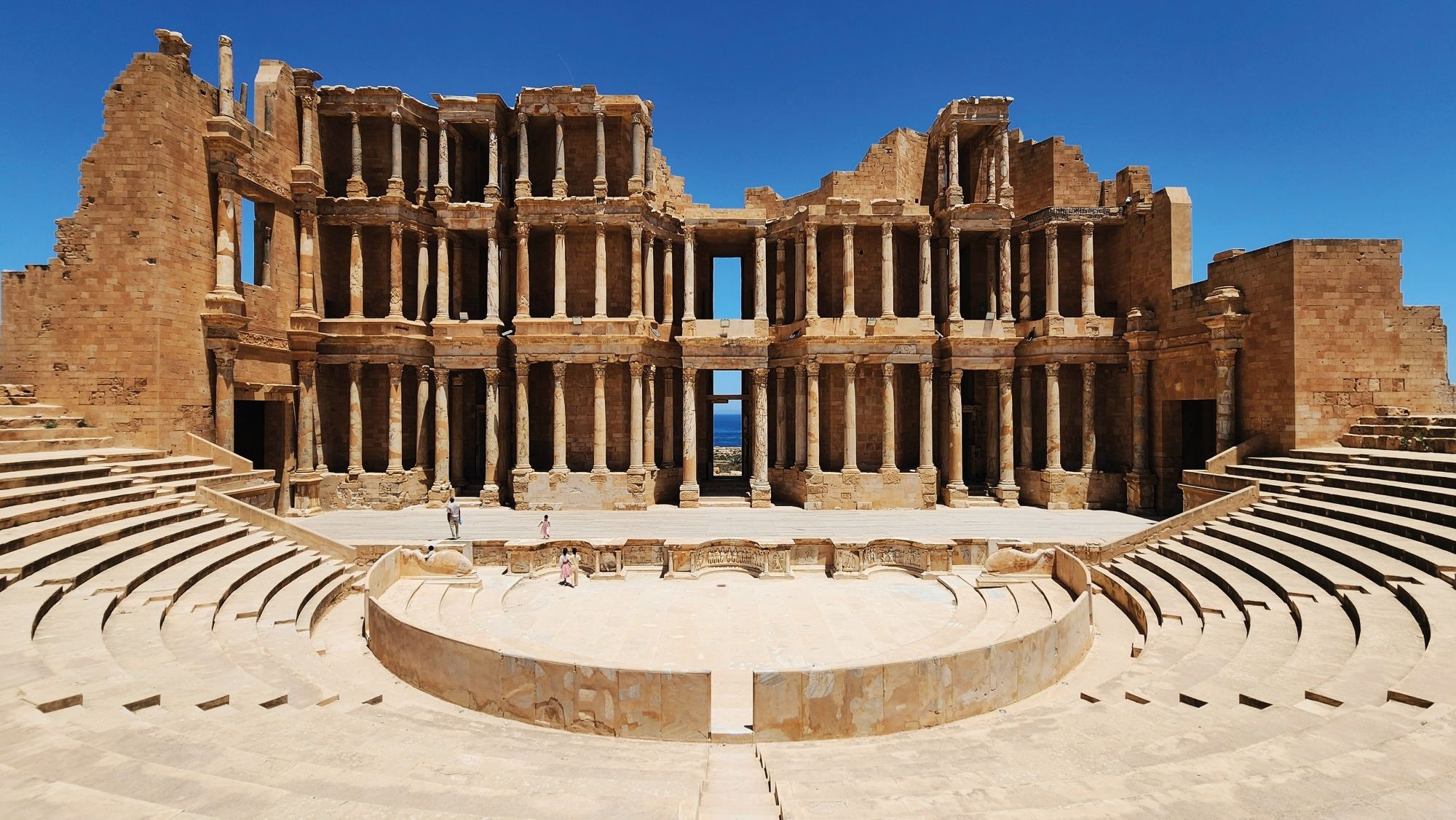
Yet even through the narrow window given to me, the country’s beauty shone through – the marble and ruins gleamed with a serenity that made me gasp aloud. The Arch of Marcus Aurelius in the Old City of Tripoli, erected to honour the Roman Emperor and his co-emperor Lucius Verus after their victories over the Parthians, is an extraordinary relic that has survived through centuries of conquest and urban transformation. It endures not because anyone cherished it, but because no one quite got around to tearing it down.
At the ancient coastal ruin of Apollonia, I saw the remains of a once-proud Greek port that outlived its makers and their gods, its walls pitted from grenade fire. My guide, my escort and I were the only people there. It was eerie, but beautiful. Archeological sites in Italy or Greece are often surrounded by snack shops, trinket sellers and tourist traps. In Libya there is nothing but the wind, the cry of birds and the faint whisper of the Mediterranean.
It’s a perverse irony that the post-conflict zone offers a form of tourism impossible elsewhere. Standing there, I could imagine what the ancients themselves might have heard, as if time had folded back on itself. Roman amphitheatres, detailed mosaics, coastlines that would be sought-after destinations elsewhere, all languish in silence.
Overall, my Libyan tour offered me as much valuable tourism as it did state theatre. The restrictions I went through as a tourist are a part of a larger policy of restricting free speech and the press, which includes preventing Libyans, as well as foreign journalists, from covering the challenges facing the country. One of these is the presence of migrants from Sub-Saharan Africa, who risk everything to cross Libya’s porous southern borders in the hope of reaching Europe, usually via Greece or Italy. The continual flow of these desperate people is a rebuke to the idea of Libya as a sealed and orderly state.
I was carried through a curated experience, permitted to see the ruins of antiquity but not the ruins of the present. Yet in the very act of concealment, Libya tells on itself. It reveals a nation desperate to project solidity, but in doing so shows only its divisions.
This article is from New Humanist’s Spring 2026 edition. Subscribe now.