How the jumbled-up skeletons of ancient kings and queens forced scientists and clerics to work together
How many centuries must pass for human remains to be widely considered historical objects rather than sacred remnants of personhood? And what happens with historically important bones when the doctrines of religion conflict with the demands of preserving history?
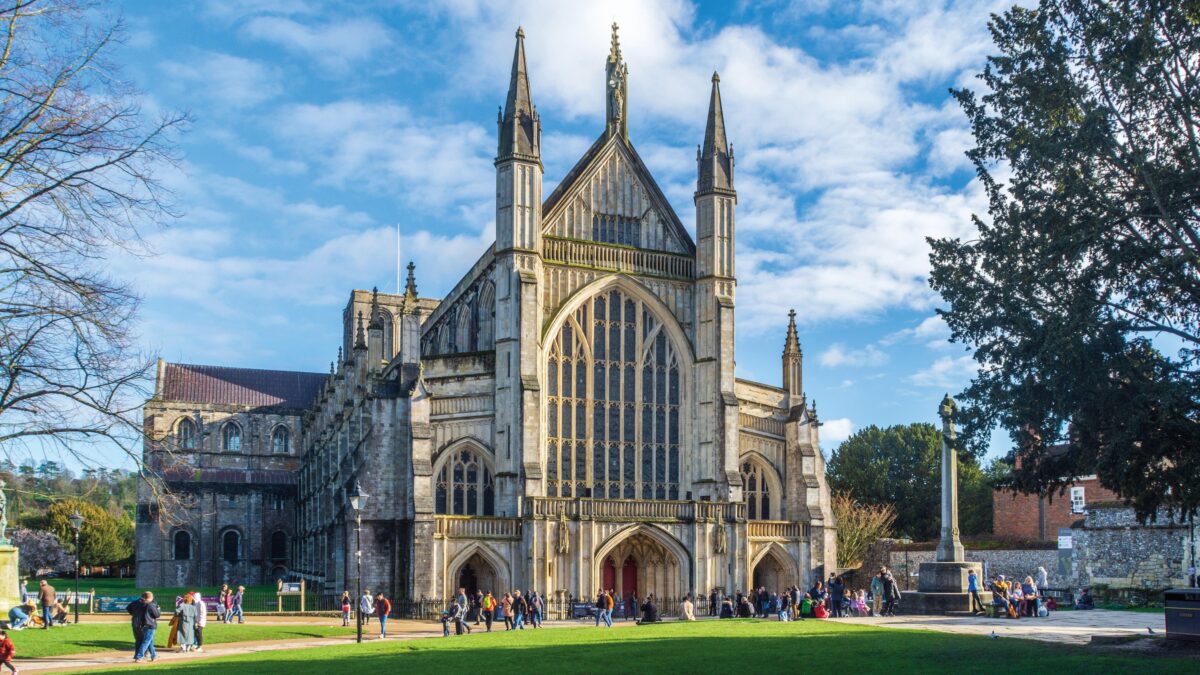
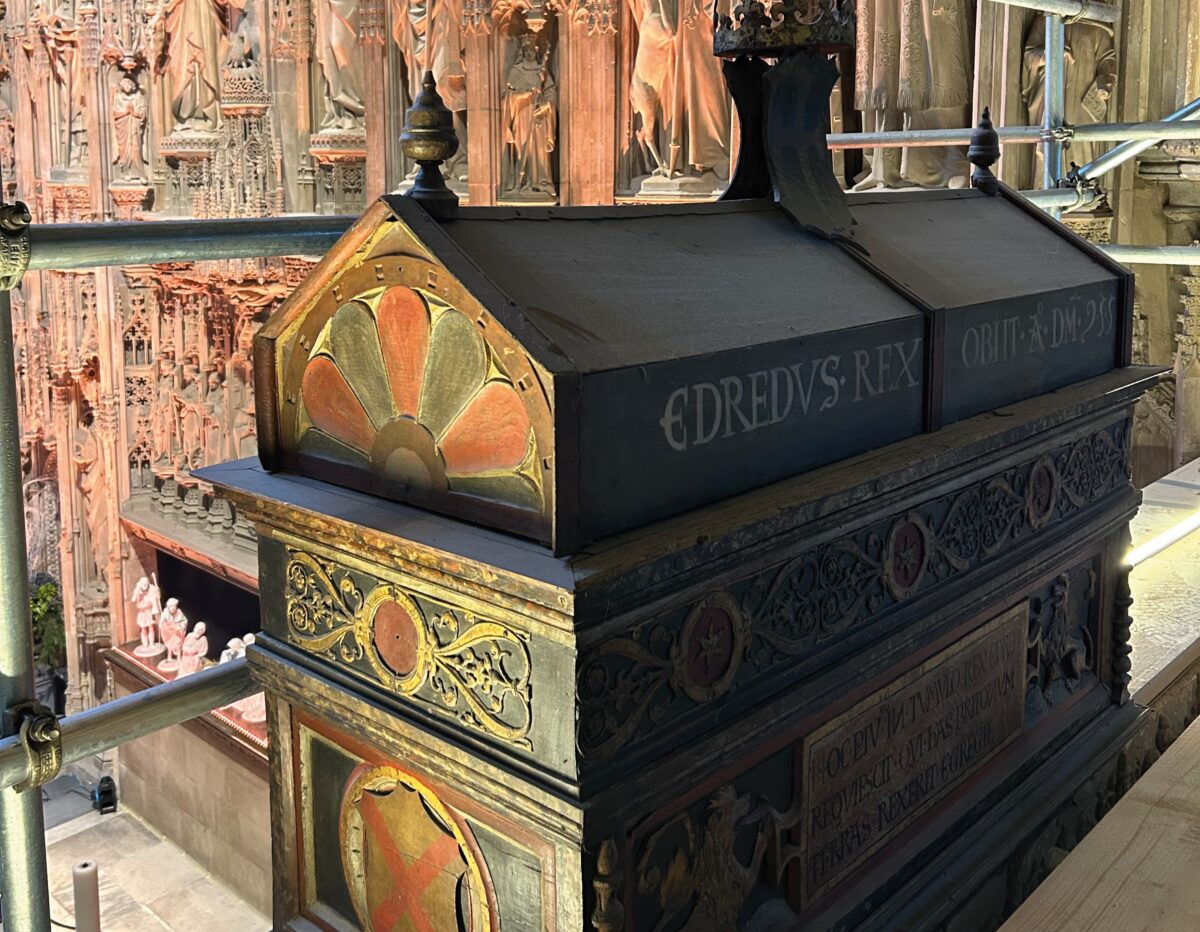
Perched above the stone-carved presbytery of Winchester Cathedral lie six ornately decorated mortuary chests, topped off with gilded crowns. These painted wooden caskets contain the bones of several of the early kings – and one queen – of England, along with an assortment of skulls, femurs and vertebrae from highborn persons unknown. Speculation abounds as to who lies within, but modern science has, so far, only solved part of the mystery.
The human remains span centuries of ancient English history, from the early Anglo-Saxon kingdoms to just beyond the Norman Conquest. Some of the names inscribed in Latin on their sides are obscure, such as Cynegils, a 7th-century King of Wessex, or Aethelwulf, known to history primarily as the father of Alfred the Great. Others are household names, such as King Cnut, famed to have demonstrated that even monarchs can’t tame the tides. (Cnut was also the grandson of Harald Bluetooth, who later inspired an eponymous modern technology; the logo is the rune for his initials, H and B, superimposed atop one another.)
But the bones were not always in these chests. Prior to the Norman Conquest, the remains were laid to rest in the Anglo-Saxon church, the Old Minster. When the new cathedral that stands today was conjured into existence by William the Conqueror in 1079, the bones were transferred over. They were later positioned next to the High Altar, the holiest place within the church – a location fit for a king, or in this case, several. Then, in the early 16th century, perhaps as a bit of a tidying-up operation, Bishop of Winchester Richard Foxe commissioned the mortuary chests to combine the royal remains into a set of unified, decorated caskets. (Given their creator, they are sometimes playfully referred to as Foxe’s Boxes.)
Rather than being permanently entombed in a peaceful resting place, these royal bones were about to transform into one of the strangest tales in English history – a tale I’ve told to thousands of visitors as a volunteer tour guide at the cathedral.
Bones as weapons
In 1642, war came to Winchester, as the city remained loyal to the monarchy at the outbreak of the English Civil War. The cathedral, as a symbol of royal power, became a prime target for the Parliamentarian troops. On 14 December that year, shortly after 9am, troops broke through the west doors of the cathedral to ransack the church. They entered, we are told, “with colours flying, their drums beating, and their matches fired”. Soldiers on horseback trotted between the soaring gothic arches of the nave, their steeds coming to a stop at the altar, where the troops began to smash monuments, damage the organ, and demolish and deface memorials to the dead.
When they came across the ornate mortuary chests high above, it isn’t hard to imagine the hopes of an underpaid soldier, cracking open the dusty wooden caskets with wide-eyed dreams of gold and jewels. Instead, there was a disappointing array of hundreds of musty old bones. Rather than moving along, however, the soldiers reportedly decided to use the bones as weapons. “Those painted windows which they could not reach with their Swords, Muskets, or Rests, they brake [sic] to pieces by throwing at them the bones of Kings, Queens, Bishops, Confessors, and Saints,” a 17th-century account recorded.
King Cnut’s femur, it seems, may have been temporarily turned into a missile. And when the attack on the cathedral ended, the skulls and scapulas were jumbled up and tossed back into the surviving chests, several of which were broken beyond repair. This led to the rather unusual fact that many of England’s early kings remained, for centuries, haphazardly disassembled due to their prior temporary use as glass-smashing projectiles. Where lies the body of King Aethelwulf or King Egbert? From 1642 onward, the best answer to that question was: “Probably mostly in three to six of these boxes, but nobody knows which ones.”
For hundreds of years, then, Winchester Cathedral’s mortuary chests functioned as a bizarre historic relic, a frozen snapshot of the chaos and destruction of the Civil War. The country tore itself apart, and it was symbolically fitting that the rebels literally tore the founders of the country apart, too. But even as war abated and England became whole again, this hodgepodge of split-up humans remained impossible to rectify. With only guesswork, Cnut would have to remain in pieces forever.
Putting them back together again?
That all changed in our current generation, with astonishing advances in ancient DNA technology. In 1984, scientists managed to extract DNA from a 150-year-old specimen of a quagga, an extinct member of the horse family. That success catalysed a new field of rapidly improving research; by 2021, scientists successfully extracted DNA from mammoth molars that were over a million years old, an achievement that would have previously been regarded as sci-fi fantasy. Tiny, long-decaying fragments could now yield a wealth of information, decoding what had seemed like the past’s unsolvable mysteries.
Suddenly, it became plausible to test the bones of Winchester, identify which ones came from the same person, and, perhaps, put the human remains back together. But this new possibility stirred fresh tension between religion and history. Should the remains be left as they were, or did the religious dogma of treating human remains with dignity require us to reunify as much of each skeleton as possible? Should the desecration of the bones during the English Civil War be undone through the wizardry of modern technology?
That question largely hinged on whether it was essential or absurd to treat aged bones differently from any other inanimate object that has outlived its original purpose. At one extreme, the Toraja people of Indonesia preserve the intact bodies of their dead relatives and live with them, providing them with meals, offering daily cigarettes, dressing them and including them in family meals – sometimes for more than a decade. On the other end, human remains, in an extreme secular view, may merely be treated as unremarkable decaying matter, temporarily borrowed from the cosmic library until the due date arrives, at which point it’s handed back in, to inevitably return to disorganised dust.
The sanctity of bodies and bones
Such divides are defined by religion and culture alike. Christians believe that remains must be treated with extreme care to preserve dignity, even if bodies are merely temporary vessels for a divine spark. As Pope John Paul put it in 2000, death is defined by “the separation of the life-principle (or soul) from the corporal reality of the person”. In Ancient Egypt, a preserved khet, or physical body, was required for any hope of a prosperous afterlife, leading to mummification. The display of these remains in museums would surely be viewed by ancient Egyptians as a horrific desecration with unspeakable eternal consequences for the soul, and yet it has today become uncontroversial, with hordes of tourists routinely gawking around desiccated corpses. By contrast, controversy still rages in Israel, where intense scientific interest in the cornucopia of human remains scattered beneath ancient ruins is often blocked by Orthodox Jews who insist that graves must not be disturbed for virtually any reason.
In Britain, the oversized bones of the Irish Giant Charles Byrne, who was 7 feet 7 inches tall, were displayed in London’s Hunterian Museum starting in 1799. In life, Byrne was aware that his bones would be a coveted prize for anatomists and purveyors of curiosities, so he arranged for a hasty sea burial in the event of his death. Unscrupulous bribes secured a different fate for his skeleton, on show in a glass case for museum-goers until 2023, when a pressure campaign led to the removal of the bones from public display.
Beyond cultural and religious divides, there are also reasonable questions about how the time elapsed since death affects the sanctity of bodies and bones. Collective outrage against dismembering a body suggests a philosophical intuition that recent remains are somehow still the person, whereas few express outrage over digging up prehistoric bones.
How would the ancient bones of Winchester Cathedral fit into these delicate debates over whether the physical remnants of a body belonged to the secular forces of history and science or the doctrines of religion?
Forensics in the chapel
In 2012, a series of experts that looked like crime scene investigators descended on the south aisle of Winchester Cathedral. Clad in pristine white, with plastic goggles, nitrile gloves and surgical masks, they paused for a ceremony unseen in most scientific labs: the Vice Dean prayed for the success of their research. The cathedral had embarked on a prolonged scientific research project to unlock the secrets of the mortuary chests using new technology. But under no circumstances would the bones be permitted to leave the cathedral where they had lain for nine centuries.
So, partnering with the universities of Winchester and Bristol, and the Francis Crick Institute, the cathedral proposed an innovative solution: to transform the Lady Chapel at the far east end of the church into an improbably located forensics unit. The chests were carefully lowered, gingerly opened, then photographed extensively. As each bone was removed for study, its precise location was perfectly documented, ensuring they could be put back exactly as they were.
As Dr Heidi Dawson-Hobbis, an osteoarchaeologist at the University of Winchester told me, they were able to extract ancient DNA (or aDNA) from each of the surviving skulls in the chests as well as left femur bones. Her team took samples from ear ossicles (tiny bones inside the ear canal) and then drilled small holes into the femurs to collect a bit of bone powder. Dawson-Hobbis is cognisant that these objects were once infused with life. “Human remains are the mortal remains of once living individuals and as such are always treated with dignity and respect by researchers,” she explains. “I see it as a privilege to be able to work with these remains and my aim is to be able to find out information about these people’s lives and to be able to tell their stories … Every skeleton has something interesting to tell us about past peoples and populations.”
Boxes full of surprises
There have been significant surprises. Among the roughly 1,300 bones in the chests, there are the remains of at least 25 individuals, far more than the 12 who are mentioned in writing on the painted chests. And while all historical documentation refers to adults in the chests, researchers have discovered four juveniles, with no clues as to who they might be. Hundreds of silk fragments were also inside the boxes, possibly brought to England over the Silk Road; their purpose in the chests remains unknown. And there are also, somewhat inexplicably, an assortment of bones from animals, including sheep, rabbits and birds.
But despite stunning advances in aDNA technology, it has – so far – not been possible to positively identify specific individuals. The one exception is Queen Emma, who was married to two different kings. As the only female believed to be in the chests, she could be identified with reasonable confidence, so a 3D printed replica of her intact skeleton has been on display in the cathedral’s Kings & Scribes exhibition for the past several years. The researchers are planning to release their major findings this year, so it is still possible that additional specific bones will be positively identified, particularly because several of the kings are related to one another. “For example, King Ecgberht (died 839) is the father of King Aethelwulf (died 858),” Dawson-Hobbis tells me.
Throughout the research process, the scientists have collaborated closely with the cathedral, often liaising with the Interim Dean, Roland “Roly” Riem, about questions of religious significance. And as the physical sampling ended, the thorny question finally needed to be definitively answered: should the skeletons remain jumbled as historic artefacts or reunited in recognition of the sacred individual they once were?
Science and religion meet
With little public fanfare, it was announced in 2025 that the bones would be reinterred as individuals, undoing the historic dissembling from 1642. In January, a small crowd of tourists who happened to visit the church that day gathered in the cathedral’s presbytery. They were accidental witnesses as individual archival cardboard boxes, each containing remains from just one or two people, were carefully lowered into the mortuary chests. Having gained access to photos that have not been publicly released, I was amazed to see how intact the bones are – leg bones and arm bones delicately stacked alongside bits of vertebrae inside the boxes, crafted to protect them for future preservation. Hours after the bones were reunited for the first time in 384 years, a brief prayer was said at the evensong service.
Sitting below the chests, I asked the cathedral’s enthusiastic curator, Eleanor Swire, why the bones were not put back in as they were originally. She explained that there was consensus between science and religion, even if the justifications differed. For the cathedral, the prevailing question was “how can we best show respect for the memory of these individuals?” But for the scientists, it was a practical question. When the chests were opened, some contained skulls stacked atop other skulls, for example, a surefire recipe for eventual damage. Moreover, having done the hard work of identifying which bones belong together, they wanted to give future researchers an easier time, saving them from the onerous work of unjumbling.
Scientific pragmatism conveniently overlapped with religious doctrine. It was probably the right call. Still, as we gaze up at the gorgeous chests, home to early England’s reunified royals, I can’t help feeling a bit of sadness, an unease that something historically important has been lost. King Cnut and Queen Emma were human beings, but when the skeletal traces they left behind became wartime missiles to desecrate a church, the objects also became historic artefacts, a profoundly weird and darkly delightful bit of Civil War legend. But perhaps, like all good legends, this one has the elastic power to be slightly reworked across generations, sparking debate for all who now come to pay their respects or gaze back into history.
Visitors will now have to answer the question for themselves: should the scattered bones of Winchester have been put back together again?