
The revival of Jack in the Green – an eccentric May Day ritual – meets a real need for connection in England today
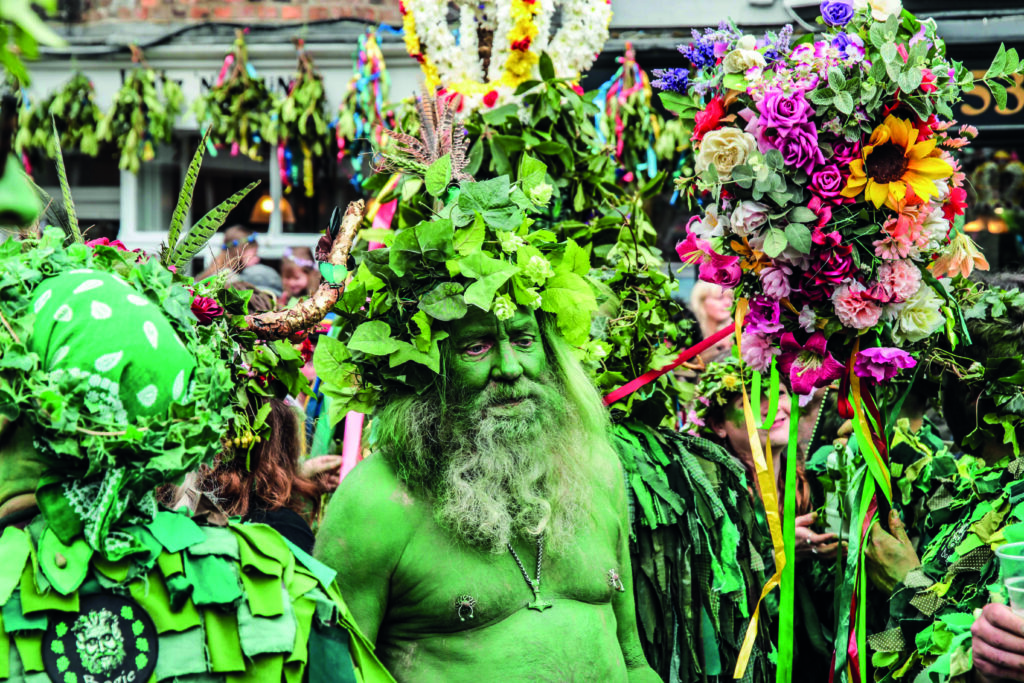
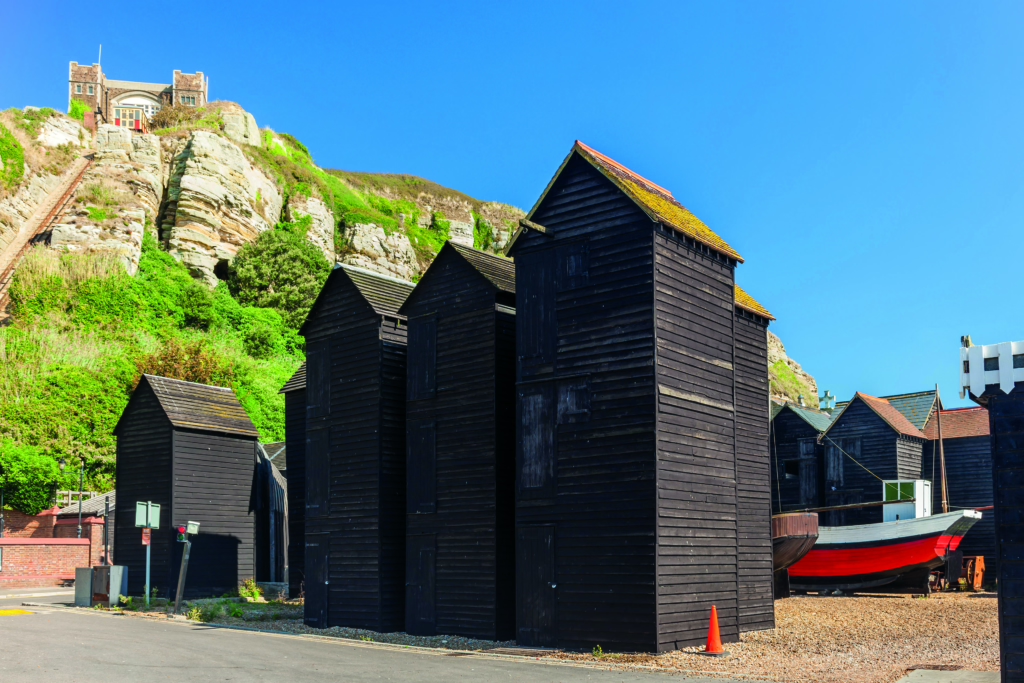
As I descend into the Old Town of Hastings, locals drape luscious garlands and leafy bunting from their front doors and shop windows. They clap excitedly for towering troops of papier-mâché giants, who sway in the streets, gazing down upon Morris dancers playing accordions, bells jangling around their ankles. A crowd has gathered in its thousands, heads adorned with ivy, some with faces painted green and others masquerading as animals. We march together past crooked Tudor buildings and black fishermen’s huts to a chorus of folk melodies and rhythmic drumming. We’re all here for one thing: the leaf-laden Jack.
This giant green conical figure, a foliate mask peering out of his shrubbery, is topped with a floral crown and flowing with ribbons. He marches through the winding streets and tapering twittens (or “alleyways” to all non-Sussex folk), protected by his gang of “bogies” who daub onlookers with green paint should they get too close. He leads the procession up a twisting flight of stairs to the top of a windswept hill, overlooking the rooftops and the English Channel below. This is where he meets his demise. The crowd here descends upon Jack and tears away his leaves, thereby releasing the spirit of summer.
For one long weekend, Jack in the Green, an eccentric annual May Day festivity celebrated in Hastings and elsewhere in England, offers a reminder of what it feels like to connect to nature, collectively mark the seasons and to experience something bigger than oneself.
Ahead of the festivities, I headed to the site to meet Keith Leech, who reintroduced Jack in the Green to Hastings back in 1983. We meet in a small cafe on the High Street of the Old Town – a thoroughfare of antique stores, ramshackle vintage markets and homely taverns fit for a fishermen’s town. White-haired and bearded with an earring in one ear, Leech has a Cockney charm to his voice that hints at his East London background.
“I grew up in Barking in the 50s and 60s, with an ‘I’m gonna get out of here’ attitude,” he tells me over coffee. “I managed to get into university in Wales, where I was immediately thrown into the company of people who were very into being Welsh.” It was on May Day in his first year that Leech witnessed folk-dancing for the first time. “I thought, ‘I wouldn’t mind trying that.’ That was the beginning of a very slippery slope.” After Wales, he returned to London and joined a local Morris dancing side. “We used to dance around the docks in the East End on bicycles and get pissed as rats,” he laughs.
Feeling that England’s rich heritage was too easily dismissed, Leech formed what he describes as a “traditional customs flying squad” – travelling the country to prevent these traditions from dying out. “I worried that if we weren’t careful, we’d become the 51st State because of creeping American culture,” he says. The motivation, he stresses, was never about conservatism. “If you know and appreciate who you are as a nation, you’re less afraid of outsiders. You can respect each other.”
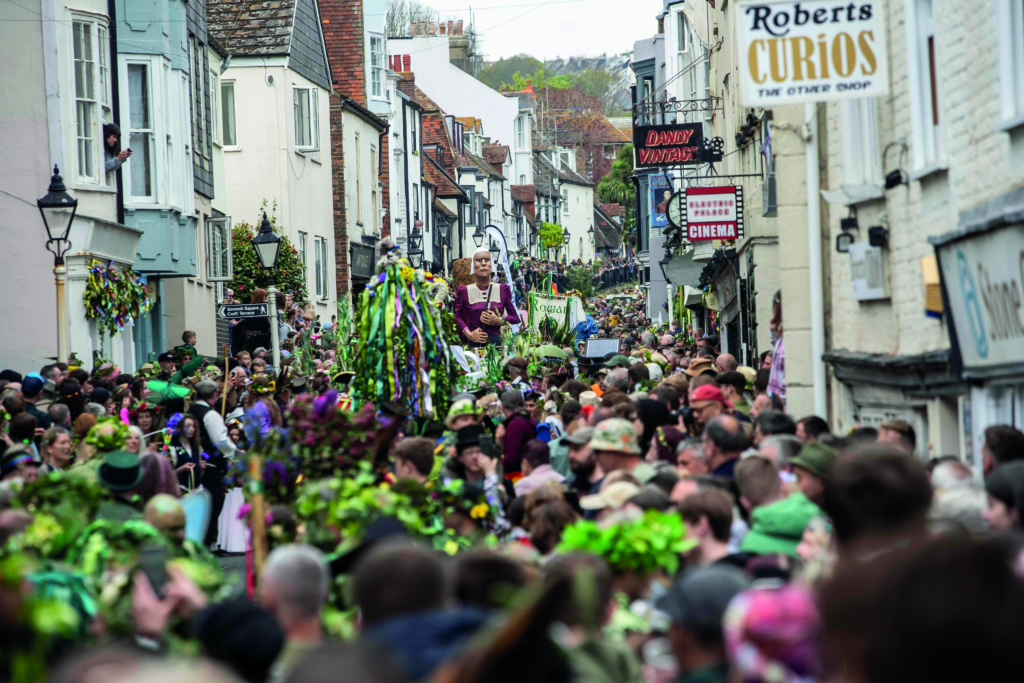
Drawn to the coast, Leech moved to Hastings. Having already helped revive Jack in the Green in Deptford, south-east London, he resolved to do the same here, soon discovering the tradition was already firmly embedded in local history. “When I got to Hastings, I did the research. I found extensive 19th-century references to the custom here – more than anywhere else, actually. I lit the flame, but I wasn’t expecting the reaction. It took off immediately.”
Walk through the Old Town today and Jack in the Green is woven into the fabric of the place – large murals decorate building facades, carved foliate heads adorn people’s porches, commemorative crests are stuck to the inside of shop and pub windows. It’s everywhere, all year round.
Anthropologists and folklorists trace Jack in the Green’s direct origins to late 17th-century London, when milkmaids paraded flower-decked pails through the streets for May Day. As the city’s chimney sweeps adopted the custom, they competed to construct ever larger garlands, eventually building frameworks of greenery and flowers big enough to swallow a person whole. This towering emblem of seasonal change became the Jack we know today. As May Day customs are rooted in Beltane – the ancient Celtic festival of summer – the Jack has long been viewed as an incarnation of the Green Man, a pre-Christian spirit of nature and fertility, whose death and rebirth herald summer’s arrival. Embodying that ancient lineage, the Jack brought anarchic revelry to towns across England throughout the 18th and 19th centuries, before mostly dying out under dour Victorian disapproval.
The folk revival of the 1970s breathed new life into the tradition, and now it draws thousands to events from London and Oxford to Bristol and Knutsford. But thanks to Leech, it’s here on the pebbly coastline of East Sussex that the epicentre of the modern festivities can be found. In 2014, he received an MBE for services to heritage in East Sussex – recognition for a life spent keeping folk customs alive.
“If the community doesn’t want a tradition, it fails,” he says. “But Hastings engaged with it straightaway. It has grown from a few locals and some guys from London to a massive event.” Leech reckons that, over the course of the weekend, tens of thousands of people bear witness to the celebration – many deliberately, others by chance, as May Day Bank Holiday is popular for tourists, as well as bikers who drive in convoy down to the coast. “They’re all enjoying a drink, but in over 40 years of doing this, we haven’t had any trouble. Everyone understands they’re part of something bigger than themselves.”
The growing popularity of Jack in the Green reflects wider shifts in how people in Britain are seeking meaning. A 2025 report from the Institute for the Impact of Faith in Life found that Paganism has become the most popular spiritual destination for people leaving the Christian faith. But the modern folk revival, and desire to reconnect with the natural world, is far broader than that, attracting many who are not religious. There has been a resurgence of associated culture – musicians like Shovel Dance Collective use traditional folk to comment on contemporary issues; authors like Robert Macfarlane are leading readers back to the eeriness of the English countryside; walking groups such as Stone Club organise gatherings and walks for standing stone enthusiasts.
Across the country, people are rediscovering, and sometimes reinventing, folk culture to physically reconnect with the landscape and feel more embedded in their local communities. English traditions and customs, rooted in the turning of the seasons and the rhythms of the natural world, are ancient and yet increasingly relevant.
Leech has watched this appetite grow for over four decades, but it’s what’s happened closer to home that moves him most. After the pandemic forced Jack in the Green’s cancellation, its return was overwhelming. “I came running out of the Fishermen’s Museum after receiving the good news and realised my son was on my right and my daughter was on my left,” he says, his voice catching. “It hit me – not only had we returned, but there was the next generation.”
“People are fascinated by it because, even though this version is only 40-odd years old, it feels ancient,” he continues. “Whether it’s real history or ‘Keith Leech bullshit’, it brings the community together.”
That’s what folk customs are all about – not historical reenactment, or exclusive ceremonies of English identity, but living and evolving communal ritual. When the stories that once tethered us unravel, Jack in the Green shows that shared rituals can bind us together again. On the streets of Hastings Old Town, you can see exactly what happens when people tend that flame. It can capture the imagination and light up a whole town.