Its warming effect is essential for life on Earth – even if human activity has pushed it to dangerous levels
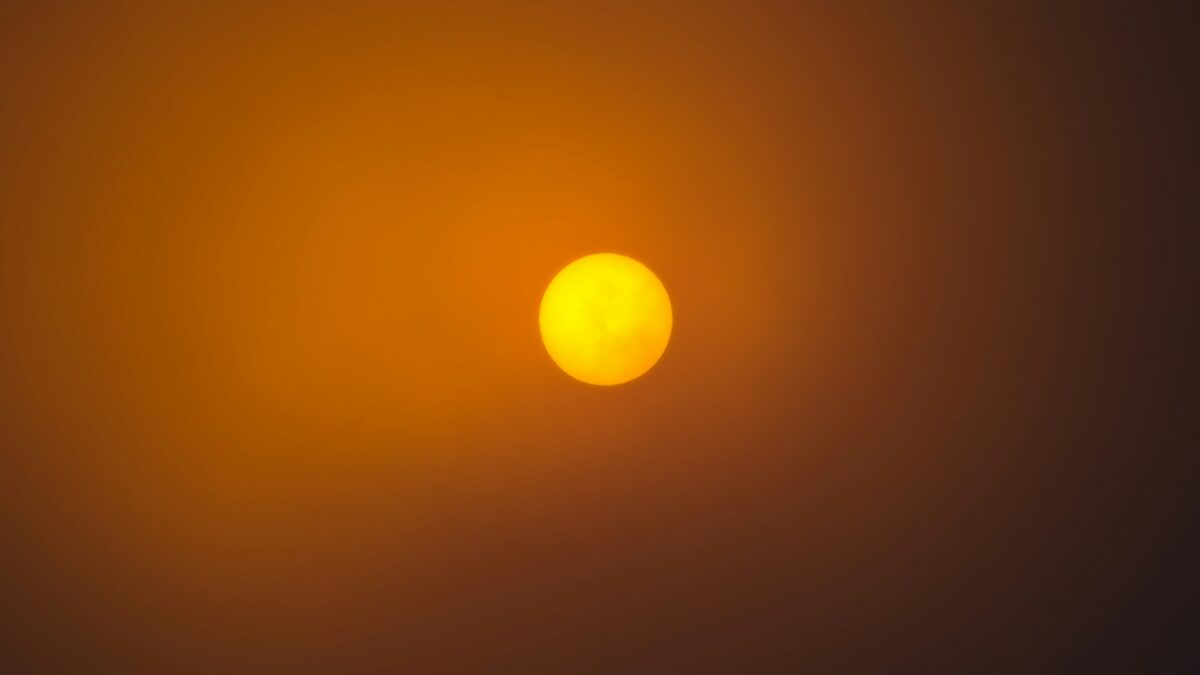
Heat radiated by the sun-warmed ground is trapped by gases in the atmosphere. This, in a nutshell, is the greenhouse effect.
The person who discovered it was an American amateur scientist and distant relative of Isaac Newton by the name of Eunice Foote. In 1856, she carried out an experiment so ridiculously simple that it could easily be done by children in a school lab today. She put thermometers in a number of glass tubes, each of which she filled with a different atmospheric gas: nitrogen, oxygen, water vapour, carbon dioxide, and so on. She then sealed the tubes and put them in the sun. Some time later, Foote was astounded to see that the temperature had risen significantly in the tubes filled with carbon dioxide and water vapour. Carbon dioxide accounts for only 1/400th of the atmosphere, but given the dramatic change, Foote went on to speculate that sudden drops in the atmospheric concentration of carbon dioxide or water vapour might trigger ice ages.
Three years later, in 1859, the Irish physicist John Tyndall independently discovered the greenhouse effect. Crucially, however, he demonstrated that it did not involve visible sunlight heating atmospheric gases directly. Instead, Tyndall showed that invisible “far-infrared” radiated by the ground heated the gases.
This is how it works: small molecules in the atmosphere are effectively atoms connected by springs. They absorb far-infrared because it makes the springs vibrate faster, but only if a molecule has an imbalance of electric charge.
Nitrogen and oxygen molecules, which make up 99 per cent of the atmosphere, have no such imbalance, which is very good news for us. If they did, the Earth would be hotter than an oven.
Weirdly, carbon dioxide has no intrinsic charge imbalance either. However, its three atoms, which are arranged in a straight line, can flex back and forth into a banana shape, causing a periodic charge imbalance. This “quantum” quirk transforms it into a greenhouse gas.
Undoubtedly, the greenhouse effect gets a bad press. And certainly carbon dioxide from the burning of fossil fuels is a problem today because its concentration is increasing faster than the biosphere can adapt to it. Levels have risen by more than 50 per cent since the start of industrial times in the 18th century, leading to rising temperatures, extreme weather and a locking in of future global warming that could threaten life on Earth as we know it.
However, in the past, the gas has been extremely beneficial. Three times in the history of the Earth – 2.2 billion years ago, 746 million years ago and 635 million years ago – the planet was ice-covered from pole to pole. Because ice reflects sunlight back into space, such “snowball Earths” ought to have been permanent. Fortunately, volcanoes under the ice spewed out carbon dioxide, which gradually built up in the atmosphere, warming the planet and eventually melting the ice.
And there may been another crucial time when the greenhouse effect came to the rescue of the planet. When the Earth was born, about 4.55 billion years ago, the Sun let out about 30 per cent less light than it does today. By rights, the planet should have been frozen solid and stayed that way for aeons. However, there is evidence from ancient rocks that liquid water existed on the surface by about 4 billion years ago. One speculation is that newborn Earth was swaddled in a super-thick blanket of carbon dioxide and methane – an even more potent greenhouse gas than carbon dioxide. By preventing the Earth from freezing over, it made possible the birth of life.
If you are still not convinced of the beneficial effects, consider this: without water vapour, the average temperature of the planet today would be -18° Celsius. Without global warming, and the invisible duvet it provides for the planet, the Earth would be utterly uninhabitable. So, come on, let’s hear it for the greenhouse effect!