The government has lost sight of why we lock people up, as the controversial early release scheme has exposed
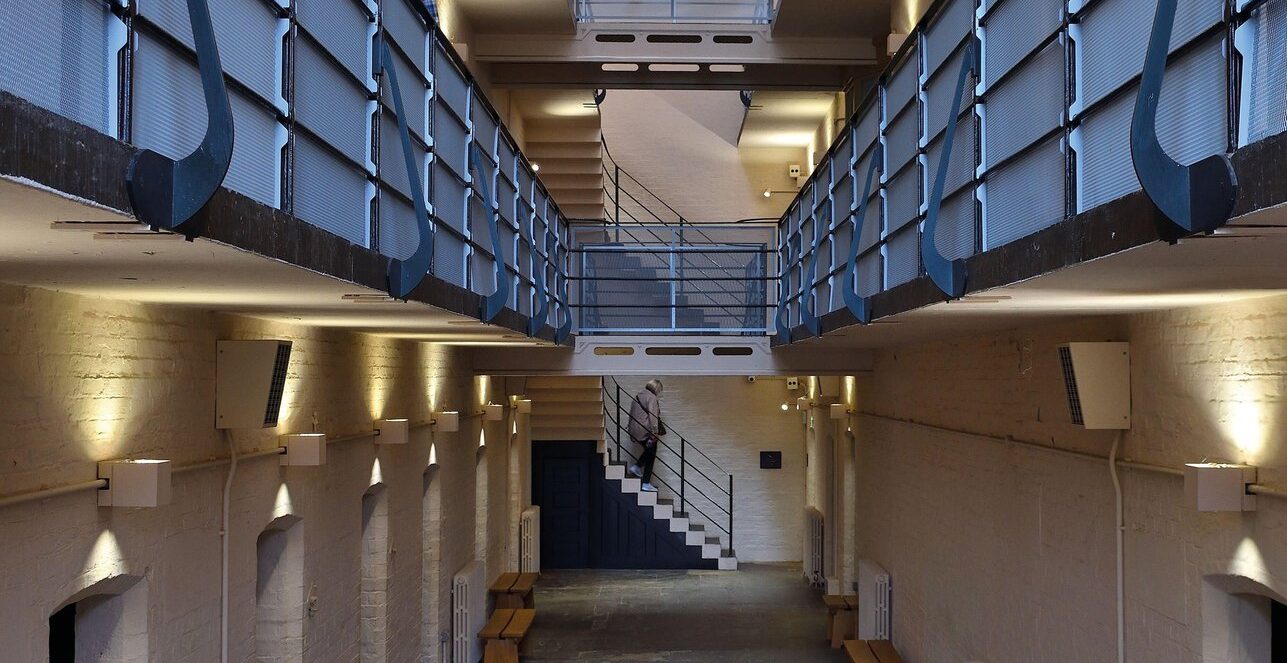
Walking the streets of England and Wales today are hundreds of convicted criminals, set free (albeit with conditions) before serving the minimum prison time that was ordered at the time of sentencing. Thousands more will follow, for the UK government is implementing a scheme for the early release of prisoners. Even more astoundingly, there is general political consensus on the broad outlines of this policy: we do not have enough places in prison, and early release is necessary until we build up capacity.
But that’s where agreement ends. The debate over who could be released early – which kind of prisoner, what type of crime – has raised fundamental questions around our approach to prison and its purpose. And while the early release scheme in England and Wales reduces the temperature, the kettle is still nearing boiling point. Our prisons are in crisis, and in order to find a way forward we need to get a firmer grip on the logic behind incarceration: why do we do it, and what are we hoping to achieve?
A muddled policy
Firstly, let’s look at the rationale behind the early release scheme. If people are justly given a prison sentence, shouldn’t they serve it? It is true already that the majority of prisoners are let out early on licence, often halfway through their sentences. After this they’re assigned a probation officer and must live under strict rules, or they are sent straight back to prison. But judges take this into account when they hand down a sentence. Introducing a general policy of early release, post-sentencing, sits awkwardly within the regime of regular and orderly criminal justice, and has extremely low levels of support from the general public.
The people have been told there is no alternative. They have had to accept early release, but alarm has been raised over who it should apply to. The general rule is that prisoners convicted of less serious offences, who previously would have served 40-50 per cent of their sentence in prison, will now leave after a third of their sentence has been completed. Those convicted of some violent and sexual offences, who would previously have served two-thirds of their sentence, will see that time reduced to half.
“The debate has drawn attention to the emotional power that victims possess”
Then there are the exceptions to the scheme. One category of prisoner was excluded from the start: those serving life sentences and extended determinate sentences, which are used for serious violent, sexual and terrorist offences where the court judges the offender to be especially dangerous and at a higher risk of reoffending. An immediate wave of public pressure added other exclusions – including those guilty of rape, serious child abuse and grooming. A second wave added indecent assault and manslaughter, following public outcry over the prospect of early release for those convicted of the manslaughter of PC Andrew Harper, who was accidentally killed while stopping the theft of a quad bike.
These changes have raised serious questions about how sentencing policy should be determined. Governments should listen to criticism, including from victims and their loved ones. Yet the debate has drawn attention to the emotional power these victims possess, and the willingness of the media to act as a megaphone. Were these changes a matter of correcting genuine mistakes, or of quietening an influential group with wide public sympathy?
Today, in England and Wales, you may spend longer behind bars than other prisoners who were given exactly the same sentence, simply because you committed a certain type of offence. Is this fair?
The cause of the crisis
This crisis arose because there is a shortage of prison places, and so we should widen the aperture and ask why that is so. In one way, the answer is obvious: more people are receiving custodial sentences than we can cope with. The prison population in the UK has been growing since the 1940s and took a sharp upward turn from 1995 in England and Wales (though not in Scotland) starting under John Major, and continuing during the Blair, Brown and Cameron administrations. In 2020-2021, the prison population dipped, possibly due to the pandemic, but has since resumed its relentless upward trend with about 97,000 people currently behind bars, outpacing growth in the general population.
It would be natural to assume that we need more prisons because crime is rising. Some categories of crime are certainly having a growth spurt, especially those related to online fraud. Overall though, most areas of crime are showing falls or no significant changes over recent years, while the year to March 2026 saw the fewest recorded murders since statistics started being compiled on the current basis in 2003. There aren’t more crimes being committed, it’s just that convicted criminals are spending longer locked away. According to a briefing from the House of Commons Library, “sentences have been lengthening, with 48 per cent of determinate prison sentences being over four years in 2025 compared with 36 per cent in June 2010.” Hence there is nothing inevitable about the rise in demand for prison places. It reflects a deliberate choice to implement harsher sentences. Why are we doing this? It’s time to look at the justifications behind our sentencing policy.
Deterrence, retribution, rehabilitation?
As an undergraduate in philosophy in the 1980s, I was taught that there were three possible justifications for criminal punishment: deterrence, retribution and rehabilitation. The spirit of the time was to consider each justification on its own, show that none of them work, and then move on to the next topic. Deterrence would justify excessive punishment, retribution is Old Testament barbarity, and rehabilitation requires battalions of support professionals that no society can afford.
Times have changed, and now we understand that there are – always were – different possible justifications. And as some in philosophy were already saying back then, these justifications may well work better in combination than alone. For example, deterrence combined with modest retribution has been used to argue against excessive sentences. Retribution is often considered an inhumane approach: calling for revenge. But defenders of the so-called “new retribution” theory point out that deterrence can be even harsher, as it has no upper limit; the death penalty for every offence would be a powerful deterrent. Retribution implies a type of proportionality and hence includes a limit to what could be a just punishment for any given offence. And rehabilitation reinforces the idea that the point of sentencing is the transformation of prisoners, which would also imply considerate treatment of them.

Yet these theories are hardly exhaustive. There is also public protection (“keep ’em off the streets”) and the expressive theory, where punishment is the way in which society expresses some sort of strong negative attitude to the offender. These, too, have their one-line put-downs. Public protection could also justify excessive sentencing, and if all we want to do is express our outrage towards the guilty party, why don’t we just burn an effigy? But once more, we can do better if we bring different justifications together.
Public protection was obviously an element behind the exclusion of life sentences, and extended determinate sentences from the early release scheme. There is at least a perception that murderers, rapists, child abusers and those who groom children are a danger to their victims and to others and that early release would cause great risk – or at least, great fear. (For this reason there have also been calls to make a further exclusion of all categories of domestic abuse.)
The philosopher Jeremy Bentham acutely remarked that fear of crime might be a bigger cause of distress in society than crime itself. After all, thankfully few of us will ever be victims of serious violent crime, but if we know there is a rapist or murderer on the streets, a great many people will live in fear and, for self-protection, perhaps even modify their behaviour (for example, not going out alone at night).
Terrorism is, again, a natural area for public protection. In fact, a special Act of Parliament of 2020 restricted existing early release schemes for those convicted of these offences. Public protection does have its own special rationale for locking people up. No other contemporary punishment – such as fines or community service orders – would serve the same purpose.
Some exceptions to early release may well, then, be justified on grounds of public protection, and reduction of fear. But manslaughter is more puzzling. Given that this particular crime entails causing death with no intention to kill or cause serious harm, reoffending seems unlikely (though people who are careless of others’ safety may well commit other crimes). It is worth reflecting on whether manslaughter would have become an exception if it were not for the tragic and highly publicised case of PC Harper, and the families, who also joined the campaign, of those who lost their lives to dangerous drivers.
The heat around the issue makes it a natural candidate for the expressive theory of punishment: critics expressed outrage at the idea of early release, as some sort of insult to the memory of those who died, which suggests that the punishment expressed both our horror at the actions of those found guilty and our respect for the life and dignity of the victims. The expressive theory can explain why we punish some offences more than others – such as actual crimes more seriously than failed attempts, or why some crimes against children are punished more harshly than those against adults. But still, these considerations should have figured in the original sentence.
“We need to calm down a bit”
We saw, though, that lengthening sentences is one reason behind the crisis. Why has this happened? I think we can say right away that we are not keeping people in prison for longer to give them more extensive training for rehabilitation, although I have every admiration for the programmes provided by prisons and charities on very limited resources. The public protection argument, on its own, is not a helpful explanation. If the figures show that violent crime is falling we need less protection, rather than more – although defenders of the policy might suggest that crime is falling precisely because the most dangerous are behind bars.
Perhaps deterrence, then? Surely the higher the punishment the more likely people are to avoid crime, and perhaps the fact that crime is falling shows that deterrence is working? But studies, including a 2022 report by the Sentencing Council, suggest that length of sentence is not a significant factor in deterrence. Instead, it is related to beliefs about the chance of detection and prosecution. After all, can we really imagine a burglar saying, “If the maximum sentence is one year I’ll risk it, but if it’s two, forget about it”? But if the chances of getting caught are higher, they might be more likely to reconsider.
“Studies show that length of prison sentence is not a significant factor in deterring crime”
What about retribution? Lord Burnett of Maldon, Lord Chief Justice between 2017 and 2023, speaking in December 2020, said: “To my mind, there has been a perceptible hardening of the public and political attitude to crime, particularly sexual and violent offending.” And if, in parallel, our outrage is increasing – as it appears to be, partially based on the mistaken view that crime is rising – then the expressive theory, combined with a desire for public protection as well as retribution, could explain increasingly lengthy sentences.
If these are the main reasons then the solution is staring us in the face: we need to calm down a bit. Simple arithmetic suggests that if we reduce sentences, we will, in time, reduce the need for prison places, though numbers will grow for a while before they start to fall. It’s clear that we need changes that can work in the long term.
It is also worth looking at developments and practices elsewhere. In the US there is a growing interest in the “prison abolition” movement. But we have to see this in the context of a society that imprisons a vast number of citizens, many of them from racial minorities, who are often required to perform demanding labour for a scandalous wage for private profit. One powerful advocate of prison abolition is the radical philosopher Angela Davis, who was herself incarcerated when on trial for the kidnapping and murder of a judge having purchased the gun that was used in the fatal Black Panther shootout. (She was later acquitted of all charges.) Davis sees clear affinities to slavery, and argues that the ruthless exploitation of prisoners must be brought to an end. Responses to Davis have accepted the comparison with slavery, but argue that there is a residue of serious offenders who would still need to be punished even in a hugely changed system. In fact, European systems are often used as a model of how the US could make its current system more humane.
What we can learn from Norway
But when American commentators become misty-eyed about enlightened European practices of criminal sentencing, they do not mean the UK. About as far from the US as possible is the Norwegian system, which focuses on rehabilitation, and the idea of restorative justice, in which offenders are encouraged to build relationships with their victims. To highlight the difference, photographs of Norwegian prisons are often circulated, showing comfortable and roomy living spaces that might well command a premium rent in many American or British cities.
But a further remarkable thing about Norway is that even criminals who receive custodial sentences do not necessarily go to prison right away. Instead, they can be placed in the “serving queue” if there is a shortage of places. Being sentenced to prison is one thing, but being sentenced to go to prison right now, on conviction, is another. For those of us used to US and UK courtroom dramas it’s shocking to imagine people being convicted but then sent back home to be put on a waiting list for their punishment to start. Rather like waiting for a hip operation on the NHS.
Of course, for the most serious offences the public protection argument mandates immediate incarceration – but even then sentences can be surprisingly short. The notorious mass murderer Anders Breivik, who slaughtered 69 members of the youth wing of the Labour Party at a summer camp, and eight people in Oslo, was sentenced to only 21 years. That may seem unjust to some, but the system gets results. Norway’s humane prison reforms are reported to have reduced reoffending rates within two years of release from 70 per cent to just 20 per cent, far lower than in other comparable countries, including England and Wales.
Societies make choices about how they want to run their criminal justice system. In England and Wales we have chosen to lengthen sentences, and it is hard to see this as driven by anything other than a wave of outrage and desire for retribution, fuelled in part by a false belief that crime is rising. The result is a prison overcrowding crisis, and our policy response has been to introduce early release, and to promise to build more prisons, as if there is no alternative.
But this is a crisis of our own making. We have a choice to act with more courage, refuse to be ruled by public outrage, fuelled by the tabloids and social media, and seriously engage with the question of what we can learn from Norway. Of course, public protection requires lengthy sentences for the most serious crimes. But beyond that, reducing sentences, and paying much more attention to what happens to people when they are in prison, could be another way to meet our objectives. Instead of the kneejerk consensus of “build, baby, build”, we should reopen public debate on what we are actually trying to achieve with our criminal justice system.