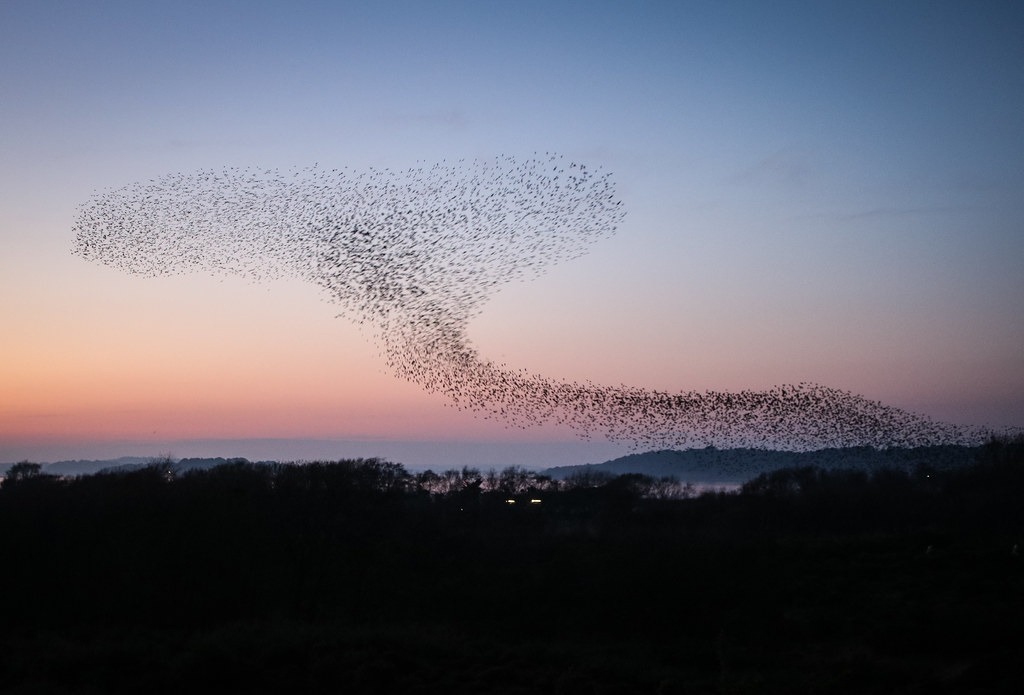
What links the brain, the climate and a murmuration of starlings? They're all made up of many components, interacting with a touch of randomness and a dash of disorder: the recipe for a complex system. The last two ingredients – randomness and disorder – make their behaviour extremely difficult to model and predict.
But physicists do enjoy a challenge, and in the 1960s Syukuro Manabe sought to model one such system: energy transfer and transport within the Earth’s climate. Manabe’s work was the first to explore the interplay between the greenhouse gas effect, the rising of hot air due to convection and the heat released when clouds form. It demonstrated that increasing carbon dioxide leads to rising temperatures closer to the ground, with the upper atmosphere becoming colder. Most strikingly, he showed that doubling the carbon dioxide concentration in the air caused an increase in Earth surface temperature of 2℃. This work seeded the climate change models we have today.
A decade later, Klaus Hasselmann took Manabe’s work a step further by incorporating the chaos of weather into climate modelling in order to make predictions over time. To represent the rapidly changing weather conditions in the atmosphere, he mathematically built in chance to the model. This paved the way to proving anthropogenic carbon dioxide emissions are behind today’s global warming.
For these breakthroughs, Manabe and Hasselmann have been awarded one half of this year’s Nobel Prize in Physics. The other half has gone to Giorgio Parisi, whose dedication to understanding disordered and complex materials led to revelations of hidden patterns in the mathematics that could be used to harness predictability in a wide range of complex disordered scenarios, from neuroscience to machine learning, and in the mesmerising sight of a flock of starlings forming a living abstract artwork across the sky.
Predicting the unpredictable sounds like a Nobel Prize-worthy achievement. And now it officially is.
This piece is a preview from the Witness section of New Humanist winter 2021. Subscribe today.