Book review: "We Are Still Here: An Anthology of Resilience, Grief, and Unshattered Hope from Gaza’s University Students"
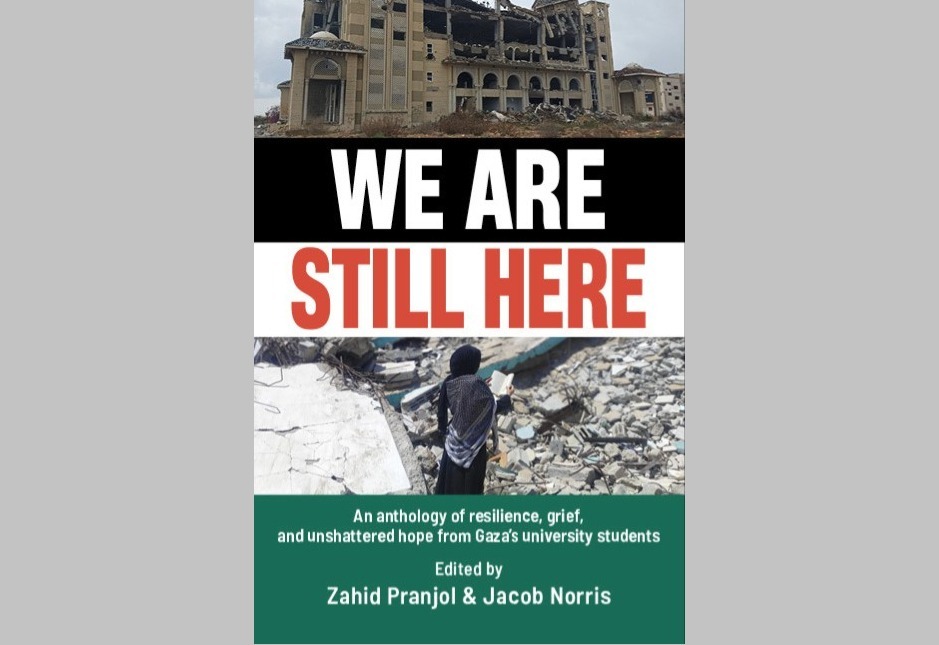
We Are Still Here: An Anthology of Resilience, Grief, and Unshattered Hope from Gaza’s University Students (Daraja Press), edited by Zahid Pranjol & Jacob Norris
“Do you know what it’s like to live in a tent during Gaza’s summer?” Wissam Yousef is asking the world beyond Palestine’s scarred dunes. He is asking you. The world has yet to give a good enough answer. Instead, Wissam must answer himself:
Extreme heat. Limited water. Overflowing trash. Open sewage. Insects. Rodents. Stray dogs trying to enter the tent at night. Noise. Chaos. Drones buzzing overhead. Contagious diseases. Scabies. Meningitis.
Compiled from Gaza’s student writers and translators, We Are Still Here is an anthology, published during Gaza’s third ceasefire in two years, and while the West Bank is threatened with outright annexation. Many of these young authors once thought they knew the shape their life might take, all of them seeing in Gaza’s universities a route to something more than poverty or selling sweets in the street. The universities are gone now. These are records of loss: fervent, burning, desperate, rage-inducing.
“Why?” Batol Alkhaldy wants to know. “We’re not asking for luxury. We’re not searching for perfect lives … We want something simple—to wake up to the sound of birds instead of warplanes, to eat a meal without wondering if it will be our last.” Waad Hamdi Allaham stares through the fog of gunsmoke and pulverised concrete, and asks the most vital of all questions: “Why are you mute? Are you pleased with the genocide?”
Many pieces are plain, brief, steady narratives in a handful of paragraphs. Here I am, they say. These were my dreams. This is the scroll of my dead. Others are fragmented, formless, experiential – trying to make sense of the insensible. The collection’s final third is made up of poems – more moving still for the gift of their metaphors and emotional compression. If the poet Mariam Marwan Malaka should survive (there is no guarantee), I wish for her a career as fulsome as the promise of her work included here. For these lines alone, she deserves garlands:
A person is humiliated in proportion to their longing—
And I, by mine, am annihilated.
The anthology is edited by two academics from the University of Sussex: Dr Jacob Norris, historian of Palestine and co-director of the university’s Middle East and North Africa Centre, and Zahid Pranjol, associate dean for the Faculty of Science, Engineering and Medicine. If there is a fault in this book, it is the editors’ and it comes from admirable motives. In getting out of the way of each student’s voice, they’ve also ensured that the contributions are slightly contextless. You wish, wading chin-height in this pain, for a small amount of detail for each author: a little biography of age, neighbourhood, present status. The anthology has no definite structure, either of chronology or theme.
But one theme dominates: the everyday, commonplace, inflicting of strife and violence. There are the night fears, the flare-lit terrors. No one knows from where the next bomb will come, or who will survive another shelling. As Hada Mohammed Homaid writes:
In Gaza, people die in the way the world fears most suddenly, senselessly, without warning … No goodbyes. No time to prepare. And what then? No space in the morgue refrigerators. No coffins. Not even cars left to carry the bodies.
Gaza’s life is one of suspension. In that space of waiting, there is hunger. When you haven’t eaten, eating is all you can think about. These lines are by Obay Jouda:
We feast on memories,
chew on the brittle skins of dry onions,
boil wild herbs and whisper to our stomachs:
“This is soup.”
If we grant enough leeway to empathy, the lives of others can cut into ours every bit as sharply as our own experience. We Are Still Here is a testament: a plea that these stories should not become their authors’ own eulogies. But there is a limit. Gaza’s experience, for most of us, is far beyond the imaginable. “It is beyond belief,” writes Reem Alaa Khalel Al-Astal. “And yet—even if you believe—it will not make you feel what we feel…”
You will not lose your family one by one.
You will not scramble daily to feed your hungry children.
You will not be displaced from your home to a tent, from north to south.
You will not wait for a miracle to pull you out of this.
You will not understand what I’m living.