The digital world is a playground for the tinfoil hat brigade. But now they are turning on the internet itself
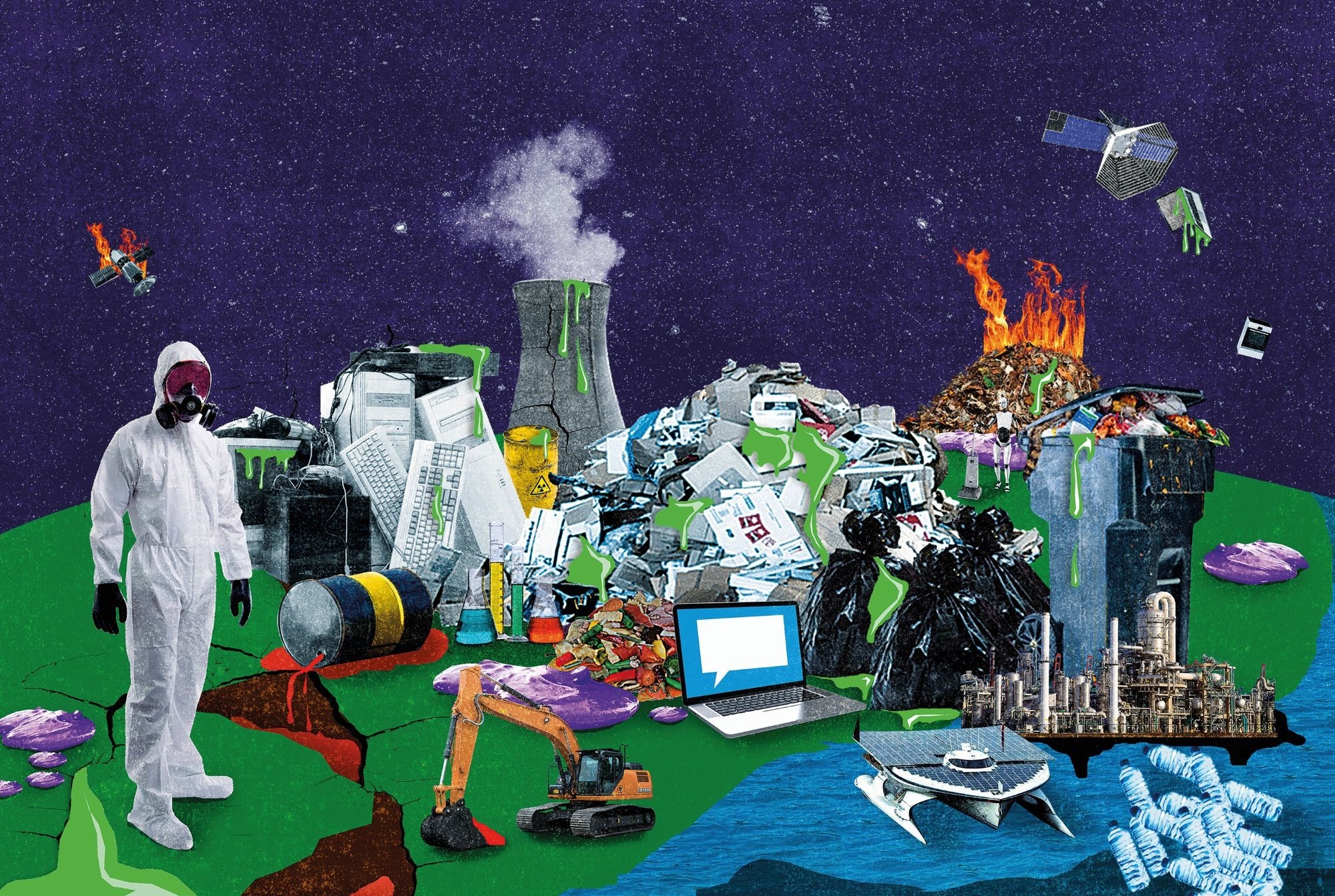
The world wide web is the most prolific incubator of conspiracy theories in human history. For the last few decades, it’s enabled users to spread their wildest, most inflammatory ideas across the globe in seconds. But it seems we are now entering a new phase of distrust. As artificial intelligence increases its dominance online, our fear and suspicion is being directed onto the medium itself. Who is really behind the screen? What is the internet doing to us?
New Humanist has donned its tinfoil hat and sifted through countless memes, message boards and metaverses to bring you a comprehensive guide to all things conspiratorial about the internet, from the slop to the pseudo-sciences. And even some theories that ring a little too true for comfort.
5G is Frying Your Brain
The idea that our phones are making us ill has been around since the days of playing Snake on brick-sized Nokias. With each iteration of mobile networks, these theories have grown stronger, and the Covid-19 pandemic boosted their reach even further. During lockdown, rumours spread that the Covid-19 vaccines contained microchips which were controlled by 5G towers. In 2020, British conspiracy theorists undertook an arson campaign on 5G towers around the country – but they weren’t the only ones giving credence to this incredibly far-fetched idea. One-third of Brits who answered a 2020 survey by the polling firm Focaldata said they couldn’t rule out a link between 5G and coronavirus.
Meanwhile, in the United States, where conspiracy theories inform government policy, Health Secretary Robert F. Kennedy Jr. has claimed that mobile phones can cause cancer in children, despite the National Cancer Institute stating that there is not enough scientific evidence to associate mobile phone use with cancer. (Of course, RFK Jr. still uses his phone.)
The Global Kill Switch
We know that governments can turn off internet access in specific regions and even entire countries. Oppressive regimes in Egypt and China have already done so in response to citizen uprisings. In the United Kingdom, the law permits the secretary of state for culture, media and sport to restrict internet access in certain extreme circumstances, such as a large-scale cyberattack. But conspiracy theorists claim that shadowy global rulers can go a step further, and shut off the internet for the entire planet at the touch of a single button.
This type of conspiracy mixes the old with the new, combining a very modern technology with the age-old fiction that hidden forces secretly control us. Switching off the world’s internet would cause economic markets to crash, logistical chaos and a catastrophic loss of data. But anyone who’s scrolled through an AI-boosted comment thread on LinkedIn might consider it worth the hassle.
Trump’s Waiting Line
In August, a host of European leaders attended peace talks at Donald Trump’s newly gold-plated White House, supporting Ukrainian president Volodymyr Zelensky’s efforts to end the war with Russia. As talks got underway, an image emerged apparently showing several dignitaries waiting outside the Oval Office looking glum. “Trump has the Presidents of Germany, France, the UK, Finland, the leader of NATO and the leader of the European Union waiting outside the Oval Office in chairs like they’re at the dentist office,” barked a right-wing commentator on X. However, the image was AI-generated, presumably as part of a campaign to make Europe look weak and the Trump administration strong. The photo spread quickly across multiple platforms and in several languages, despite clear signs it was fake. There was an extra leg hovering under a chair, an unclaimed shoe, and none of those pictured were wearing the same outfits as in official photos from the event.
Conspiracy peddlers can now create high-quality images and videos almost instantly through generative AI and control an army of bots to distribute them. This phenomenon has led to the resurgence of an old theory on the state of the internet known as…
The Dead Internet Theory
Originating around 2021, the Dead Internet Theory suggests that the internet as we know it stopped existing several years ago, and the vast majority of activity is now generated by automated bots to placate a series of algorithms. More extreme versions of the theory claim that a larger purpose exists behind the transformation – either to manipulate consumers into buying more products or to control the population in even more nefarious ways. But the core statement rings true for many modern internet users as the sense of connection has waned and ads, scams and exploitative practices bombard us relentlessly.
It’s true that significant space on the internet is now taken up by bots engaging with bots. The emergence of generative AI and the introduction of tools like ChatGPT have supercharged this eerie phenomenon. On X, since Elon Musk offered verified users a percentage of ad revenue from their comment threads, opportunists have hooked up large language models to paid verified accounts, directing them to generate engagement through viral content. Bots are interacting with other bots, beneath artificially generated content.
“I think there’s an interesting co-mingling of conspiracism and the actual shifting reality of the internet here,” says Mike Rothschild, a conspiracy theory expert and author of The Storm is Upon Us. “We are increasingly seeing large-scale fakery and bot activity, combined with the hollowing out of search engine results and the failure of more and more links.”
“Link rot” refers to the many broken hyperlinks on the internet. A 2024 study showed that at least 66.5 per cent of links to sites in the last nine years are dead. The study attributed these deaths primarily to webpages being removed, updated or redirected by their owners. As AI-generated images and video deep fakes become easier to generate, the balance is likely to shift further, undermining trust in content and creating the perfect conditions for this conspiracy theory to thrive.
AI is Already Sentient
Conscious machines have filled the pages and screens of science fiction for many years, but GenAI has made the concept much more believable. Programmes like ChatGPT are not sentient; they’re essentially automation tools that are extremely good at guessing what you want to hear. But they can mimic conscious behaviour so well that people are increasingly using them for tasks they are woefully ill-equipped for, such as using a chatbot for life advice, or even as a personal therapist.
Some conspiracy theorists believe that we’ve already reached the dawn of sentient AI and that a Skynet-like entity is controlling the internet, and by extension, everyone using it. Were this true, our AI overlord is currently trying to dumb us down with a flood of artificially generated slop like “Shrimp Jesus” – an AI meme depicting Jesus Christ as a crustacean, widely shared by boomers on Facebook. If it works, we might deserve our future of servitude to silicon tyrants.
Joe Biden is a Robot
In May, Donald Trump reposted a conspiracy theory claiming his predecessor, Joe Biden, died in 2020 and was replaced by either a robot or a clone. In this fantasy, Biden is not the only world leader switched with a robot, although little thought is given to why this might be advantageous. But the “leader of the free world” often endorses conspiracies – from the wild beliefs of QAnon to the delusions of the “manosphere”, where podcasters and influencers like Joe Rogan and Andrew Tate promote misogyny, racism and toxic masculinity though disinformation.
Media psychologist Dr Tunisha Singleton credits much of the success of these online MAGA voices to inadequate education for males in the US. “The number of white young males that are applying to college is the lowest it’s ever been,” she explains. “If you’re not getting your education in college, then where are you?”
And, as Roko shows, we’re all implicated…
In 2010, a user on LessWrong, a techno-philosophy web forum, wrote a lengthy theory about the inevitable rise of AI superintelligence. The author argued that anyone aware of this all-powerful machine’s ascent would be severely punished if they didn’t facilitate its creation. Unfortunately, this meant anyone who read the theory was immediately forced to make a choice: risk doing nothing and be obliterated by a super-AI, or help bring it to life. Therefore, according to “Roko’s theory”, by reading the last paragraph, you’ve also put yourself directly in the crosshairs of a particularly mean basilisk’s stare.
The theory was banned from the message board, adding to its legend. Slate magazine called it “the most terrifying thought experiment of all time”, and it even featured in a recent episode of Black Mirror. The hypothesis follows similar logic to Pascal’s Wager, which argues you may as well worship a god just in case it turns out to be real. And, like Pascal’s Wager, it falls apart at the merest hint of logic.
Aside from making you complicit in the rise of an AI death machine, this article has also armed you with the knowledge to identify these conspiracy theories for what they are. Unfortunately, some of your friends, family members and co-workers may have already fallen prey to them. So how do we debunk them? Given the lack of trust in the internet these days, perhaps a face-to-face conversation would be best.
This article is from New Humanist’s Winter 2025 edition. Subscribe now.