Back in the day, when online dating profiles contained more than a few sentences, I once put the phrase “enjoys the films of Wes Anderson” in my bio. Alongside the tattoos and my coffee addiction, it felt like a solid signifier of what kind of girl I was. Wes Anderson fans could be counted on to enjoy the unexpected and the twee, taking pleasure in the details and a well-chosen colour scheme.
These days, this same fact would reveal me as an ageing hipster, but judging by the turnout at Wes Anderson: The Archives – a retrospective currently showing at the Design Museum in London – there’s a lot of us. I visited a month after it opened, and it was still sold out for the day. But there’s plenty of time to attend – it’s in London until 26 July, before moving onto other cities worldwide.
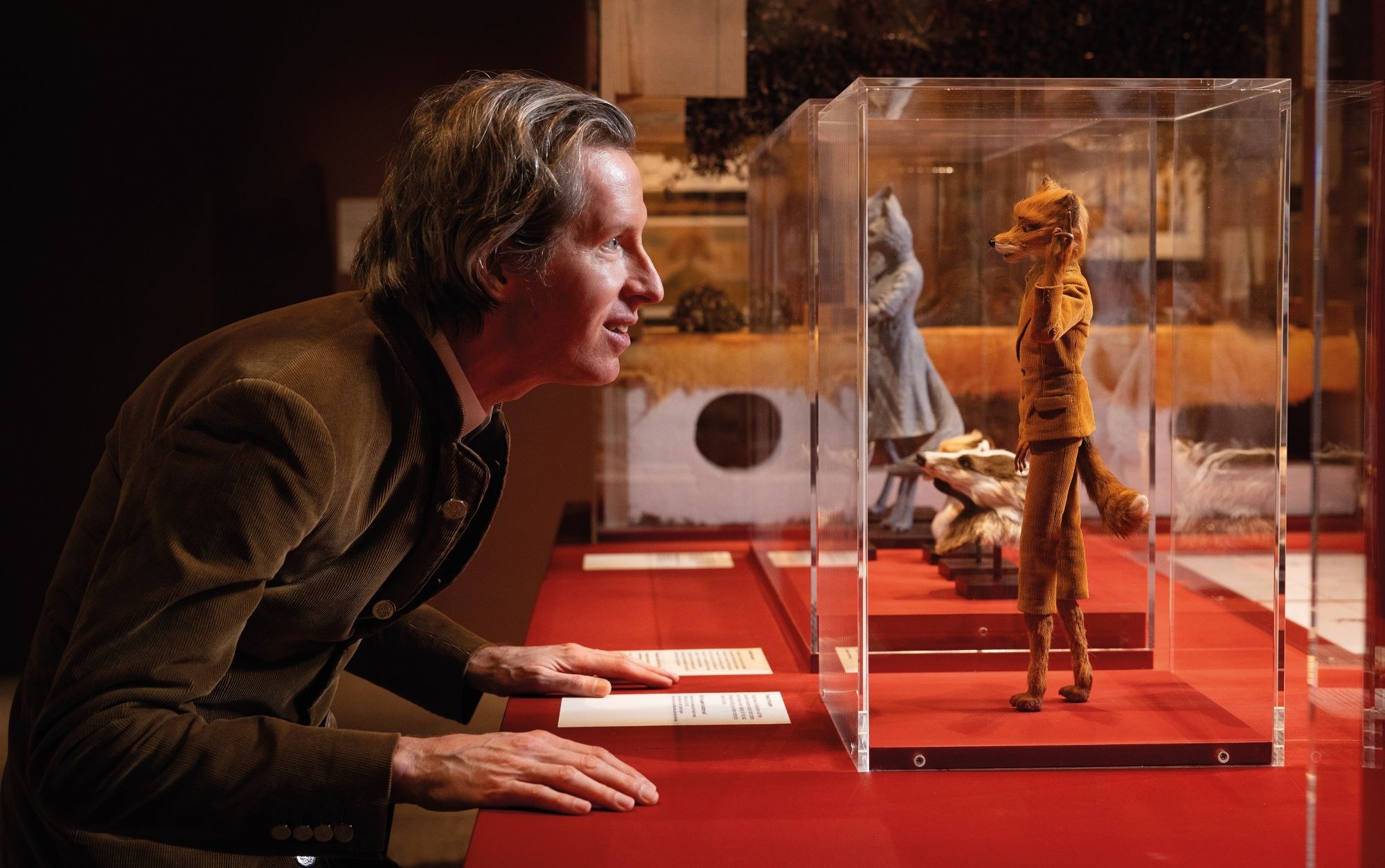
This is a show for film geeks, for sure, but one that should also appeal to connoisseurs of design, and anyone with a love of craft and a curated aesthetic. On the surface, it’s a retrospective that allows us to study the archives from the director’s 30-year career, starting with the mid-90s Bottle Rocket before concluding with last year’s The Phoenician Scheme. We’re treated to more than 700 objects, from the icing-pink model of The Grand Budapest Hotel to the lefty scissors “used in self-defence” in Moonrise Kingdom. Anderson’s overarching topics are dysfunctional families, innocence lost, grief, and obsessive characters on a mission, all styled in an exacting, deadpan manner that’s somehow also very funny. Alongside the objects, screens play clips and music, presenting little set pieces from each film.
Some items feel like a celebrity sighting – I experienced a genuine thrill on encountering the Fendi fur coat that Gwyneth Paltrow wore in The Royal Tenenbaums. Ditto the incredible animal-painted suitcases that feature prominently in The Darjeeling Limited, made by the fictional brand François Voltaire (but actually made by Marc Jacobs, in his Louis Vuitton days). The extreme attention to detail is simply stunning – like how Anderson made sure the ink used to tattoo Mayor Kobayashi in Isle of Dogs is the exact type favoured by the Japanese yakuza, even though hardly anyone would be able to tell.
We’re taken deep into Anderson’s world and we’re learning a lot, but rarely does the director reveal himself – we’re left to interpret his intentions through the objects on display. I gather he’s a man who’s exact (his notebooks, which are small, cheap and spiral-bound, are filled with neat block handwriting). He’s uncompromising about detail (he once held an audition for left-handed children just to write notes for Suzy, she of the lefty scissors). He knows what he likes (while refined over time, his aesthetic was there from the start; Bottle Rocket, a heist film that’s really about friends growing apart, is visually framed in the same exacting way as all the rest). He’s not really widened his scope over time, but maybe that was never the point: this is about honing the form, slowly and meticulously, over a lifetime.
Born and raised in Texas, Anderson first met actor Owen Wilson at the University of Texas at Austin. Wilson appears in many of Anderson’s films, one of a list of regular actors he keeps returning to. “I don’t know who gravitated toward whom,” Anderson told the New York Times in 2021. “But as soon as Owen Wilson and I started making a movie, well, I wanted Owen to be involved with the other movies I would do. As soon as I had Bill Murray, I wanted him on the next one. I wanted Jason Schwartzman. It was natural to me.” This preference of familiarity extends beyond just actors – Anderson’s younger brother, Eric, is a painter whose works often appear in his films, while filmmaker Roman Coppola has worked with the director on several recent scripts.
Now 56, Anderson’s been doing his thing for 30 years, and keeping it the same has certainly aided his journey as an auteur. Although he has on occasion crossed the line to become a parody of himself – in Asteroid City, twee charm is not quite enough to suspend disbelief about a vending machine selling real estate. But I suspect Anderson would just say he’s doing what he likes. “I’ve done a bunch of movies. And it’s a luxury to me that they’re all whatever I’ve wanted them to be,” he once told the Observer. To this day, he puts out films that walk the line between the ridiculous and profound, in a way that somehow slips past even the most determined cynicism – it simply feels delightful. (And if you disagree, let me quote my step-daughter: “Is it because you hate fun?”)
The criticism for centering white, well-off characters is harder to brush off. But he’s rarely too sympathetic to his characters, often anti-heroes who are lost, stuck or reeling from recent bereavement. This criticism is most often directed at The Darjeeling Limited, where three rich American brothers blunder their way through India. But their cluelessness is a key point of the film – the trope of the white person going to India, where they try and fail to reach some sort of enlightenment. Anderson’s characters often demonstrate naive motivations and an obsession with what they desire, while struggling to fully grasp what’s going on around them – like a lot of us, one might argue.
Of course, most of us have to work out our issues without exploring quite as many exciting foreign locales, and certainly with far fewer decadent objects and stuffed exotic animals around. Leaning hard into the quirky details is part of Anderson’s process – it’s not a shark but a jaguar shark in The Life Aquatic, faithfully represented in miniature papier-mâché. And nothing speaks to his love of detail more than stop-motion – he created not just one full-length feature using this Sisyphean method, but two.
I think this attention to detail and craft is a big part of what audiences love about Anderson’s work. We live in the era of “enshittification” – a term coined by the author and technology activist Cory Doctorow to describe how our online experience is steadily getting worse, as platforms turn their focus to profits. When everyone seems to be cutting corners, it feels good to know that some processes are uncompromising. In the age of speedy video clips, where a minute is considered long, it’s refreshing that films are still being made that are going to take as long as they take. Fantastic Mr Fox took a gruelling two years, as the stop-motion figures were moved by hand, up to 24 times per second. The worlds that Anderson creates are an invitation into a more embodied time, where all phones are wired into the wall and the idea of asking a computer for its opinion would be absurd. At the core of his obsession lies a simple beauty, and when we stand in front of it we recognise something that is human and real.
The exhibition doesn’t dwell too much on the how and why of it all. Instead, we are invited to simply admire, for example, the mismatched red hats from The Life Aquatic. But maybe the withholding of context, and biographical information, is part of the point. (“The film is the thing,” director David Lynch once said when pressed to explain himself; everything he wanted to say was already on the screen.) In interviews, Anderson is described as reserved and polite, reluctant to talk much about himself but very eager to get into the nuts and bolts of his projects, so it’s fitting that the show is no different.
There are still some hints of the man behind the screen. There’s a miniature of the book Fantastic Mr Fox on display as part of the props from the film – we’re told it’s an exact replica of the edition the director had as a child. Anderson has commissioned lots of book covers to be used in his films, but this time he chose something from his own history. We’re not told why, but we can imagine.
I’m left enthralled by the exactness of it all, imagining the director in deep concentration as he chases down some rabbit hole, riding the flow of focus, seeking discovery and his own idea of perfection. Anderson is always going to be the one who cares the most. He’s doing it for the love of the craft – and thankfully, we get to watch.
This article is from New Humanist's Spring 2026 edition. Subscribe now.