Martin Crimp’s freewheeling adaptation of "The Misanthrope" is full of themes that are too quickly discarded
The Misanthrope
National Theatre Live, in cinemas until 15 December
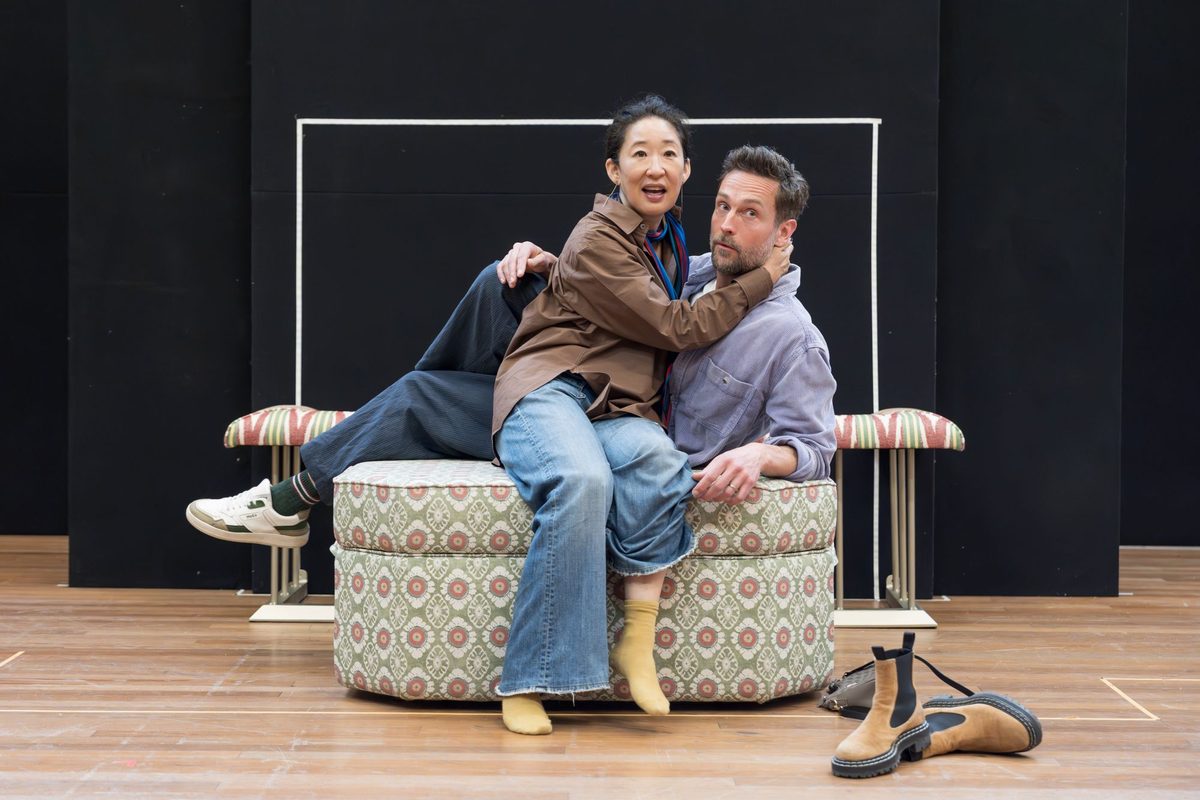
“I seem to be acting in a play I don’t understand,” declares a despairing Sandra Oh towards the end of Martin Crimp’s freewheeling new adaptation of Molière’s 17th-century satire The Misanthrope. The play ran at the National Theatre over the summer, with a performance filmed for screening in cinemas nationwide. Oh’s line is one of a number of enjoyably metatheatrical jokes scattered through Crimp’s text. But it’s also uncomfortably apt: the play’s satire is blunted by the profusion of targets it tries to hit.
In Molière’s original, protagonist Alceste excoriates the hypocrisies and lies of aristocratic and courtly life. Crimp’s gender-flipped Alice, played by Oh, is a fêtéd novelist whose chances of winning a prestigious German literary prize are imperilled by an interview in which she used a word that the prize jury want her to retract. We never learn what that word is and it is hard to imagine what it might have been: Alice’s critiques of society are boilerplate stuff about patriarchy and the invisible pain of the powerless.
Alice expounds her views in an opening scene – set, like most of the play, in a boutique hotel – to her closest friend and confidant John, a gay playwright, a bland part played with warmth by Paul Chahidi. John thinks she would be happier if she tried to get along with people, to accommodate their sensitivities. We’re all only human, he says. That’s not good enough for Alice. “I hate human nature,” she says. “I hate everyone. Not just men.”
This is not true, of course. Alice is in love with Stefan (Tom Mison), a vain younger actor whose recent vicious divorce from Elaine (Jemima Rooper), an orchestra conductor, has seen his reputation – perhaps unfairly, perhaps not – trashed. If the play’s satire is unfocused, its drama snaps into life in the scenes involving this triangle. There, the thorny questions of honesty and trust that run throughout it are sharply and powerfully articulated.
Rooper’s character, in particular, merited further exploration. Alice disdains Elaine’s escapist ideas about art, but in the one scene they share, Elaine points out that Alice, for all her talk of truth-telling, merely writes about trauma in fiction while she, who has suffered and sacrificed through Stefan’s addictions for years, has lived it. The ethics of art, and its relationship to life, is one of many subjects raised and then discarded.
Conflict is promised by a subplot involving Imogen Elliott’s Esmée, a self-declared fan dripping with narcissism and privilege, who is so affronted by Alice’s blunt critique of her draft novel that she maligns her to her vast social media following. But the online storm – and its potential drama – is quickly stifled by Stefan’s social media manager Allen (Freddie MacBruce), an apostle of technology, who believes that “The world’s not here, it’s in a machine”.
Alice, by contrast, doesn’t own a phone and still writes at a child’s desk. Perhaps her refusal of performative niceties, her rejection of 21st-century norms, is not just old-fashioned but infantile. Her latest novel concerns a satirical poet at the court of the Sun King, Louis XIV (under whose rule Molière wrote the play). The poet is destroyed for his art: his writing hand is cut off before he is burned alive. Does Alice see herself in such a martyr? If so, how seriously should we take her high moral self-regard?
Oh’s towering performance – by turns angry, acerbic, passionate and vulnerable – dominates the play, as it must. At The Misanthrope’s heart is Alice’s own humanity, her flaws – among them both hope and despair – all too vividly on show. She is fighting not just for honesty and personal integrity, but for a sense of what is real and what is true. It is her tragedy that she thinks these are questions of absolute clarity, that there is such a thing as the “clean white space” she dreams of living in.
The play ends with abrupt and awkward tidiness at a party thrown by Stefan in which the whole cast, save Alice, wear 17th-century costume. Is the modern world, trapped in the distorting mirror of the internet, an iteration of the Sun King’s court, its dazzling glamour barely masking its brutal coercive power? In Alice’s novel the poet’s hand carries on writing after his death, but in her own ultimate exile she seems to reject her art. It’s a darker ending than Molière’s, but defter plotting and sharper satire might have strengthened its punch.