"Project Hail Mary" is sci-fi storytelling at its best: solid science, an everyman hero, and a funny little alien
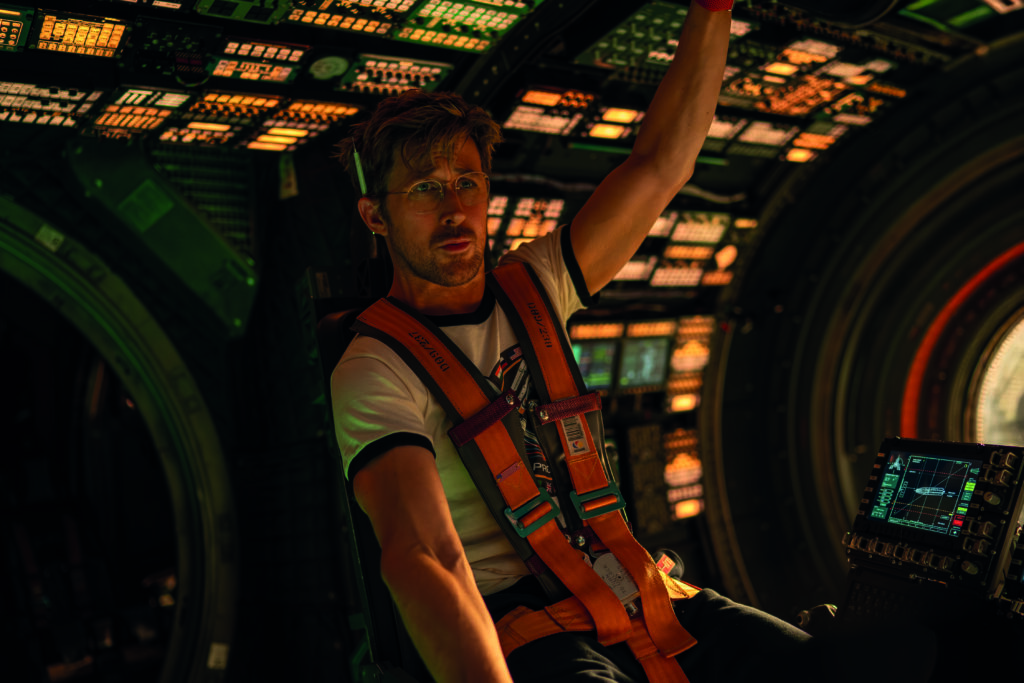
When people imagine first contact, they often think of a little green man coming to Earth in a ship. But if you ask a scientist, they’ll probably say the first life we find beyond our planet will be a microbe, and it’ll take a whole lot of data analysis to be sure it’s the big find we think it is. This year’s first sci-fi mega-hit movie somehow delivers both, giving us a view of the real scientific method and the intelligent alien buddy we love to imagine.
Project Hail Mary, starring Ryan Gosling, is science fiction at its finest: well thought-out details of how spaceships and alien life actually might work, combined with deeply human stories. It’s an adaptation of the 2021 novel of the same name by Andy Weir, who also wrote The Martian, which was adapted into the Ridley Scott film with Matt Damon. But this one is directed by Phil Lord and Christopher Miller, who began their collaboration with the comedy cartoon Cloudy With a Chance of Meatballs. As one might expect, they bring a more playful, light-hearted tone to the typical story of the man-alone-in-space.
Gosling plays Dr Ryland Grace, the reluctant hero and a disgraced academic-turned-teacher. He awakes from a medically induced coma as the lone survivor aboard the spaceship Hail Mary, so named because it is humanity’s last ditch effort to save our planet. At first, he doesn’t know who or where he is, but as Grace figures out what’s happening (“I am several lightyears from my apartment. And I’m not an astronaut”), the backstory is similarly revealed to the audience.
A space microbe referred to as “astrophage” (Latin for “star eater”) is sucking the life out of our Sun, cooling our star and therefore our planet, threatening our species with extinction from an extreme ice age. Eva Stratt (Sandra Hüller) is a no-nonsense government agent, laser-focused on her role leading an international team referred to as Project Hail Mary, to which she recruits Grace as a renegade biologist, brought on to study the microbe.
The project plans to send a spaceship to Tau Ceti, the only star nearby that isn’t being consumed by astrophage, in the hopes that it will reveal a solution to humanity’s existential problem. Tau Ceti, however, is about 12 light-years away. With our current fastest space probes (like Nasa’s Parker Solar Probe, which reached 430,000mph), that journey would take 20,000 years – far, far too long. Thankfully, the dedicated Project Hail Mary team manages to invent a spacecraft that can travel at the speed of light, so they can reach Tau Ceti and send a probe back to Earth with the information gained there in just short of 24 years.
Still, this is a long time. One of the biggest problems in space travel is that humans are hard to care for. We need air, water and enough food to stay alive. But we’re also incredibly useful, especially when you don’t know what you’re getting into. A human scientist can improvise and attempt to figure things out as new information becomes available, much better than any current robotic technology. Einstein’s theory of relativity helps keep the Hail Mary’s crew alive: instead of 12 years, they only need to manage it for about four thanks to time dilation, one of the many weird quirks of this famously unintuitive theory. While two decades have passed on Earth, the astronauts on the Hail Mary have only lived a few years, experiencing time and ageing more slowly because they’re moving at light speed. (The crew apart from Grace don’t survive, but this is due to a failure in the medical transport system.)
In many respects, Project Hail Mary is “hard” science fiction, which tends to lean towards realism, following the laws of physics, with stories driven by a problem to be solved. While we haven’t come close to light-speed travel, there have been attempts in real life, such as the now-defunct Breakthrough Starshot project. This billionaire-backed endeavour had the lofty goal of sending robotic nano-spacecraft to Alpha Centauri, our nearest neighbour star, within a generation.
There are a number of other delightful details in the film, drawn from our real-life voyages to the stars. When Grace starts exploring the ship, he encounters a series of gold panels depicting humans, our solar system and other somewhat cryptic markings. These are a reference to the Voyager Golden Records – records containing sounds of Earth (such as “hello” in hundreds of languages) that were sent aboard the Voyager spacecraft in the 1970s. It is hoped that the golden records would be decipherable to an alien, teaching them what humans look like, where our star system is, and more. Both Voyager 1 and 2 are now in interstellar space, outside our solar system, still carrying these hopeful messages from humanity.
Tau Ceti is also a real star, the nearest Sun-like star to us, and in real life we already know it has planets around it. Astronomers have discovered more than 6,000 planets around other stars, known as exoplanets, since the early 1990s. In 2017, they discovered Tau Ceti e, a “super-Earth” planet (that is, one that is between two and 10 times the Earth’s size) with a year about 160 days long, and three other possible worlds around this neighbour star.
Once Grace arrives at Tau Ceti, though, we get the fiction part of sci-fi that we all love: a friendly, intelligent alien. In this case, his name is Rocky, because he looks like a rock (and Grace can’t pronounce his actual name). Rocky is from a planet called Erid; his people have a language of musical trills inaccessible to human vocal cords; they “see” with echolocation like whales or bats; and they can somehow turn the noble gas xenon into a metal, which they use for advanced technology. Erid’s star has the same astrophage problem, and Rocky’s crew has similarly all died on the journey to Tau Ceti. Rocky and Grace quickly bond, two souls who thought they were completely alone in the cosmos, working together to save their stars.
Although this sounds like quite a serious scenario – two planets facing extinction, two astronauts abandoned and completely isolated in space – the film is light-hearted, optimistic and playful. Rocky and Grace joke with each other, like any other cinematic odd couple. After Grace figures out how to translate Eridian, creating an automated translator for his new pal, Rocky moves into Grace’s spaceship unannounced, proclaiming “Dirty, dirty, dirty! Why room so messy, question?”
We discover, through flashbacks woven in, that Grace’s mission is even more fearsome than he thought. In many ways, he’s an “everyman” character, and never saw himself as the brave one – definitely not the type of person who would willingly take on this mission. But once he’s alone out in space, he rises to meet the challenge – mostly for his newfound friend Rocky. As the ship’s commander told Grace before launch, “You just need to find someone to be brave for.” The bond between the two lone astronauts is enough for them to make major sacrifices for each other, including risking their lives.
Although Grace is in a fantastical predicament that most of us can’t even fathom, there’s something deeply relatable here, touching on some of the most uniting human experiences: grief, loss, and the utter unpredictability of life. Both man and alien have lost their crews and may never return to their respective planets. Experiencing any kind of deep grief can feel like Grace waking up on the spaceship – you absolutely did not and would not choose to be in this situation, but you’re powerless to stop it. Now you must live in this timeline, which feels deeply weird and wrong, and either sulk or make the best of it (and Grace does a bit of both).
At the same time, the film reminds us that life has not only unpredictable lows, but also unpredictable joys and fulfilment. Grace never would have imagined his life going the way it did: becoming Earth’s saviour, making such a deep connection with an alien creature. Yet – and you’ll have to see the film to find out how – his turns out to be a life filled with connection, love and contentment. Grace’s story makes clear that even if life doesn’t go to plan, it can still be well worth living, and maybe even better than you had imagined it could be.
Project Hail Mary has attracted some criticism for being silly at points, or “unserious” compared with epics like Christopher Nolan’s Interstellar. But I found it an incredibly enjoyable watch. The lightness doesn’t take away from the film’s meaning. Instead, it enhances it, reminding us that we can find hope and joy even in dark situations.
In a landscape littered with endless reboots, it’s an absolute treat to encounter such an original and uplifting film. Project Hail Mary brings the best of sci-fi to the big screen, teaching us about both science and ourselves. It’s a story that really makes you feel your place in the universe, and reminds you what it means to be human.