
An exhibition at the Tate highlights Frida Kahlo's enduring influence – which comes with pros and cons
Review: Frida: The Making of an Icon
At the Tate Modern, London, until January 2027
Frida: The Making of an Icon is the highest pre-selling exhibition in Tate’s history, with more than 50,000 tickets sold before it opened in June – a measure of Kahlo’s global renown. She is now considered one of the most significant artists of the 20th century, though for most of her life she was better known as the wife of Diego Rivera, the Mexican painter and muralist whom she married in 1929, rather than as an artist in her own right.
This exhibition focuses on her enduring influence and posthumous fame, curating more than 30 of her works alongside those of 80 contemporary artists worldwide who were inspired by her art, her personality and the way she documented her pain.
Born in 1907 to a devoutly Catholic Mexican mother and an areligious German-Jewish father, Kahlo grew up during the Mexican Revolution, a highly politicised period. Although raised a Catholic, she rejected organised religion. Her plans to study medicine were curtailed at 18 by a near-fatal accident in Mexico City in 1925. Caught in a collision between a bus and tram, a metal handrail pierced her abdomen and uterus, leaving her infertile. She endured a broken spine, pelvis and foot, injuries compounded by childhood polio. The accident shaped her life and her art, and it was during her long recuperation that she began to paint.
In the 1930s, Kahlo adopted the clothing of the Zapotec women. It was a political as well as personal act, emphasising her mestiza heritage and affinity with indigenous Mexican traditions, while the long skirts hid her disability.
This intertwining of her identity with her suffering and political commitment is evident in paintings like “The Frame” (1938), where her steady gaze conveys resilience while the composition suggests a religious icon. In “Self Portrait with Thorn Necklace and Hummingbird” (1940), the dead bird, a symbol of rebirth in Aztec mythology, is affixed to Christ’s crown of thorns worn around her neck, subverting the symbolism of religious martyrdom.
The exhibition also displays Kahlo’s dresses and jewellery, including the plaster corset worn for her broken spine, on which she painted a hammer and sickle and unborn baby in 1950. One section addresses the surrealist nature of her work, although she rejected the label, claiming, “I don’t paint dreams or nightmares. I paint my own reality.” “Survivor” (1938) illustrates the point – a miniature pre-Columbian idol in an empty plain, framed in handcrafted Oaxacan tin – which Kahlo said mirrored her loneliness and survival.
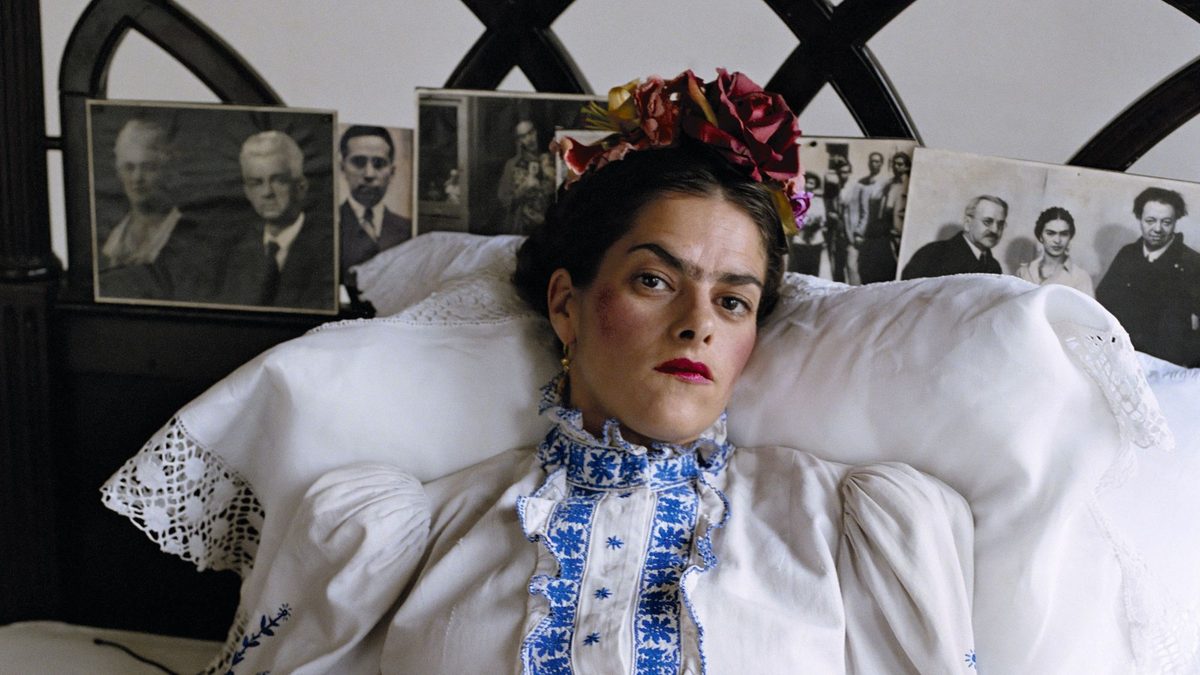
Two of the 10 rooms feature artworks by her contemporaries and other artists influenced by her. They hang alongside her own paintings, and portrait photographs taken by, among others, Imogen Cunningham, Nickolas Muray and gallery owner Julian Levy. Of the artworks influenced by her, one of the most memorable is Mary McCartney’s “Being Frida” (2000): an image of Tracey Emin posing in bed as Kahlo, bearing an uncanny resemblance to the artist. It earns its place. Both women confronted difficult, sometimes taboo, themes.
Kahlo often presented herself as bisexual and androgynous – accentuating her moustache and monobrow and occasionally wearing masculine clothing – so it is unsurprising that she was embraced by the LGBTQI community. Her influence is reflected in several reinterpretations of her portraits throughout the exhibition.
The final room, “Fridamania”, explores the merchandise capitalising on her image – cushions, T-shirts, posters, dolls – a bleak conclusion to the exhibition. It’s ironic that we then step into the Tate gift shop to be assailed by fridge magnets and tote bags. The show is not billed as a retrospective, but the imbalance between Frida’s own work and that of her imitators and admirers (some more interesting than others) is its main flaw.
Frida is hugely more popular than when I first encountered her art at the Casa Azul, her home and now museum, in Mexico more than 20 years ago. If you’re a fan, or just discovering the artist, Frida: The Making of an Icon is still well worth a visit.
