People’s lives are being destroyed by messages sent years ago. Are revenge leaks ever justified, and how do we protect ourselves?
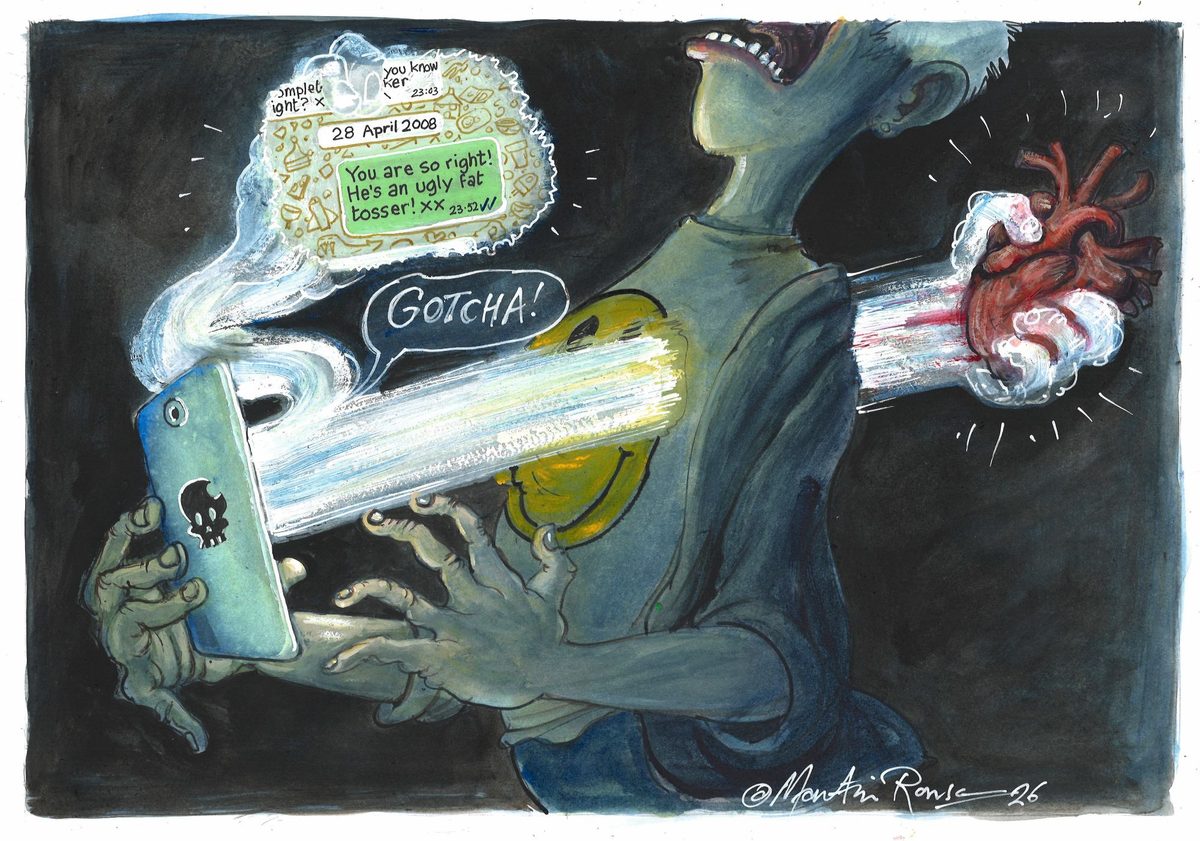
Most women, at one time or another, have lamented that all the attractive men are taken. When I texted this to a close friend, her response was neither endorsement nor disagreement, but a screenshot of my message. My remark was, she explained, “frameable. Or, in this case, write-in-my-book-able”. This friend then admitted to quietly amassing screenshots of our exchanges for years as material for a novel based on her life. Not only would our conversations feature in it, but so would I, reimagined as a character.
The revelation was unsettling. Writers have long plundered their lives for inspiration. Annie Ernaux was recently awarded the Nobel Prize in literature for a body of work that draws heavily on autobiography. And here I am, sadly not a Nobel winner, recounting my experience in this very article. Yet, there is something peculiarly modern about years of personal discussions being filed without a person’s knowledge or consent, transforming ephemeral chats into a digital archive primed for publication. The notion that a loved one might secretly store our thoughts for use in a bestseller sounds like the premise of a work of fiction itself. But, in an age of online communication, few of us can be certain that our messages will remain private forever.
How do we deal with this prospect hanging over our heads? And does it have to radically alter the way we communicate with one another?
“Most people could find a private conversation they’ve had in the last decade, whether in the pub or on WhatsApp, that would be distasteful or embarrassing if it were published”
Most of us are familiar by now with the personal correspondence of political figures entering the public domain. Think of the Covid-19 inquiry or the recent release of sex offender Jeffrey Epstein’s personal correspondence, including more than a million emails, to and from hundreds of people. Even if there is no inquiry, recipients can leak messages, damaging careers long after remarks were made. In 2025, the contents of WhatsApp group “Shiver Me Timbers” were leaked. Participants, who included Labour activists, councillors and politicians, had exchanged antisemitic, racist and sexist comments, alongside derogatory remarks about constituents. It ended Andrew Gwynne’s ministerial career.
Later that year, Paul Ovenden quit as Downing Street’s director of political strategy over messages sent eight years prior, recounting sexual remarks about MP Diane Abbott. Resigning, he observed that “most people could find a private conversation they’ve had in the last decade, whether in the pub or on WhatsApp, that would be distasteful or embarrassing if it were published” and “it is chilling that a private conversation from nearly a decade ago can do this sort of damage”. The messages had apparently dogged Ovenden for some time, with campaigner Matt Zarb-Cousin claiming that media outlets had long known of them.
Politicians aren’t the only ones who find themselves living in fear. The possession of correspondence opens up opportunities for blackmail, even for those of us who are not public figures. Embroiled in a dispute with a client, freelance illustrator Kate asked self-employed acquaintance Harry for advice. “He was sympathetic,” she told me. “He let me vent and connected me with his lawyer, saying he hated to see freelancers exploited.” But, after the dispute was resolved and Kate resumed work for the firm, Harry’s behaviour changed.
“Malicious actors can intentionally provoke compromising exchanges to exploit later”
“He left comments under social media posts promoting my work, like ‘Glad you stopped fighting’. When I asked him to stop, he claimed he was ‘too nice to do it’ but could ruin my career by forwarding or publishing texts in which I had discussed the dispute and criticised the company.” Kate thought he was motivated by professional rivalry, but then he sent flirtatious texts. “Was this a signal he wanted me to sleep with him to keep him quiet? Or was he toying with me? What’s absurd is this all stems from chats that, in a traditional workplace, would have amounted to a brief grumble in the kitchen. Instead, everything was written so it became something he could save and hold over me.”
Malicious actors can intentionally provoke compromising exchanges to exploit later, while screenshots can trap people in coercive relationships. During a period of marital strife, Agnes’ husband began texting her false allegations. “He’d claim I hadn’t fed our children,” she says. “My instinct was to ignore them; I’d no idea what he was talking about. But I realised that failing to respond could be construed as an admission of guilt. I feared that, if we divorced, those unanswered messages could paint me as an unfit mother and support his custody bid. I answered every one, denying the claims, until he stopped.”
We may support publishing communications that expose serious wrongdoing, like Epstein’s crimes. But where should the line be drawn, when illegal behaviour is not involved? We have likely all sent texts or emails about relationships, gossip, workplace frustrations, health concerns or private jokes that would seem odd to outsiders, or that we might regret years down the line. Many will have been written in lust, in grief, under pressure, drunk or simply without picturing an infinite audience. Stripped of context and placed online – searchable, shareable – exchanges take on entirely different meanings than we intended.
How should we act if we know personal material is circulating online? Crisis PR strategist Lauren Beeching advises against pre-emptively informing employers or business contacts unless there is a high likelihood they will receive it directly. “One of the biggest mistakes people make is accidentally amplifying something that may never have travelled beyond a small online bubble. Embarrassing does not automatically mean career-ending. There’s a huge difference between genuinely harmful behaviour and simply being human in private, which most adults understand.”
“What happens to society when we all start writing with one eye on how our messages could be construed?”
Legal recourse exists. Judith Thompson of Samuels Solicitors notes that the European Convention on Human Rights guarantees the right to a private and family life, including correspondence. “Provided the claimant has a reasonable expectation of privacy in relation to the content published, they would potentially have a claim for damages for misuse of their private information, even if the correspondence did not contain anything intimate,” she explains. “The front page of a newspaper would probably attract higher damages than publication to just a few individuals. However, this is not always the case, as publication to close family members can have a devastating impact. A publication which is designed to harm someone’s reputation, such as to an employer, could mean higher damages because of the malicious nature.”
Still, nobody relishes the prospect of going to court, and most of us are thinking in terms of avoiding scandal or embarrassment. What happens to society when we all start writing with one eye on how our messages could be construed? Beeching says we are in “a very strange cultural space where people are expected to have maintained perfect emotional regulation and flawless opinions since adolescence. That simply isn’t reality. People are beginning to fear normal human interaction itself.” Afraid of weaponised screenshots, we are becoming “more guarded, less trusting, more performative and ultimately less honest with each other”.
Given the untold damage to careers and reputations, how do those who publish intimate correspondence justify themselves? One explanation is emotion, amplified by the speed with which thoughts become content. In moments of hurt, social media provides instant validation. As their relationship collapsed in 2020, Lara posted her boyfriend’s offensive texts on Facebook. She was distressed and isolated by lockdown. “I don’t think he saw them because I’d blocked him,” she says. “It’s hard to know what to do when someone is cruel and you have no recourse. I was wanting support.” Lara redacted her boyfriend’s name, but his identity would have been known by most of her Facebook contacts.
Money is another incentive. In an attention economy, public shaming can be monetised, even if it purportedly aims to expose poor behaviour. Viral screenshots have been mooted as one reason why dating apps are falling out of favour. Dancer Lucia Jamous has amassed over 111,000 Instagram followers through routines set to men’s bizarre voice notes, highlighting the appetite for this genre of spectacle. While the voice notes may be anonymous, some commenters claim to have stumbled across the voices of men they know.
“There are steps we can take to protect ourselves, like making sure that our messages are deleted automatically”
Technology is likely to render the problem more complex as AI-generated images become increasingly convincing. Alternatively, as awareness spreads of how easily evidence can be altered, we may treat images with greater scepticism. Meanwhile, there are steps we can take to protect ourselves, like making sure that our messages are deleted automatically. Most messaging apps now offer this option, including Signal and WhatsApp, where messages can be set to vanish in a matter of hours or days. However, it doesn’t stop people from storing screenshots, and not everyone is aware that the setting exists.
It’s important to remember that being identified doesn’t have to be the end of the world. “Embarrassing messages can be managed if there’s a credible explanation and sincere contrition,” explains George Thwaites, head of corporate at Maltin PR. “Audiences tend to be more forgiving of stories involving human embarrassment or poor judgement than those exposing dishonesty or hypocrisy. A swift, measured and credible response is almost always better than a panicked denial or silence.” Still, even if no damage is done, being exposed to public judgement can be a painful experience.
I responded furiously to my friend’s revelation, stressing that I did not consent. She was unmoved. Telling me would have defeated the object, she explained, with some of her recent remarks having been made specifically to elicit responses for the novel. Rather than sever ties outright, I opted for a slow fade, ignoring texts or feigning indifference when asked for my views. To send a video or picture is, in effect, to place material on someone’s phone uninvited and gauge their reaction. When she sent me a reel promoting conspiracy theories, I pushed back hard. I would have challenged it regardless, though in softer, less formal language. But I felt the gaze of unseen readers upon me and wrote as though addressing an audience. For all I knew, I was.
Note: Some names (Kate, Harry, Agnes and Lara) have been changed to protect their privacy.